
Motmot

Finsch's Francolin vs Hartlaub's Spurfowl

Scleroptila finschi versus Pternistis hartlaubi

Play a quiz with Finsch's Francolin and Hartlaub's Spurfowl

Finsch's Francolin (Scleroptila finschi) Finsch's Francolin
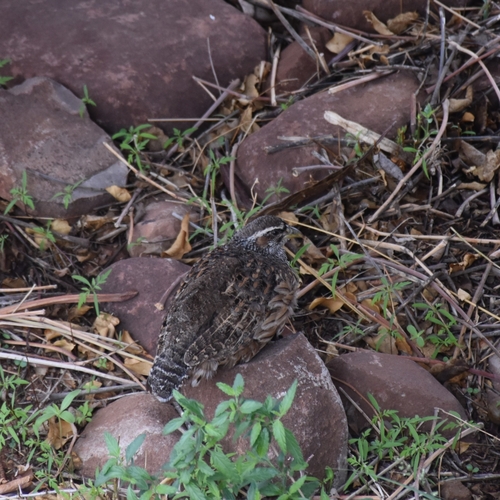
Hartlaub's Spurfowl (Pternistis hartlaubi) Hartlaub's Spurfowl

Media

Loading…

In short

The most reliable field mark for separating Finsch's Francolin from Hartlaub's Spurfowl is the strong sexual dimorphism and distinctive head pattern of Hartlaub's Spurfowl, especially the male's bold white eyestripe and rufous ear coverts, which Finsch's Francolin lacks. Hartlaub's Spurfowl is also notably smaller, with a disproportionately large bill and yellow legs, while Finsch's Francolin is larger and less strikingly marked. Juvenile and female Hartlaub's Spurfowl can be confused with Finsch's Francolin, but the combination of size, bill shape, and habitat preference helps clarify identification. Always consider the context: Hartlaub's Spurfowl is restricted to rocky outcrops in arid Namibia and Angola, while Finsch's Francolin is found in more humid, grassy regions of central Africa.

Identification tips

  1. Head pattern (adult males): Hartlaub's Spurfowl males have a bold white eyestripe and rufous ear coverts, creating a striking facial contrast. Finsch's Francolin lacks this, showing a plainer head.
  2. Sexual dimorphism: Hartlaub's Spurfowl is highly sexually dimorphic. Females are dull rufous below and on the head, lacking the male's streaking and bold face. Finsch's Francolin shows little to no sexual dimorphism; both sexes look similar.
  3. Bill structure: Hartlaub's Spurfowl has a disproportionately large, heavy bill, especially in females, with a brownish upper mandible and yellow lower mandible. Finsch's Francolin's bill is less massive and lacks this two-tone color.
  4. Leg color: Hartlaub's Spurfowl has yellow legs with flattened spurs. Leg color in Finsch's Francolin is not specified, but yellow legs are a good mark for Hartlaub's in its range.
  5. Underpart pattern: Male Hartlaub's Spurfowl has pale grey underparts with strong dark streaks; females are plain rufous below. Finsch's Francolin is more uniformly colored below, lacking this contrast.
  6. Juvenile confusion: Juvenile male Hartlaub's Spurfowl resembles adult males but with finer upperpart streaking. Juvenile females are like adult females—dull rufous and plain. Finsch's Francolin juveniles are not described as differing markedly from adults, so beware of dull young Hartlaub's females in poor light.
  7. Size: Hartlaub's Spurfowl is distinctly smaller than Finsch's Francolin. If you have a sense of scale, this is a strong clue.
  8. Habitat: Hartlaub's Spurfowl is restricted to rocky outcrops in arid/semidesert Namibia and SW Angola. Finsch's Francolin is found in humid, grassy habitats in central Africa. Habitat alone can often clinch the ID.
  9. Behavior: Hartlaub's Spurfowl is extremely shy, hiding among rocks and only flushing at close range. Finsch's Francolin is not noted for this rock-bound, elusive behavior.
  10. Foraging behavior: Female Hartlaub's Spurfowl dig for corms, while males have a broader diet and foraging style. Such behavior is not described for Finsch's Francolin.
  11. Group size: Hartlaub's Spurfowl is usually in pairs or small family groups (up to four), rarely in larger flocks. Finsch's Francolin's social structure is not specified, but large groups are unlikely for either.
  12. Vocalization: If flushed, Hartlaub's Spurfowl gives a rapid, chattering 'krak' call. Finsch's Francolin's call is not described, so this is only useful if you hear the spurfowl's distinctive sound.
  13. Range: If you are outside Namibia or SW Angola, Hartlaub's Spurfowl is ruled out. If you are in rocky outcrop habitat within its range, Finsch's Francolin is very unlikely.
  14. Overlap with other francolins: In Hartlaub's Spurfowl habitat, other francolins (Red-billed Spurfowl, Orange River Francolin) occur in adjacent but different microhabitats. Finsch's Francolin does not overlap with Hartlaub's Spurfowl in habitat or range.
  15. Pitfalls: Female and juvenile Hartlaub's Spurfowl can appear plain and may be confused with Finsch's Francolin, especially in poor light or at a distance. Use bill size, leg color, and habitat as additional checks.

Size

Hartlaub's Spurfowl is the smallest African spurfowl, with males averaging 28 cm and 245–290 g, and females around 25 cm and 210–240 g. Finsch's Francolin is larger (exact measurements not provided, but typical Scleroptila francolins are notably bigger than Hartlaub's Spurfowl). The size difference is most apparent when birds are seen together or with a sense of scale. Hartlaub's Spurfowl also has a disproportionately large, heavy bill relative to head size, especially in females.

Plumage

No distinctive juvenile or immature upperwing pattern is described for either species, so focus falls on adult and sex-specific plumage. Adult male Hartlaub's Spurfowl shows a dark brownish forehead, bold white eyestripe, rufous ear coverts, and pale grey underparts with strong dark streaks. The female is duller, with rufous underparts and head, lacking the male's streaking and facial contrast. Juvenile males resemble adult males but with finer upperpart streaking; young females are similar to adult females. Finsch's Francolin lacks the strong facial pattern and sexual dimorphism of Hartlaub's Spurfowl, presenting a more uniform and less contrasting appearance. Both sexes of Finsch's Francolin look similar, without the bold head pattern or color differences seen in Hartlaub's Spurfowl.

Behaviour

Hartlaub's Spurfowl is highly inconspicuous, preferring to hide among rocks and only flushing when closely approached, often flying rapidly with a chattering call. They are usually found in pairs or small family groups and are not easily flushed. Their foraging is sexually differentiated: females dig for corms, while males use a wider range of techniques. Finsch's Francolin's behavior is less specifically described, but it is not noted as being as rock-bound or as secretive as Hartlaub's Spurfowl.

Habitat

Habitat is a strong separator. Hartlaub's Spurfowl is endemic to northcentral/northwestern Namibia and a small area of southwestern Angola, strictly tied to rocky granite and sandstone outcrops surrounded by semidesert steppe at 800–1,600 m elevation. Finsch's Francolin occupies more humid, grassy habitats in Angola, Republic of the Congo, Democratic Republic of the Congo, Cameroon, and Gabon, and is not tied to rocky outcrops. If you find a francolin in rocky, arid, outcrop-dominated terrain in Namibia or SW Angola, it is almost certainly Hartlaub's Spurfowl.

Voice

Hartlaub's Spurfowl, when flushed, gives a rapid, chattering 'krak' call. No specific vocalization is described for Finsch's Francolin in the provided notes, so voice is only diagnostic if you hear the distinctive spurfowl call.

Submit a better description

Use the same sections as the comparison. Your text is published immediately.

The most reliable field mark for separating Finsch's Francolin from Hartlaub's Spurfowl is the strong sexual dimorphism and distinctive head pattern of Hartlaub's Spurfowl, especially the male's bold white eyestripe and rufous ear coverts, which Finsch's Francolin lacks. Hartlaub's Spurfowl is also notably smaller, with a disproportionately large bill and yellow legs, while Finsch's Francolin is larger and less strikingly marked. Juvenile and female Hartlaub's Spurfowl can be confused with Finsch's Francolin, but the combination of size, bill shape, and habitat preference helps clarify identification. Always consider the context: Hartlaub's Spurfowl is restricted to rocky outcrops in arid Namibia and Angola, while Finsch's Francolin is found in more humid, grassy regions of central Africa.

  1. Head pattern (adult males): Hartlaub's Spurfowl males have a bold white eyestripe and rufous ear coverts, creating a striking facial contrast. Finsch's Francolin lacks this, showing a plainer head.
  2. Sexual dimorphism: Hartlaub's Spurfowl is highly sexually dimorphic. Females are dull rufous below and on the head, lacking the male's streaking and bold face. Finsch's Francolin shows little to no sexual dimorphism; both sexes look similar.
  3. Bill structure: Hartlaub's Spurfowl has a disproportionately large, heavy bill, especially in females, with a brownish upper mandible and yellow lower mandible. Finsch's Francolin's bill is less massive and lacks this two-tone color.
  4. Leg color: Hartlaub's Spurfowl has yellow legs with flattened spurs. Leg color in Finsch's Francolin is not specified, but yellow legs are a good mark for Hartlaub's in its range.
  5. Underpart pattern: Male Hartlaub's Spurfowl has pale grey underparts with strong dark streaks; females are plain rufous below. Finsch's Francolin is more uniformly colored below, lacking this contrast.
  6. Juvenile confusion: Juvenile male Hartlaub's Spurfowl resembles adult males but with finer upperpart streaking. Juvenile females are like adult females—dull rufous and plain. Finsch's Francolin juveniles are not described as differing markedly from adults, so beware of dull young Hartlaub's females in poor light.
  7. Size: Hartlaub's Spurfowl is distinctly smaller than Finsch's Francolin. If you have a sense of scale, this is a strong clue.
  8. Habitat: Hartlaub's Spurfowl is restricted to rocky outcrops in arid/semidesert Namibia and SW Angola. Finsch's Francolin is found in humid, grassy habitats in central Africa. Habitat alone can often clinch the ID.
  9. Behavior: Hartlaub's Spurfowl is extremely shy, hiding among rocks and only flushing at close range. Finsch's Francolin is not noted for this rock-bound, elusive behavior.
  10. Foraging behavior: Female Hartlaub's Spurfowl dig for corms, while males have a broader diet and foraging style. Such behavior is not described for Finsch's Francolin.
  11. Group size: Hartlaub's Spurfowl is usually in pairs or small family groups (up to four), rarely in larger flocks. Finsch's Francolin's social structure is not specified, but large groups are unlikely for either.
  12. Vocalization: If flushed, Hartlaub's Spurfowl gives a rapid, chattering 'krak' call. Finsch's Francolin's call is not described, so this is only useful if you hear the spurfowl's distinctive sound.
  13. Range: If you are outside Namibia or SW Angola, Hartlaub's Spurfowl is ruled out. If you are in rocky outcrop habitat within its range, Finsch's Francolin is very unlikely.
  14. Overlap with other francolins: In Hartlaub's Spurfowl habitat, other francolins (Red-billed Spurfowl, Orange River Francolin) occur in adjacent but different microhabitats. Finsch's Francolin does not overlap with Hartlaub's Spurfowl in habitat or range.
  15. Pitfalls: Female and juvenile Hartlaub's Spurfowl can appear plain and may be confused with Finsch's Francolin, especially in poor light or at a distance. Use bill size, leg color, and habitat as additional checks.

Hartlaub's Spurfowl is the smallest African spurfowl, with males averaging 28 cm and 245–290 g, and females around 25 cm and 210–240 g. Finsch's Francolin is larger (exact measurements not provided, but typical Scleroptila francolins are notably bigger than Hartlaub's Spurfowl). The size difference is most apparent when birds are seen together or with a sense of scale. Hartlaub's Spurfowl also has a disproportionately large, heavy bill relative to head size, especially in females.

No distinctive juvenile or immature upperwing pattern is described for either species, so focus falls on adult and sex-specific plumage. Adult male Hartlaub's Spurfowl shows a dark brownish forehead, bold white eyestripe, rufous ear coverts, and pale grey underparts with strong dark streaks. The female is duller, with rufous underparts and head, lacking the male's streaking and facial contrast. Juvenile males resemble adult males but with finer upperpart streaking; young females are similar to adult females. Finsch's Francolin lacks the strong facial pattern and sexual dimorphism of Hartlaub's Spurfowl, presenting a more uniform and less contrasting appearance. Both sexes of Finsch's Francolin look similar, without the bold head pattern or color differences seen in Hartlaub's Spurfowl.

Hartlaub's Spurfowl is highly inconspicuous, preferring to hide among rocks and only flushing when closely approached, often flying rapidly with a chattering call. They are usually found in pairs or small family groups and are not easily flushed. Their foraging is sexually differentiated: females dig for corms, while males use a wider range of techniques. Finsch's Francolin's behavior is less specifically described, but it is not noted as being as rock-bound or as secretive as Hartlaub's Spurfowl.

Habitat is a strong separator. Hartlaub's Spurfowl is endemic to northcentral/northwestern Namibia and a small area of southwestern Angola, strictly tied to rocky granite and sandstone outcrops surrounded by semidesert steppe at 800–1,600 m elevation. Finsch's Francolin occupies more humid, grassy habitats in Angola, Republic of the Congo, Democratic Republic of the Congo, Cameroon, and Gabon, and is not tied to rocky outcrops. If you find a francolin in rocky, arid, outcrop-dominated terrain in Namibia or SW Angola, it is almost certainly Hartlaub's Spurfowl.

Hartlaub's Spurfowl, when flushed, gives a rapid, chattering 'krak' call. No specific vocalization is described for Finsch's Francolin in the provided notes, so voice is only diagnostic if you hear the distinctive spurfowl call.

Discard your changes?

You have unsaved edits. If you leave now, those changes will be lost.

Finsch's Francolin · Hartlaub's Spurfowl · My Tricky Birds