

Fieldfare vs Snow Bunting
Turdus pilaris versus Plectrophenax nivalis
Play a quiz with Fieldfare and Snow Bunting
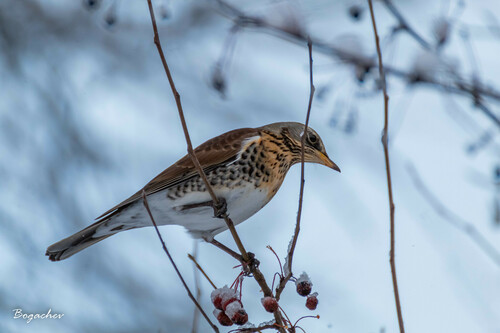 Fieldfare
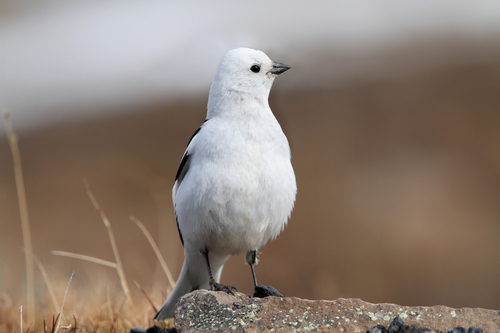 Snow Bunting
In short
The most reliable field mark to separate Fieldfare from Snow Bunting is the Fieldfare’s bold, speckled breast and slate-grey head versus the Snow Bunting’s white underparts and black-and-white wing pattern, especially in flight. Juvenile Fieldfares are duller but still show streaked breasts, while all ages of Snow Bunting have much more white in the wing and lack any breast spotting. Structurally, Fieldfares are much larger, with a heavy thrush build and longer tail, while Snow Buntings are smaller, chunkier, and often show a yellowish or black-tipped bill. In flight, Fieldfares reveal white underwing coverts and a dark tail, while Snow Buntings flash extensive white in the wings and tail. Habitat is also a strong clue: Fieldfares are usually in wooded or parkland areas, Snow Buntings on open ground or tundra.
Identification tips
- Size and Structure: Fieldfare is much larger and bulkier than Snow Bunting. If the bird appears thrush-sized, it is almost certainly a Fieldfare.
- Bill Shape and Color: Fieldfare has a strong, slightly curved bill that is orange-yellow in winter (with a dark tip), while Snow Bunting has a short, conical bunting bill, yellow with a black tip in winter, all black in breeding males.
- Breast Pattern: Fieldfare always shows a boldly speckled or streaked breast (even in juveniles), while Snow Bunting has clean white underparts with no spotting at any age.
- Head and Face: Fieldfare has a slate-grey head and nape with black lores and under-eye, giving a masked look; Snow Bunting has a much plainer, white-faced look in males, or a less marked face in females, never with the Fieldfare’s mask.
- Back and Rump: Fieldfare has a chestnut-brown back and grey rump; Snow Bunting’s back is black-and-white in breeding males, or brown-fringed in winter, but never chestnut or grey.
- Wing Pattern in Flight: Fieldfare shows white underwing coverts and axillaries, but upperwings are plain brownish-black. Snow Bunting flashes extensive white in the upperwing and tail, especially obvious in flight in all ages and sexes.
- Tail: Fieldfare’s tail is rounded, dark brownish-black with subtle barring and a slight white border on the outer feathers. Snow Bunting’s tail is shorter, with much more white visible, especially in flight.
- Legs and Feet: Fieldfare has brown legs and feet; Snow Bunting has feathered tarsi (legs) as an adaptation to cold, which can sometimes be seen at close range.
- Juvenile Plumage: Juvenile Fieldfares are duller but still streaked; juvenile Snow Buntings are always white below and show white in the wings.
- Sexual Dimorphism: Fieldfare sexes are similar, with females slightly browner and less marked; Snow Buntings are strongly dimorphic in breeding plumage, with males much whiter and blacker than females.
- Habitat: Fieldfares are found in wooded or parkland areas, often near trees; Snow Buntings are on open ground, tundra, or stubble fields, rarely near trees.
- Behavior: Fieldfares perch in trees and feed on the ground; Snow Buntings are almost always on the ground, walking or running, rarely perching up.
- Flight Style: Fieldfares fly strongly and directly, often calling; Snow Buntings have a more fluttery, bounding flight with flocks swirling and flashing white.
- Voice: Listen for the Fieldfare’s harsh "tsak tsak" call versus the Snow Bunting’s softer, rippling whistle.
- Seasonal Changes: Fieldfare plumage is stable year-round; Snow Buntings become whiter in spring as feather edges wear off, but always lack breast spots and show white in the wing.
Size
Fieldfare is substantially larger and heavier (body mass ~105 g) than Snow Bunting (30–40 g). Fieldfares reach about 25 cm in length with a wingspan of 39–42 cm, while Snow Buntings are smaller at 15 cm with a wingspan of 32–38 cm. In the field, Fieldfares appear as large, robust thrushes with a long tail and strong bill, whereas Snow Buntings are noticeably smaller, more compact, and bunting-like, with shorter tails and smaller, conical bills.
Plumage
- Juvenile/First-winter: Juvenile Fieldfares are duller than adults but still have pale streaks on the breast and a generally streaked, brownish appearance; they lack the extensive white in the wing shown by Snow Buntings. Juvenile and adult Snow Buntings always show white underparts and prominent white in the wings and tail, with orangey-brown fringes in winter.
- Adult (non-breeding): Fieldfares have a slate-grey head and rump, chestnut-brown back, bold blackish breast spots, and white underwing coverts visible in flight. Snow Buntings in winter are white below, with black-and-white wings and back, and orangey-brown fringes on the back feathers.
- Adult (breeding): Fieldfares do not change much seasonally, while male Snow Buntings become even more striking, with white body and black back/wings. Female Snow Buntings are similar but with brownish fringes on the back. Fieldfares never show the all-white underparts or the sharp black-and-white wing pattern of Snow Buntings.
Behaviour
Fieldfares are often seen in flocks, especially in winter, feeding on the ground or perched high in trees. Their flight is strong and direct, often with a harsh call. Snow Buntings are ground-dwelling, walking or running rather than hopping, and are typically found in flocks on open ground, especially in winter. In flight, Snow Buntings are agile and show a lot of white in the wings and tail, often swirling in tight groups.
Habitat
Fieldfares breed and feed in woodland, scrub, and parkland, especially in northern Europe and the Palearctic, and are often seen in open fields in winter but near trees. Snow Buntings are Arctic specialists, breeding on tundra or high mountains, and wintering in open, treeless areas such as coastal fields, stubble, or tundra. If you see the bird in a wooded area or perched in a tree, Fieldfare is much more likely; if it’s on open, barren ground, especially in a flock, Snow Bunting is the better bet.
Voice
Fieldfare’s most distinctive call is a harsh, repeated "tsak tsak" note, especially in flight or when alarmed. Their song is weak and rarely heard, a mix of blackbird-like phrases and squeaks. Snow Bunting has a rippling, liquid whistle (per,r,r,rit) and a brief, loud warbling song, but is generally quieter in winter flocks. The Fieldfare’s call is much harsher and more thrush-like, while Snow Bunting’s is softer and more musical.