

Ferruginous Duck vs Greater Scaup
Aythya nyroca versus Aythya marila
Play a quiz with Ferruginous Duck and Greater Scaup
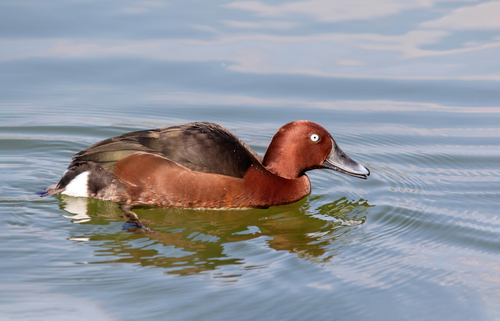 Ferruginous Duck
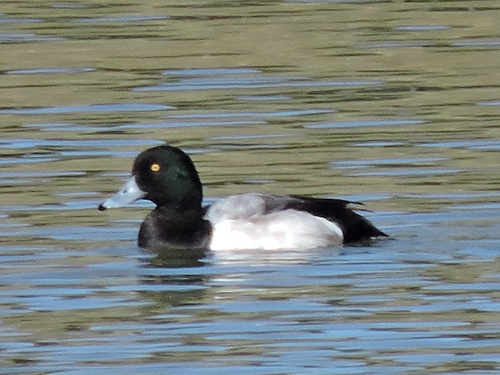 Greater Scaup
In short
The most reliable field mark to separate Ferruginous Duck from Greater Scaup is the overall plumage color and pattern: Ferruginous Duck males are rich chestnut with a striking white undertail and belly, while Greater Scaup males are much paler, with a white belly, grey back, and a dark head with a greenish or purplish sheen. In flight, Greater Scaup shows a bold white wing stripe extending from the speculum through the primaries, while Ferruginous Duck has a less extensive white underwing and belly. Females of both species are brown, but Ferruginous Duck females are warmer-toned and lack the scaup's distinctive white face patch. Bill color and shape also help: Greater Scaup has a broad, pale blue bill, while Ferruginous Duck's bill is darker and more slender. Juveniles and females can be confusing, but attention to wing pattern, head shape, and undertail color will usually resolve the ID.
Identification tips
- Wing pattern in flight (all ages): Greater Scaup shows a bold white stripe extending from the speculum through the primaries to the wingtip; Ferruginous Duck has a less extensive white underwing patch and white belly, but not a long white stripe on the upperwing. This is most obvious in flight and is a key mark for all ages.
- Overall plumage (adult males): Ferruginous Duck males are rich, dark chestnut all over with a pure white undertail and belly. Greater Scaup males have a dark head with green or purple gloss, black breast and tail, bright white flanks and belly, and a pale grey back.
- Female and juvenile plumage: Female Greater Scaup is brown with a distinctive white patch at the base of the bill and a pale blue bill; Ferruginous Duck females are duller, warmer brown, lack the white face patch, and have a darker bill.
- Bill color and shape: Greater Scaup has a broad, pale blue-grey bill with a black nail at the tip; Ferruginous Duck's bill is darker, more slender, and lacks the broad, spatulate look.
- Eye color: Ferruginous Duck males have a yellow eye, females a dark eye; Greater Scaup of both sexes have yellow eyes. This is useful at close range but can be hard to see at distance.
- Head shape: Greater Scaup has a more rounded, fuller head profile, especially compared to Ferruginous Duck's more compact, sloping head. This is subtle and best used in direct comparison.
- Undertail pattern: Ferruginous Duck always shows a pure white undertail, especially obvious when the tail is curled during display or when swimming. Greater Scaup's undertail is dark and does not contrast strongly with the rest of the plumage.
- Back color (males): Greater Scaup males have a pale grey, vermiculated back; Ferruginous Duck is uniformly chestnut without pale vermiculations.
- Flank color: Greater Scaup males have bright white flanks; Ferruginous Duck males are chestnut throughout the flanks.
- Face pattern (females/immatures): Female Greater Scaup has a white patch at the base of the bill; Ferruginous Duck females lack this, appearing plain-faced.
- Size and structure: Greater Scaup is larger, bulkier, and longer-bodied than Ferruginous Duck. In mixed flocks, scaup will stand out by size and bulk.
- Habitat context: Ferruginous Duck is more likely in vegetated, sheltered waters; Greater Scaup prefers open lakes and coastal waters, especially in winter.
- Flock behavior: Large, dense rafts are typical of Greater Scaup; Ferruginous Duck usually forms smaller, looser groups.
- Courtship display: Ferruginous Duck males may curl the tail to show a triangular white undertail patch; Greater Scaup does not show this behavior.
- Pitfalls: Female and juvenile Greater Scaup can appear quite dark and may lack obvious white on the face at distance, but the wing stripe in flight and bill color/shape remain reliable. Ferruginous Duck can appear paler in strong light, but never shows the strong wing stripe or pale back of scaup.
Size
Greater Scaup is noticeably larger and heavier than Ferruginous Duck. Ferruginous Duck averages about 551.5 g in body mass [wikidata], while Greater Scaup is both longer and heavier (adult males 726–1,360 g, length 39–56 cm, wingspan 71–84 cm) [wikipedia]. In mixed flocks, Greater Scaup will look bulkier and longer-bodied, with a broader head and bill. Ferruginous Duck is mid-sized for an Aythya, but still clearly smaller and more compact than Greater Scaup.
Plumage
Juvenile and female Greater Scaup are brown with a distinctive white patch at the base of the bill and a white wing stripe that extends from the speculum through the primaries in flight. Their underparts are paler, and the back is greyish in males, brown in females and juveniles. Ferruginous Duck males are a uniform rich chestnut with a contrasting pure white undertail and belly, and a less extensive white underwing patch in flight. Females are duller, more uniformly brown, but still warmer-toned than scaup, and lack the white face patch. In all plumages, Ferruginous Duck has a yellow (male) or dark (female) eye, while Greater Scaup's eye is yellow in both sexes. The scaup's head has a green or purple gloss in males, and the bill is always pale blue-grey with a black nail, while Ferruginous Duck's bill is darker and more slender.
Behaviour
Both species are diving ducks and may be seen feeding by diving or dabbling, often in mixed flocks with other Aythya species. Ferruginous Duck is less social than Greater Scaup, tending to form smaller flocks, though it can be gregarious where common. Greater Scaup is highly gregarious in winter, forming large 'rafts' that can number in the thousands. Ferruginous Duck males may display by curling the tail to show a triangular white undertail patch during courtship, a behavior not seen in scaup.
Habitat
Ferruginous Duck prefers well-vegetated lakes, ponds, and marshes, often in more sheltered or inland sites, and sometimes nests in emergent vegetation. Greater Scaup favors larger, open water bodies, including lakes and coastal bays, especially in winter. While both may occur together on large lakes, Ferruginous Duck is more likely in quieter, reed-fringed waters, while Greater Scaup is typical of open water and coastal habitats.