

Fairy Prion vs Broad-billed Prion
Pachyptila turtur versus Pachyptila vittata
Play a quiz with Fairy Prion and Broad-billed Prion
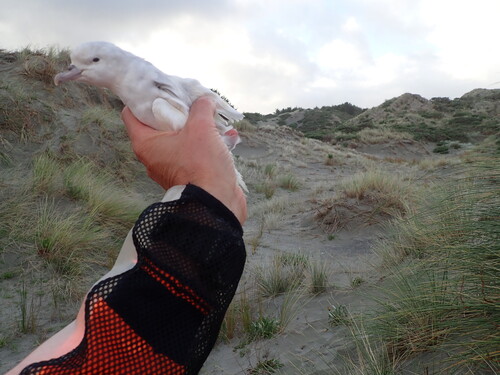 Fairy Prion
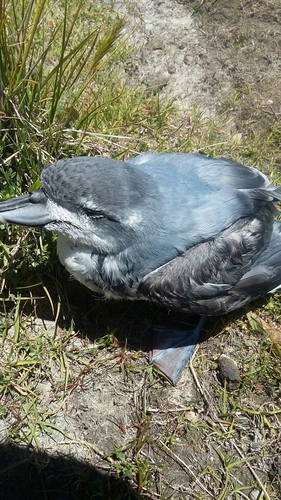 Broad-billed Prion
In short
The most reliable field mark to separate Fairy Prion from Broad-billed Prion is the bill: Broad-billed Prion has a much broader, heavier, and iron-grey bill, while Fairy Prion’s bill is slimmer and pale blue. In flight or at rest, both show blue-grey upperparts with a dark 'M' across the wings and a black-tipped tail, but Broad-billed Prion is noticeably larger and has a more distinct head pattern (grey crown, dark eye-stripe). Tail banding is less extensive in Broad-billed Prion than in Fairy Prion. These differences are subtle at sea, but bill structure and size are the best clues if seen well.
Identification tips
- Bill shape and color: Broad-billed Prion has a much broader, heavier, and iron-grey to blackish bill; Fairy Prion’s bill is slimmer and pale blue. This is the single most reliable field mark if the bill is visible.
- Size and structure: Broad-billed Prion is bulkier and longer-winged, weighing up to 235 g versus Fairy Prion’s 139 g. If both are seen together, Broad-billed Prion will look noticeably larger.
- Head pattern: Broad-billed Prion shows a distinct grey crown and a pronounced dark eye-stripe, giving the face a more contrasting look. Fairy Prion’s head is plainer and less distinctly marked.
- Tail band: Fairy Prion has a more extensive black tip to the tail, while Broad-billed Prion’s tail band is less extensive. This is subtle and may be hard to judge at sea.
- Upperparts and 'M' mark: Both show the classic prion 'M' across the upperwings and back; this is not a separator.
- Leg color: Fairy Prion has blue legs and feet, but this is rarely visible in the field.
- Flight style: Both species are agile and buoyant in flight, but Broad-billed Prion may appear heavier and more powerful due to its size.
- Feeding behavior: If seen feeding, Broad-billed Prion may be observed hydroplaning (skimming with bill in water), while Fairy Prion more often dips or seizes prey from the surface.
- At-sea confusion: Both species are extremely similar at sea, and even experts may struggle to separate them without a clear view of the bill or direct size comparison.
- Sexes and ages: Both sexes are alike in both species, and there is no documented age-specific difference in upperwing pattern or plumage between juveniles and adults for field identification.
- Context: Both species occur together in southern oceans and breed on similar islands, so location alone is not diagnostic.
- Voice: No distinctive vocal differences are noted for field separation.
- Pitfalls: Beware of overlap with other prion species, especially Fulmar Prion, which is also very similar; always focus on bill structure and head pattern for best chance of correct ID.
- Lighting and distance: Bill color and head pattern can be hard to judge in poor light or at range; in such cases, identification may not be possible.
- Summary tip: If you see a prion with a distinctly broad, heavy, iron-grey bill and a strong head pattern, favor Broad-billed Prion; if the bill is slim and pale blue and the bird is smaller, favor Fairy Prion.
Size
Broad-billed Prion is the largest prion, measuring 25–30 cm in length with a wingspan of 57–66 cm and a mass of 160–235 g. Fairy Prion is smaller, about 25 cm long with a 56 cm wingspan and a mass of 139 g. In direct comparison, Broad-billed Prion appears bulkier and longer-winged, but overlap in length means size alone is not always reliable unless both species are seen together.
Plumage
Both species share blue-grey upperparts, a dark 'M' across the back and wings, white underparts, and a black-tipped tail. However, Broad-billed Prion has a more distinct head pattern with a grey crown and a pronounced dark eye-stripe, while Fairy Prion’s head is plainer. The tail band is less extensive in Broad-billed Prion. Both sexes are alike and there is no mention of age-specific upperwing patterns or juvenile differences in the sources, so these marks apply to all ages. Bill color is also a clue: Fairy Prion’s bill is pale blue, Broad-billed Prion’s is iron-grey to blackish. In poor light or at sea, these differences can be very subtle.
Behaviour
Both species are pelagic and gregarious, often seen in flocks over southern oceans. Broad-billed Prion is noted for hydroplaning, flying with its bill in the water to skim and filter food, while Fairy Prion typically seizes prey at the surface or dips its bill while flying. Neither species is strongly associated with fishing boats. Behavior is not a strong field separator except possibly for feeding technique if observed well.
Habitat
Both species breed on subantarctic and southern temperate islands and are widespread in southern oceans. There is significant overlap in range and habitat, so context is not a reliable separator. Both nest colonially on islands, often in burrows or crevices.