

Motmot

European Turtle Dove vs Rufous Turtle Dove

Streptopelia turtur versus Streptopelia orientalis

Play a quiz with European Turtle Dove and Rufous Turtle Dove
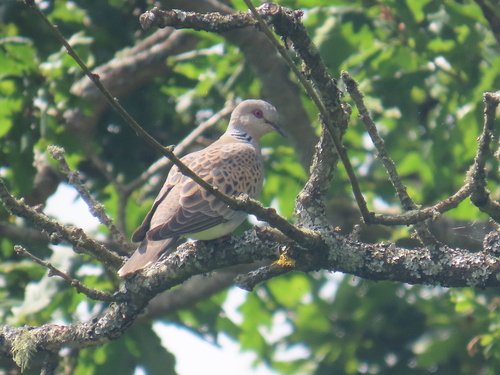
European Turtle Dove (Streptopelia turtur) European Turtle Dove
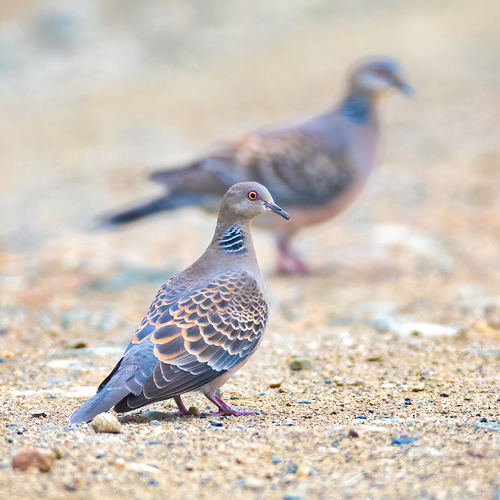
Rufous Turtle Dove (Streptopelia orientalis) Rufous Turtle Dove

Media

Loading…

In short

The most reliable field mark to separate European Turtle Dove from Rufous (Oriental) Turtle Dove is the presence of a bare red eye-ring on European Turtle Dove, which Rufous Turtle Dove lacks. In flight, both show a wedge-shaped tail with white tips, but subtle differences in tail pattern and wing coloration can help, especially in adults. European Turtle Dove is smaller and more slender, with a blue-grey head and neck and rich cinnamon wings, while Rufous Turtle Dove is bulkier, with browner, scaly-looking wings and a less pinkish breast. Juvenile European Turtle Doves are duller and lack the adult's neck patch, which can make confusion with juvenile Rufous Turtle Doves more likely. Careful attention to structure, face pattern, and tail details is essential when separating these two, especially in mixed flocks or on migration.

Identification tips

  1. Bare red eye-ring: European Turtle Dove of all ages shows a conspicuous bare red eye-ring, which Rufous Turtle Dove lacks. This is often visible even at moderate range with binoculars.
  2. Size and structure: European Turtle Dove is smaller and more slender, with a lighter build and more delicate jizz. Rufous Turtle Dove is larger, bulkier, and heavier-billed, about the size of a Collared Dove.
  3. Neck patch: Both species have a black-and-white striped patch on the side of the neck in adults, but the feathers are silver-tipped in Rufous Turtle Dove. Juvenile European Turtle Doves lack this patch entirely, so absence does not confirm Rufous Turtle Dove in immatures.
  4. Wing coloration: European Turtle Dove has rich cinnamon-brown wings with black mottling, while Rufous Turtle Dove's wings are browner with darker centers, giving a scaly or checkered look. This is most obvious on perched birds or in good flight views.
  5. Breast color: European Turtle Dove has a vinaceous (pinkish) breast, while Rufous Turtle Dove's breast is less pink and duskier.
  6. Tail pattern in flight: Both species have a wedge-shaped tail with white tips, but in Rufous Turtle Dove, the tip can be grey or white depending on subspecies, and the amount of black in the outer tail feathers varies. European Turtle Dove's tail is more consistently white-tipped with a dark center.
  7. Under-tail pattern: When viewed from below, European Turtle Dove shows a blackish chevron on a white background due to white undertail coverts obscuring the dark bases. Rufous Turtle Dove's undertail is more variable, with some subspecies showing slaty grey undertail coverts and tail band.
  8. Face pattern: European Turtle Dove's blue-grey head and neck contrast with its warm wings; Rufous Turtle Dove's head is browner, especially in some subspecies, and lacks the same crisp contrast.
  9. Leg color: European Turtle Dove has red legs in adults, but juveniles have brown legs. Rufous Turtle Dove's leg color is less emphasized but does not show the same red eye-ring.
  10. Flight style: European Turtle Dove's flight is arrow-like and agile, while Rufous Turtle Dove's is more relaxed and direct. This is subtle and best used in combination with other marks.
  11. Juvenile confusion: Juvenile European Turtle Doves are duller, browner, and lack the neck patch, making them easy to confuse with juvenile Rufous Turtle Doves. Look for overall structure and the presence/absence of the eye-ring.
  12. Habitat and range: In Europe, a turtle dove with these features is almost always European Turtle Dove; in Asia, especially east of the Urals, Rufous Turtle Dove is far more likely. Vagrants do occur, so always check multiple features.
  13. Subspecies variation: Rufous Turtle Dove subspecies differ in tail and undertail pattern. S. o. meena is most similar to European Turtle Dove in tail pattern (white-tipped), while S. o. orientalis often has a greyer tail tip and more black in the outer tail feathers. These differences are not always consistent, so use with caution.
  14. Perched vs. flight: Many field marks (eye-ring, neck patch, wing pattern) are easier to see on perched birds. In flight, focus on tail shape, tail tip color, and overall structure.
  15. Pitfalls: Do not rely solely on the neck patch, as juveniles of both species may lack it. Always combine multiple features, especially in autumn or in mixed flocks.

Size

European Turtle Dove is distinctly smaller and more slender, with an average body mass of about 136 g. Rufous Turtle Dove is larger, about the size of a Eurasian Collared Dove, and appears bulkier overall. When perched side by side, Rufous Turtle Dove's larger frame and heavier build are apparent, but beware overlap in lone birds. In flight, the European Turtle Dove's more streamlined appearance can be a subtle clue, but is less reliable at distance.

Plumage

For adults, European Turtle Dove shows a blue-grey head, neck, flanks, and rump, with a distinctive black-and-white striped neck patch and rich cinnamon-brown wings mottled with black. The breast is vinaceous, and the underparts are white. Rufous Turtle Dove also has a black-and-white neck patch but with silver-tipped feathers, and its wings are browner with darker centers, creating a scaly appearance rather than the European's more uniform cinnamon. The breast is less pink, and the overall tone is duskier. The tail on both is wedge-shaped with white tips, but in Rufous Turtle Dove, the tip can be grey or white depending on subspecies, and the amount of black in the outer tail feathers varies. Juvenile European Turtle Doves are browner and duller, lacking the neck patch and showing brown legs, which can make them resemble juvenile Rufous Turtle Doves, but the latter still tends to look bulkier and more scaly on the wing coverts. The bare red eye-ring is a key mark for European Turtle Dove of all ages; Rufous Turtle Dove lacks this.

Behaviour

European Turtle Dove is more slender and often appears more delicate in its movements, feeding mostly on the ground and being notably shy, especially in areas with hunting pressure. Its flight is described as arrow-like but not particularly fast, with a high, circling nuptial display. Rufous Turtle Dove is bulkier and its flight is more relaxed and direct, lacking the arrow-like quality. In display, Rufous Turtle Dove males flap noisily and shoot up before gliding down with an outspread tail. Both species perch in trees, but Rufous Turtle Dove's heavier build may make it look less dainty when doing so.

Habitat

European Turtle Dove prefers open woodlands, edges, and large gardens, but is generally more timid and less likely to be seen in dense forests. Rufous Turtle Dove has a wider range across Asia and uses a broader variety of wooded habitats, including open woodlands, taiga, and even mid-canopy forest. In winter, both may be found in agricultural areas, but Rufous Turtle Dove's habitat preferences are more variable depending on subspecies and region. European Turtle Dove is rare in northern Eurasia, while Rufous Turtle Dove is absent from Europe except as a vagrant.

Submit a better description

Use the same sections as the comparison. Your text is published immediately.

The most reliable field mark to separate European Turtle Dove from Rufous (Oriental) Turtle Dove is the presence of a bare red eye-ring on European Turtle Dove, which Rufous Turtle Dove lacks. In flight, both show a wedge-shaped tail with white tips, but subtle differences in tail pattern and wing coloration can help, especially in adults. European Turtle Dove is smaller and more slender, with a blue-grey head and neck and rich cinnamon wings, while Rufous Turtle Dove is bulkier, with browner, scaly-looking wings and a less pinkish breast. Juvenile European Turtle Doves are duller and lack the adult's neck patch, which can make confusion with juvenile Rufous Turtle Doves more likely. Careful attention to structure, face pattern, and tail details is essential when separating these two, especially in mixed flocks or on migration.

  1. Bare red eye-ring: European Turtle Dove of all ages shows a conspicuous bare red eye-ring, which Rufous Turtle Dove lacks. This is often visible even at moderate range with binoculars.
  2. Size and structure: European Turtle Dove is smaller and more slender, with a lighter build and more delicate jizz. Rufous Turtle Dove is larger, bulkier, and heavier-billed, about the size of a Collared Dove.
  3. Neck patch: Both species have a black-and-white striped patch on the side of the neck in adults, but the feathers are silver-tipped in Rufous Turtle Dove. Juvenile European Turtle Doves lack this patch entirely, so absence does not confirm Rufous Turtle Dove in immatures.
  4. Wing coloration: European Turtle Dove has rich cinnamon-brown wings with black mottling, while Rufous Turtle Dove's wings are browner with darker centers, giving a scaly or checkered look. This is most obvious on perched birds or in good flight views.
  5. Breast color: European Turtle Dove has a vinaceous (pinkish) breast, while Rufous Turtle Dove's breast is less pink and duskier.
  6. Tail pattern in flight: Both species have a wedge-shaped tail with white tips, but in Rufous Turtle Dove, the tip can be grey or white depending on subspecies, and the amount of black in the outer tail feathers varies. European Turtle Dove's tail is more consistently white-tipped with a dark center.
  7. Under-tail pattern: When viewed from below, European Turtle Dove shows a blackish chevron on a white background due to white undertail coverts obscuring the dark bases. Rufous Turtle Dove's undertail is more variable, with some subspecies showing slaty grey undertail coverts and tail band.
  8. Face pattern: European Turtle Dove's blue-grey head and neck contrast with its warm wings; Rufous Turtle Dove's head is browner, especially in some subspecies, and lacks the same crisp contrast.
  9. Leg color: European Turtle Dove has red legs in adults, but juveniles have brown legs. Rufous Turtle Dove's leg color is less emphasized but does not show the same red eye-ring.
  10. Flight style: European Turtle Dove's flight is arrow-like and agile, while Rufous Turtle Dove's is more relaxed and direct. This is subtle and best used in combination with other marks.
  11. Juvenile confusion: Juvenile European Turtle Doves are duller, browner, and lack the neck patch, making them easy to confuse with juvenile Rufous Turtle Doves. Look for overall structure and the presence/absence of the eye-ring.
  12. Habitat and range: In Europe, a turtle dove with these features is almost always European Turtle Dove; in Asia, especially east of the Urals, Rufous Turtle Dove is far more likely. Vagrants do occur, so always check multiple features.
  13. Subspecies variation: Rufous Turtle Dove subspecies differ in tail and undertail pattern. S. o. meena is most similar to European Turtle Dove in tail pattern (white-tipped), while S. o. orientalis often has a greyer tail tip and more black in the outer tail feathers. These differences are not always consistent, so use with caution.
  14. Perched vs. flight: Many field marks (eye-ring, neck patch, wing pattern) are easier to see on perched birds. In flight, focus on tail shape, tail tip color, and overall structure.
  15. Pitfalls: Do not rely solely on the neck patch, as juveniles of both species may lack it. Always combine multiple features, especially in autumn or in mixed flocks.

European Turtle Dove is distinctly smaller and more slender, with an average body mass of about 136 g. Rufous Turtle Dove is larger, about the size of a Eurasian Collared Dove, and appears bulkier overall. When perched side by side, Rufous Turtle Dove's larger frame and heavier build are apparent, but beware overlap in lone birds. In flight, the European Turtle Dove's more streamlined appearance can be a subtle clue, but is less reliable at distance.

For adults, European Turtle Dove shows a blue-grey head, neck, flanks, and rump, with a distinctive black-and-white striped neck patch and rich cinnamon-brown wings mottled with black. The breast is vinaceous, and the underparts are white. Rufous Turtle Dove also has a black-and-white neck patch but with silver-tipped feathers, and its wings are browner with darker centers, creating a scaly appearance rather than the European's more uniform cinnamon. The breast is less pink, and the overall tone is duskier. The tail on both is wedge-shaped with white tips, but in Rufous Turtle Dove, the tip can be grey or white depending on subspecies, and the amount of black in the outer tail feathers varies. Juvenile European Turtle Doves are browner and duller, lacking the neck patch and showing brown legs, which can make them resemble juvenile Rufous Turtle Doves, but the latter still tends to look bulkier and more scaly on the wing coverts. The bare red eye-ring is a key mark for European Turtle Dove of all ages; Rufous Turtle Dove lacks this.

European Turtle Dove is more slender and often appears more delicate in its movements, feeding mostly on the ground and being notably shy, especially in areas with hunting pressure. Its flight is described as arrow-like but not particularly fast, with a high, circling nuptial display. Rufous Turtle Dove is bulkier and its flight is more relaxed and direct, lacking the arrow-like quality. In display, Rufous Turtle Dove males flap noisily and shoot up before gliding down with an outspread tail. Both species perch in trees, but Rufous Turtle Dove's heavier build may make it look less dainty when doing so.

European Turtle Dove prefers open woodlands, edges, and large gardens, but is generally more timid and less likely to be seen in dense forests. Rufous Turtle Dove has a wider range across Asia and uses a broader variety of wooded habitats, including open woodlands, taiga, and even mid-canopy forest. In winter, both may be found in agricultural areas, but Rufous Turtle Dove's habitat preferences are more variable depending on subspecies and region. European Turtle Dove is rare in northern Eurasia, while Rufous Turtle Dove is absent from Europe except as a vagrant.

Discard your changes?

You have unsaved edits. If you leave now, those changes will be lost.

European Turtle Dove · Rufous Turtle Dove · My Tricky Birds