

European Turtle Dove vs Collared Dove
Streptopelia turtur versus Streptopelia decaocto
Play a quiz with European Turtle Dove and Collared Dove
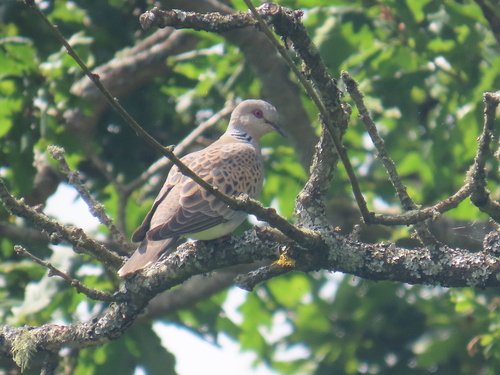 European Turtle Dove
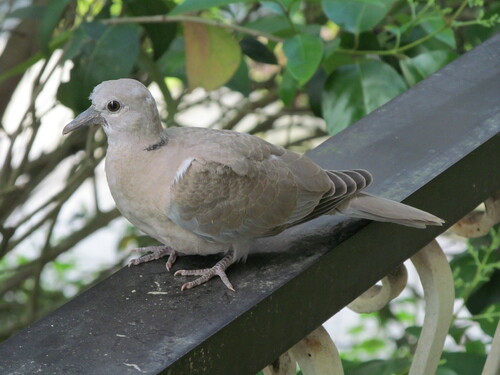 Collared Dove
In short
The most reliable field mark to separate European Turtle Dove from Collared Dove is the combination of tail pattern and neck markings, especially in flight or when perched with the tail spread. Turtle Dove shows a wedge-shaped tail with a dark center and broad white edges and tips, and adults have a bold black-and-white striped patch on the side of the neck. Collared Dove, in contrast, has a squarer tail with less contrast—grey above, dark grey below with narrow white tips—and a distinctive black half-collar edged with white on the nape. Juvenile Turtle Doves lack the neck patch, but remain browner and more patterned than the plainer, greyer Collared Dove. Collared Dove is also noticeably larger and bulkier, with a more uniform appearance and a pinkish-grey tone. These marks are reliable across seasons and ages, but beware of juveniles and distant views.
Identification tips
- Tail pattern in flight: Turtle Dove shows a wedge-shaped tail with a dark center and broad white edges/tips, forming a blackish chevron on a white background from below. Collared Dove has a squarer tail, grey above, dark grey below, with only narrow white tips—never a bold wedge. This is visible in all ages, especially when the bird is flying away or raising its tail.
- Neck markings (adults): Adult Turtle Dove has a bold black-and-white striped patch on the side of the neck; Collared Dove has a black half-collar edged with white on the nape, never on the side. Juvenile Turtle Doves lack the neck patch, but Collared Dove juveniles may show a faint collar.
- Overall coloration: Turtle Dove is browner and more patterned, with cinnamon and black-mottled wings, blue-grey head and rump, and vinaceous breast. Collared Dove is uniform grey-buff to pinkish-grey, with a slight pinkish tinge below and little contrast on the wings.
- Size and structure: Collared Dove is noticeably larger, bulkier, and longer-tailed than the slender, compact Turtle Dove. This is apparent when both species are seen together, but can be subtle alone.
- Leg and eye color: Both have red legs, but Collared Dove's eye is surrounded by bare white or yellow skin, while Turtle Dove has a red eye ring. Collared Dove's iris is red but appears dark at a distance.
- Juvenile confusion: Juvenile Turtle Doves are browner and more patterned above, with brown legs and lacking the adult neck patch. Juvenile Collared Doves are plain grey-buff, with a poorly developed collar and brown iris. Focus on upperpart pattern and tail shape if the neck patch is missing.
- Wing pattern (in flight): Turtle Dove's wings are cinnamon with black mottling; Collared Dove's underwing is blue-grey, but the upperwing is plain and lacks strong patterning.
- Tail shape when perched: Turtle Dove's tail appears more wedge-shaped and often shows white tips when fanned; Collared Dove's tail is squarer and less contrasting.
- Habitat context: Turtle Dove is rarely found near buildings or in urban areas, preferring open countryside. Collared Dove is almost always near human habitation, often in towns and gardens.
- Behavior: Turtle Dove is shy and flushes at distance, feeding on the ground in cover. Collared Dove is confiding, perching openly and tolerating close approach.
- Seasonality: Turtle Dove is a migrant, present in Europe mainly from late April to September. Collared Dove is resident year-round.
- Display flight: Collared Dove's display is a rapid vertical climb and gliding descent with wings in an inverted 'V'; Turtle Dove's nuptial flight is high and circling but less distinctive.
- Bill color: Both species have black bills; not a useful separation.
- Sex differences: Both species are sexually monomorphic in plumage; do not rely on sex for identification.
- Pitfalls: Beware of juvenile Turtle Doves lacking neck patch and appearing dull; focus on tail pattern and upperpart color. Collared Dove's collar is always on the nape, never the side.
Size
Collared Dove is substantially larger and heavier than European Turtle Dove, with an average body mass of about 193 g versus 136 g for Turtle Dove [wikidata]. Collared Dove measures around 32 cm in length and has a wingspan of 47–55 cm, while Turtle Dove is smaller and more slender at 26–28 cm length and 47–53 cm wingspan [wikipedia]. In the field, Collared Dove appears bulkier and longer-tailed, while Turtle Dove is more delicate and compact.
Plumage
Juvenile Turtle Doves are browner and duller than adults, lacking the black-and-white neck patch, and have brown legs. Their upperparts are still more patterned than Collared Dove juveniles, which are plain grey-buff and only show a faint, poorly developed collar and a brown iris. Adult Turtle Doves are strikingly patterned: blue-grey head and rump, cinnamon wings mottled with black, vinaceous breast, and a diagnostic black-and-white striped neck patch. The tail in flight is wedge-shaped with a dark center and broad white edges and tips, forming a blackish chevron on a white background when viewed from below. Collared Dove adults are uniform grey-buff to pinkish-grey, slightly darker above, with a black half-collar edged in white on the nape, and a blue-grey underwing patch. Their tail is more squared, grey above, dark grey below with narrow white tips, and lacks the Turtle Dove's bold wedge pattern. Both species have red legs and black bills, but Collared Dove's eye is surrounded by bare white or yellow skin, while Turtle Dove has red eye rings.
Behaviour
Turtle Dove is more timid and wary, often feeding on the ground in open woodlands or hedgerows and rarely nesting near humans. Its flight is described as arrow-like but not especially fast, and its nuptial flight is high and circling. Collared Dove is much more confiding, often seen in urban and suburban areas, perching on wires, rooftops, and feeding near people. Its display flight is a rapid vertical climb followed by a gliding descent with wings in an inverted 'V', but otherwise it flies directly with fast, clipped wingbeats and little gliding.
Habitat
Turtle Dove prefers open woodlands, hedgerows, and farmland with scattered trees, avoiding dense forests and rarely nesting near human habitation. It is migratory, breeding in Europe and wintering in sub-Saharan Africa. Collared Dove is highly synanthropic, thriving in towns, villages, farms, and suburban gardens, almost always within 1 km of buildings. It is a resident species in most of its range and breeds year-round where food is abundant.