

European Storm-Petrel vs Leach's Storm-Petrel
Hydrobates pelagicus versus Hydrobates leucorhous
Play a quiz with European Storm-Petrel and Leach's Storm-Petrel
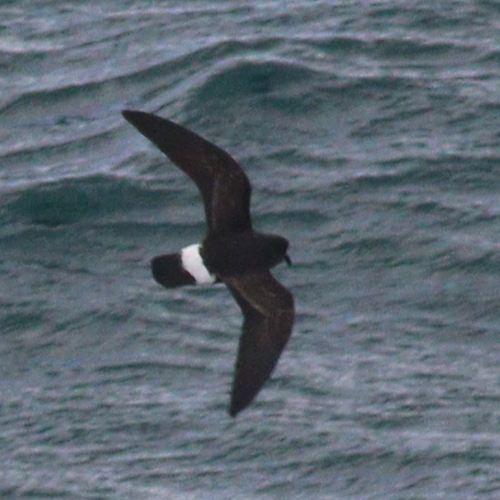 European Storm-Petrel
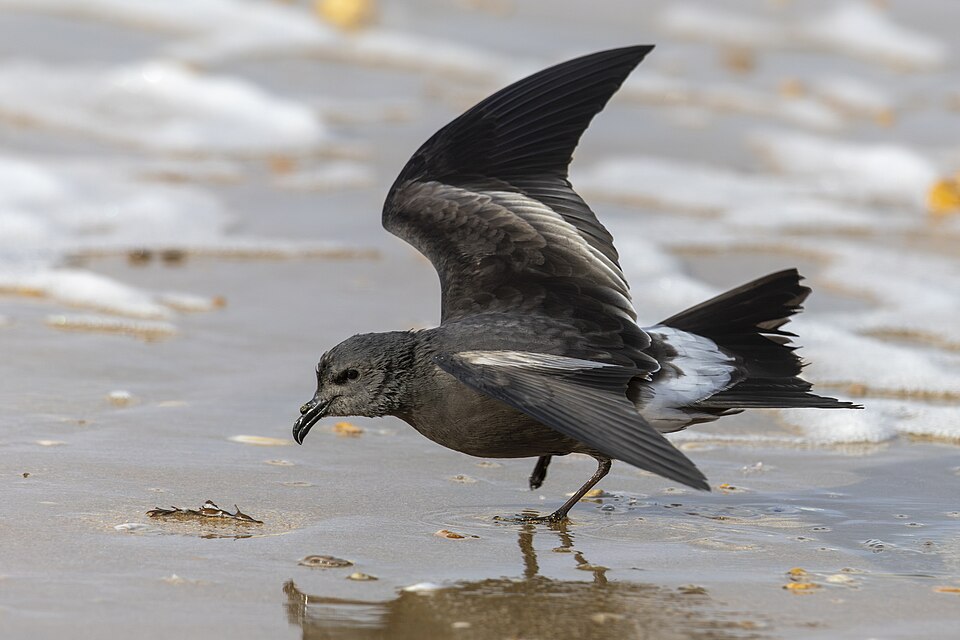 Leach's Storm-Petrel
In short
Tail shape and size are the most reliable field marks: European Storm-Petrel is distinctly smaller with a square tail, while Leach's Storm-Petrel is larger and shows a noticeably forked tail. Both species are mostly black with a white rump, but Leach's often has a dark line dividing the rump and a paler face, while European has a clean white rump and a white underwing bar. In flight, European Storm-Petrel appears more fluttery and bat-like, whereas Leach's Storm-Petrel is more buoyant and gliding. Juvenile European Storm-Petrels can show a narrow white bar on the upperwing, a feature not seen in Leach's. Use tail shape and size first, then check for underwing bar and flight style.
Identification tips
- Tail shape is the best field mark: European Storm-Petrel always has a square tail, while Leach's Storm-Petrel shows a forked tail, especially obvious when the tail is spread in flight or when banking. This works for all ages and seasons.
- Size difference: Leach's is noticeably larger and longer-winged than European, but this is best judged with experience or direct comparison.
- Underwing bar (European only): Look for a broad white band on the underwing of European Storm-Petrel (all ages); Leach's lacks this feature.
- Upperwing bar in juveniles (European only): Fresh juvenile/immature European Storm-Petrels can show a narrow white bar on the upperwing, absent in Leach's at all ages.
- Rump pattern: European has a clean, snow-white rump extending to the tail sides; Leach's usually has a white rump with a dark central line or split, and some Pacific Leach's are entirely dark-rumped (rare in the Atlantic).
- Facial color: Leach's may show a slightly paler face, while European's face is uniformly dark.
- Flight style: European Storm-Petrel has a weak, fluttery, bat-like flight with short glides; Leach's is more buoyant, with deeper, more bounding wingbeats and longer glides.
- Feeding behavior: Both patter on the water, but European often hovers with wings raised and does not appear to walk on the surface; Leach's may look more direct and less fluttery.
- Plumage wear: European Storm-Petrel can look dark brown (not black) when plumage is worn, but this is variable and not always reliable.
- Bill and leg structure: Not reliably separable at sea; differences are subtle and not diagnostic in the field.
- Sex and subspecies: No reliable field marks for sex or subspecies in either species at sea.
- Habitat/context: Both are pelagic, but Leach's is more likely farther offshore or in colder waters; not diagnostic unless at a known colony.
- Vocalizations: Not covered in the notes; not a practical field mark at sea.
- Pitfall: Beware of dark-rumped Leach's (mainly Pacific); these can be very difficult and may be indistinguishable from other all-dark storm-petrels.
- Summary tip: Start with tail shape and size, then check for underwing bar and rump pattern. Use flight style and upperwing bar in juveniles as supporting marks.
Size
European Storm-Petrel is significantly smaller (14–18 cm length, 36–39 cm wingspan, average 28 g) compared to Leach's Storm-Petrel (18–21 cm length, 43–48 cm wingspan) [wikipedia][avonet]. The difference is usually obvious in direct comparison or with experience, but can be harder to judge at sea without a reference. Leach's is bulkier and longer-winged, appearing more substantial in flight.
Plumage
- Juvenile/immature European Storm-Petrel can show a narrow white bar on the upperwing, which is absent in Leach's Storm-Petrel at all ages. This is a key mark for fresh young birds.
- Rump pattern: European Storm-Petrel has a clean, snow-white rump extending to the sides of the tail base; Leach's Storm-Petrel usually has a white rump with a dark central line or divide, and some Pacific Leach's can be entirely dark-rumped (rare in the Atlantic).
- Underwing: European Storm-Petrel shows a broad white band on the underwing, visible in good light; Leach's lacks this mark, instead showing a paler grey-brown bar on the upperwing coverts and a slightly paler face.
- Tail: European Storm-Petrel has a square tail, while Leach's has a distinctly forked tail, especially visible in flight and when fanned.
- Overall color: Both are mostly black, but European Storm-Petrel can look dark brown when worn; Leach's may show a paler face and upperwing bar.
Behaviour
European Storm-Petrel has a weak, fluttering, bat-like flight with frequent short glides. It often hovers with wings raised and patters on the water, but does not appear to walk on the surface. Leach's Storm-Petrel has a more buoyant, gliding flight with deeper wingbeats and a more erratic, bounding jizz. Both species patter on the water to feed, but Leach's may appear more purposeful and less fluttery. On land, both walk awkwardly, shuffling to their burrows.
Habitat
Both species are pelagic and breed on remote islands, rarely seen from land except at colonies. European Storm-Petrel breeds mainly in the northeast Atlantic (Faroe Islands, UK, Ireland, Iceland), while Leach's has a broader North Atlantic and North Pacific distribution. At sea, both can occur together, but Leach's is more likely farther offshore and in colder waters. Context is rarely diagnostic unless at a known colony.
European Storm-Petrel · Leach's Storm-Petrel · My Tricky Birds