

Motmot

European Honey-buzzard vs Western Marsh Harrier

Pernis apivorus versus Circus aeruginosus

Play a quiz with European Honey-buzzard and Western Marsh Harrier
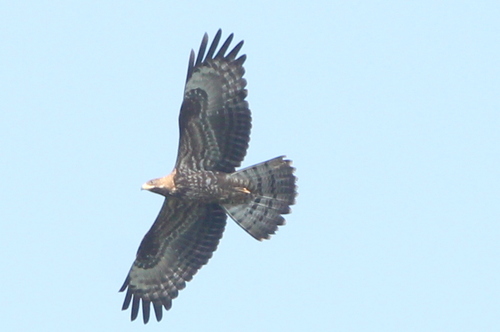
European Honey-buzzard (Pernis apivorus) European Honey-buzzard
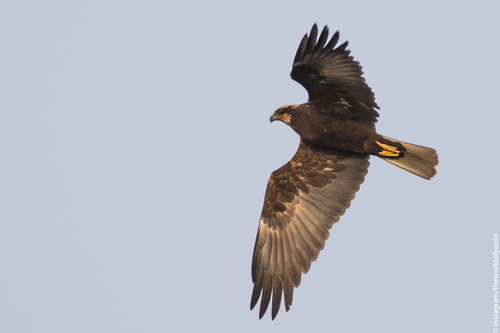
Western Marsh Harrier (Circus aeruginosus) Western Marsh Harrier

Media

Loading…

In short

The most reliable field mark to separate European Honey-buzzard from Western Marsh Harrier in flight is structure: Honey-buzzard shows a long neck, small pigeon-like head, and long, narrow tail with fewer (usually two) dark bars, while Marsh Harrier is bulkier with broader wings and a shorter, less distinctly barred tail. Juvenile Honey-buzzards may mimic Common Buzzard, but not Marsh Harrier; Marsh Harrier juveniles are dark and lack the honey-buzzard's distinctive head and tail shape. Soaring jizz is key: Honey-buzzard glides on flat, straight wings with the head projecting forward, while Marsh Harrier holds its wings in a shallow V and often dangles its legs. Sex differences are visible in both, but the honey-buzzard's blue-grey male head is unique. Use these structural and flight clues first, then check plumage and context.

Identification tips

  1. Head and neck shape in flight: Honey-buzzard shows a small, pigeon-like head and a long neck projecting forward, unlike the blockier head and shorter neck of Marsh Harrier. This is the single best mark at distance.
  2. Tail length and barring: Honey-buzzard's tail is longer and narrower, with usually two narrow dark bars plus a broad subterminal bar, visible in all ages; Marsh Harrier's tail is shorter, broader, and lacks this pattern.
  3. Wing shape and posture: Honey-buzzard soars on flat, straight wings, sometimes with a downward kink at the carpal; Marsh Harrier holds wings in a shallow V (dihedral) and often dangles legs when hunting.
  4. Plumage in adult males: Male Honey-buzzard has a blue-grey head (unique), while male Marsh Harrier has a pale head and shoulders, brown forewing, grey secondaries and tail, and black primaries—appearing three-toned from below.
  5. Plumage in females and juveniles: Female Honey-buzzard has a brown head and is slightly darker than the male; Marsh Harrier females and juveniles are dark chocolate-brown with a pale yellowish head and shoulders, and a dark eye mask. Juvenile Marsh Harrier never shows the honey-buzzard's tail pattern or head shape.
  6. Jizz and flight style: Honey-buzzard appears long-necked and almost goose-like in direct flight, with a sometimes angular chest; Marsh Harrier is bulkier, with a heavier, more harrier-like flight and often visible dangling legs.
  7. Habitat context: Honey-buzzard is almost always associated with woodland, especially in breeding season; Marsh Harrier is tied to open wetlands and marshes. Habitat can be a strong clue.
  8. Behavior: Honey-buzzard is secretive, rarely seen except in display or migration; Marsh Harrier is conspicuous, often hunting low over open ground.
  9. Mimicry confusion: Juvenile Honey-buzzard may mimic Common Buzzard, but not Marsh Harrier. If you think you see a 'buzzard' with a long neck and small head, check for honey-buzzard.
  10. Sexual dimorphism: Both species are sexually dimorphic, but only Honey-buzzard males have a blue-grey head. Marsh Harrier males have a pale head and grey secondaries/tail, but never a blue-grey head.
  11. Size: Honey-buzzard is slightly longer and longer-winged, but less heavy-bodied; Marsh Harrier is bulkier, especially in females. Size is subtle and best used with other marks.
  12. Legs in flight: Marsh Harrier often flies with legs dangling; Honey-buzzard does not.
  13. Voice: Both are generally silent; honey-buzzard's 'peee-lu' is rarely heard and not a reliable field mark.
  14. Season and range: Honey-buzzard is a scarce summer migrant, most likely in spring/summer over woodland; Marsh Harrier is more widespread and likely over marshes year-round.
  15. Pitfalls: Do not rely on overall brown coloration or size alone; focus on head/neck shape, tail pattern, and flight style for reliable separation.

Size

European Honey-buzzard is slightly longer (52–60 cm) and has a broader wingspan (130–150 cm) than Western Marsh Harrier (48–56 cm, 115–130 cm wingspan), but is less heavy-bodied (440–1050 g vs. 400–800 g). Honey-buzzard appears longer and slimmer, with a proportionally longer tail and neck, while Marsh Harrier is bulkier, especially in females. In the field, Marsh Harrier often looks heavier and broader-winged, but the difference is subtle and best judged in direct comparison or with experience.

Plumage

Juvenile and immature plumages are a common pitfall. Juvenile European Honey-buzzard can resemble Common Buzzard, but not Marsh Harrier: it shows a long, narrow tail with two or three dark bars and a broad subterminal band, and a small, pigeon-like head. Juvenile Marsh Harriers are dark chocolate-brown overall, sometimes with limited yellow on the head and shoulders, but never show the honey-buzzard's tail pattern or head shape. Adult male Honey-buzzard has a blue-grey head (unique in this pair), while the female's head is brown; both sexes have a long, barred tail and flat, straight wings. Adult male Marsh Harrier is three-toned in flight: brown forewing, grey secondaries and tail, black primaries, and pale head/shoulders. Females and juveniles are dark brown with a pale yellowish head and shoulders, and a dark mask around the eye. Marsh Harrier never shows the honey-buzzard's small head, long neck, or tail pattern. The honey-buzzard's angular chest and head projection are best seen in direct flight.

Behaviour

Honey-buzzard soars on flat, straight wings, often high and with little flapping, and may show a slight downward kink at the carpal. Its head projects forward, giving a long-necked look. Marsh Harrier hunts low over marshes and fields, gliding with wings in a shallow V and legs often dangling. In display, honey-buzzard males may wing-clap. Marsh Harrier is more likely to be seen quartering low over open ground, while honey-buzzard is more secretive and often seen only during migration or display flights.

Habitat

European Honey-buzzard breeds in woodlands and is inconspicuous except during spring display. It is scarce and local in the UK, mostly in southeastern England, and is rarely seen away from forested areas. Marsh Harrier is a bird of open wetlands, marshes, and reedbeds, and is much more likely to be seen flying low over open country. If you see a large raptor over a marsh, Marsh Harrier is far more likely; over mature woodland, especially in spring, consider Honey-buzzard.

Voice

Honey-buzzard gives a clear 'peee-lu' call, but is generally silent and not often heard in the field. Marsh Harrier is also generally silent, and voice is not a reliable field mark for separation between these two.

Submit a better description

Use the same sections as the comparison. Your text is published immediately.

The most reliable field mark to separate European Honey-buzzard from Western Marsh Harrier in flight is structure: Honey-buzzard shows a long neck, small pigeon-like head, and long, narrow tail with fewer (usually two) dark bars, while Marsh Harrier is bulkier with broader wings and a shorter, less distinctly barred tail. Juvenile Honey-buzzards may mimic Common Buzzard, but not Marsh Harrier; Marsh Harrier juveniles are dark and lack the honey-buzzard's distinctive head and tail shape. Soaring jizz is key: Honey-buzzard glides on flat, straight wings with the head projecting forward, while Marsh Harrier holds its wings in a shallow V and often dangles its legs. Sex differences are visible in both, but the honey-buzzard's blue-grey male head is unique. Use these structural and flight clues first, then check plumage and context.

  1. Head and neck shape in flight: Honey-buzzard shows a small, pigeon-like head and a long neck projecting forward, unlike the blockier head and shorter neck of Marsh Harrier. This is the single best mark at distance.
  2. Tail length and barring: Honey-buzzard's tail is longer and narrower, with usually two narrow dark bars plus a broad subterminal bar, visible in all ages; Marsh Harrier's tail is shorter, broader, and lacks this pattern.
  3. Wing shape and posture: Honey-buzzard soars on flat, straight wings, sometimes with a downward kink at the carpal; Marsh Harrier holds wings in a shallow V (dihedral) and often dangles legs when hunting.
  4. Plumage in adult males: Male Honey-buzzard has a blue-grey head (unique), while male Marsh Harrier has a pale head and shoulders, brown forewing, grey secondaries and tail, and black primaries—appearing three-toned from below.
  5. Plumage in females and juveniles: Female Honey-buzzard has a brown head and is slightly darker than the male; Marsh Harrier females and juveniles are dark chocolate-brown with a pale yellowish head and shoulders, and a dark eye mask. Juvenile Marsh Harrier never shows the honey-buzzard's tail pattern or head shape.
  6. Jizz and flight style: Honey-buzzard appears long-necked and almost goose-like in direct flight, with a sometimes angular chest; Marsh Harrier is bulkier, with a heavier, more harrier-like flight and often visible dangling legs.
  7. Habitat context: Honey-buzzard is almost always associated with woodland, especially in breeding season; Marsh Harrier is tied to open wetlands and marshes. Habitat can be a strong clue.
  8. Behavior: Honey-buzzard is secretive, rarely seen except in display or migration; Marsh Harrier is conspicuous, often hunting low over open ground.
  9. Mimicry confusion: Juvenile Honey-buzzard may mimic Common Buzzard, but not Marsh Harrier. If you think you see a 'buzzard' with a long neck and small head, check for honey-buzzard.
  10. Sexual dimorphism: Both species are sexually dimorphic, but only Honey-buzzard males have a blue-grey head. Marsh Harrier males have a pale head and grey secondaries/tail, but never a blue-grey head.
  11. Size: Honey-buzzard is slightly longer and longer-winged, but less heavy-bodied; Marsh Harrier is bulkier, especially in females. Size is subtle and best used with other marks.
  12. Legs in flight: Marsh Harrier often flies with legs dangling; Honey-buzzard does not.
  13. Voice: Both are generally silent; honey-buzzard's 'peee-lu' is rarely heard and not a reliable field mark.
  14. Season and range: Honey-buzzard is a scarce summer migrant, most likely in spring/summer over woodland; Marsh Harrier is more widespread and likely over marshes year-round.
  15. Pitfalls: Do not rely on overall brown coloration or size alone; focus on head/neck shape, tail pattern, and flight style for reliable separation.

European Honey-buzzard is slightly longer (52–60 cm) and has a broader wingspan (130–150 cm) than Western Marsh Harrier (48–56 cm, 115–130 cm wingspan), but is less heavy-bodied (440–1050 g vs. 400–800 g). Honey-buzzard appears longer and slimmer, with a proportionally longer tail and neck, while Marsh Harrier is bulkier, especially in females. In the field, Marsh Harrier often looks heavier and broader-winged, but the difference is subtle and best judged in direct comparison or with experience.

Juvenile and immature plumages are a common pitfall. Juvenile European Honey-buzzard can resemble Common Buzzard, but not Marsh Harrier: it shows a long, narrow tail with two or three dark bars and a broad subterminal band, and a small, pigeon-like head. Juvenile Marsh Harriers are dark chocolate-brown overall, sometimes with limited yellow on the head and shoulders, but never show the honey-buzzard's tail pattern or head shape. Adult male Honey-buzzard has a blue-grey head (unique in this pair), while the female's head is brown; both sexes have a long, barred tail and flat, straight wings. Adult male Marsh Harrier is three-toned in flight: brown forewing, grey secondaries and tail, black primaries, and pale head/shoulders. Females and juveniles are dark brown with a pale yellowish head and shoulders, and a dark mask around the eye. Marsh Harrier never shows the honey-buzzard's small head, long neck, or tail pattern. The honey-buzzard's angular chest and head projection are best seen in direct flight.

Honey-buzzard soars on flat, straight wings, often high and with little flapping, and may show a slight downward kink at the carpal. Its head projects forward, giving a long-necked look. Marsh Harrier hunts low over marshes and fields, gliding with wings in a shallow V and legs often dangling. In display, honey-buzzard males may wing-clap. Marsh Harrier is more likely to be seen quartering low over open ground, while honey-buzzard is more secretive and often seen only during migration or display flights.

European Honey-buzzard breeds in woodlands and is inconspicuous except during spring display. It is scarce and local in the UK, mostly in southeastern England, and is rarely seen away from forested areas. Marsh Harrier is a bird of open wetlands, marshes, and reedbeds, and is much more likely to be seen flying low over open country. If you see a large raptor over a marsh, Marsh Harrier is far more likely; over mature woodland, especially in spring, consider Honey-buzzard.

Honey-buzzard gives a clear 'peee-lu' call, but is generally silent and not often heard in the field. Marsh Harrier is also generally silent, and voice is not a reliable field mark for separation between these two.

Discard your changes?

You have unsaved edits. If you leave now, those changes will be lost.

European Honey-buzzard · Western Marsh Harrier · My Tricky Birds