

European Honey-buzzard vs Eurasian Sparrowhawk
Pernis apivorus versus Accipiter nisus
Play a quiz with European Honey-buzzard and Eurasian Sparrowhawk
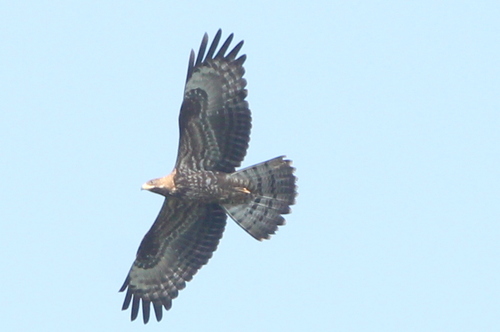 European Honey-buzzard
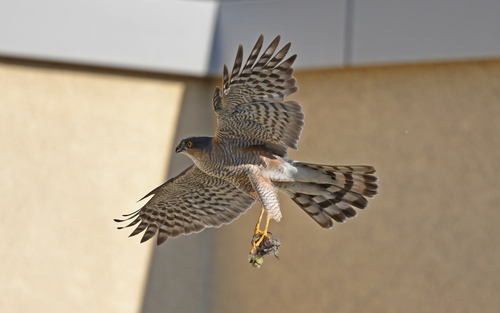 Eurasian Sparrowhawk
In short
The most reliable field mark between European Honey-buzzard and Eurasian Sparrowhawk is their structure in flight: Honey-buzzard shows long, flat, paddle-shaped wings and a small, pigeon-like head, while Sparrowhawk is compact with short, broad wings and a proportionally longer tail. Juvenile Honey-buzzards can mimic Common Buzzards, but not Sparrowhawks. Sparrowhawks, especially females and juveniles, are much smaller and have a characteristic flap-flap-glide flight style, while Honey-buzzards soar with flat wings and a protruding head. Plumage differences are subtle at a distance, but the Honey-buzzard's tail pattern (fewer, broader bars) and the Sparrowhawk's fine barring and countershading are helpful. Use structure and flight style first, then plumage and size.
Identification tips
- Structure in flight: Honey-buzzard shows long, paddle-shaped wings held flat and a small, pigeon-like head that projects forward; Sparrowhawk has short, broad wings and a proportionally longer, square-tipped tail. This is the most reliable field mark for all ages.
- Flight style: Honey-buzzard soars and glides with flat wings; Sparrowhawk uses a flap-flap-glide pattern, with rapid wingbeats and short glides, creating an undulating flight path.
- Tail pattern: Honey-buzzard's tail is long with only two narrow dark bars and a broad subterminal bar (all ages); Sparrowhawk's tail has many fine bars and is square-tipped (all ages).
- Head and neck: Honey-buzzard appears long-necked with a small, pigeon-like head; Sparrowhawk is short-necked and compact.
- Adult male plumage: Male Honey-buzzard has a blue-grey head (unique among large raptors); male Sparrowhawk has slate-grey upperparts and orange-barred underparts.
- Adult female plumage: Female Honey-buzzard has a brown head and is slightly larger/darker than the male; female Sparrowhawk is brown or grey-brown above with brown-barred underparts.
- Juvenile/immature plumage: Juvenile Honey-buzzard can mimic Common Buzzard but not Sparrowhawk; juvenile Sparrowhawk is brown above with rusty fringes and coarsely barred or spotted brown below, with pale yellow eyes and a streaked throat.
- Plumage barring: Sparrowhawk of all ages shows fine, even horizontal barring on the underparts (adults) or coarser barring (juveniles); Honey-buzzard never shows this pattern.
- Size: Honey-buzzard is much larger and longer-winged; even the largest female Sparrowhawk is dwarfed by a Honey-buzzard.
- Perched jizz: Honey-buzzard looks slim, long-necked, and upright; Sparrowhawk is compact, upright, and short-necked.
- Habitat/context: Honey-buzzard is scarce and local, usually in mature woodland or seen migrating; Sparrowhawk is common and widespread, often in gardens or urban areas.
- Behavior: Honey-buzzard spends time soaring or on the forest floor digging for wasp nests; Sparrowhawk is an active bird-hunter, often seen darting through trees.
- Voice: Honey-buzzard's 'peee-lu' call is rarely heard; Sparrowhawk is mostly silent in the field.
- Sexual dimorphism: Both species show sex differences, but only Honey-buzzard males have a blue-grey head; Sparrowhawk females are much larger than males, but both are much smaller than Honey-buzzard.
- Pitfalls: Juvenile Honey-buzzard may mimic Common Buzzard, but not Sparrowhawk; confusion is more likely with structure and flight style than with plumage.
Size
European Honey-buzzard is much larger and longer-winged than Eurasian Sparrowhawk. Honey-buzzard measures 52–60 cm in length with a 130–150 cm wingspan and is relatively lightly built for its size, while Sparrowhawk is 29–41 cm long with a 59–80 cm wingspan and weighs around 220 g (adult average; females larger). Even the largest female Sparrowhawk is dwarfed by a Honey-buzzard. In the field, Honey-buzzard appears long-necked and slim, whereas Sparrowhawk is compact and short-necked.
Plumage
-
Juvenile/immature birds: Juvenile Honey-buzzards can resemble Common Buzzards but not Sparrowhawks. They lack the fine horizontal barring of Sparrowhawks and instead show a longer tail with only two narrow dark bars and a broad subterminal bar. Juvenile Sparrowhawks are brown above with rusty fringes and coarsely barred or spotted brown below, with pale yellow eyes and a streaked throat (no midline stripe).
-
Adult males: Honey-buzzard males have a blue-grey head (unique among large raptors in the region), while Sparrowhawk males have slate-grey upperparts and orange-barred underparts. The Honey-buzzard's underparts are variable but never show the fine, even barring of Sparrowhawk.
-
Adult females: Female Honey-buzzard has a brown head, is slightly larger and darker than the male, and still shows the long tail with few bars. Female Sparrowhawks are brown or grey-brown above, with brown-barred underparts and bright yellow to orange irides.
-
Flight feathers and tail: Honey-buzzard's tail is longer with fewer, broader bars; Sparrowhawk's tail is long but square-tipped with many fine bars. Honey-buzzard's wings are longer and paddle-shaped; Sparrowhawk's are short and rounded.
Behaviour
Honey-buzzard soars on flat wings with the wing tips held horizontal or slightly down, often showing a protruding head and sometimes an angular chest, especially in direct flight. It spends much time soaring or gliding and is inconspicuous except during spring displays. Sparrowhawk flies with a distinctive flap-flap-glide pattern, creating an undulating flight path, and is highly maneuverable, often seen darting through woodland or gardens in pursuit of small birds. Perched, Honey-buzzard looks long-necked and slim, while Sparrowhawk appears compact and upright.
Habitat
Honey-buzzard breeds in mature woodlands and is secretive, often overlooked except during migration or display flights. In Britain, it is scarce and local, mostly in southeastern England and parts of Wales and Scotland. Sparrowhawk is much more widespread and common, found in a variety of wooded habitats, parks, and even gardens, especially where small birds are abundant. If seen in open country or soaring high, Honey-buzzard is more likely; if seen dashing through trees or gardens, Sparrowhawk is the default.
Voice
Honey-buzzard gives a clear 'peee-lu' call, but is generally silent and inconspicuous outside the breeding season. Sparrowhawk is also mostly silent, with no distinctive call noted in the provided sources for field separation.
European Honey-buzzard · Eurasian Sparrowhawk · My Tricky Birds