
Eurasian/Green-winged Teal vs Marbled Duck
Anas crecca versus Marmaronetta angustirostris
Play a quiz with Eurasian/Green-winged Teal and Marbled Duck
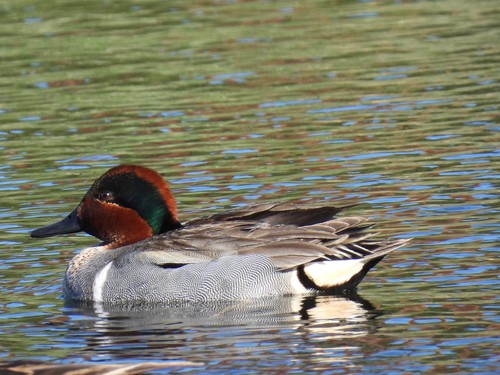 Eurasian/Green-winged Teal
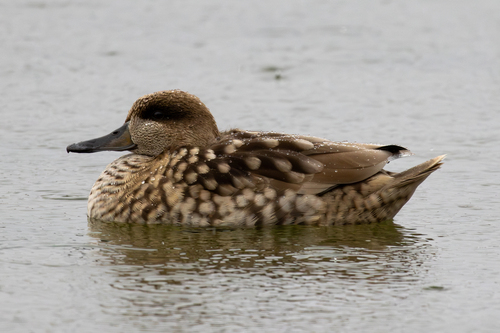 Marbled Duck
In short
The most reliable field mark between Eurasian/Green-winged Teal and Marbled Duck is the upperwing pattern in flight: the teal shows a bold, iridescent green speculum with white edges (all ages), while Marbled Duck has uniformly pale wings with no speculum or strong pattern. On the ground, the teal drake in breeding plumage is strikingly patterned with a chestnut head and green face patch, but females and immatures are much duller and can be confused with Marbled Duck. Marbled Duck is overall paler, with a marbled sandy-brown appearance and a distinctive dark eye-patch, and lacks any strong wing markings even in flight. Size and structure differ subtly, but are less useful than wing pattern and plumage details.
Identification tips
- In flight (all ages): Look for the speculum. Teal always shows a bold, iridescent green speculum with white edges; Marbled Duck has plain, pale wings with no speculum or strong pattern.
- Resting birds (adult male teal): Breeding drake teal is unmistakable with a chestnut head, bold green face patch, narrow yellowish-white border, and a white horizontal side-stripe. Marbled Duck never shows these features.
- Resting birds (female/immature teal vs Marbled Duck): Female and immature teal are mottled brown with a dark eyestripe and compact shape, but still show the green speculum in flight or when stretching wings. Marbled Duck is paler, sandy-buff, diffusely blotched off-white, with a distinct dark eye-patch and no green in the wing.
- Eye-patch: Marbled Duck of all ages and sexes has a dark, well-defined eye-patch on a pale face, unlike teal.
- Overall coloration: Marbled Duck is much paler and more marbled-looking, with sandy and off-white blotches; teal is darker and more uniform brown or grey (except for the drake's bright head in breeding plumage).
- Bill color: Teal males have a dark grey bill; females and immatures have a pinkish or yellowish base, darkening with age. Marbled Duck's bill is narrow and not as distinctly colored.
- Tail and undertail: Teal males have a yellowish triangular patch at the tail sides; Marbled Duck lacks this.
- Underwing: Teal shows a white underwing with grey remiges and dark spotting on the inner coverts; Marbled Duck's underwing is pale and unmarked.
- Size: Marbled Duck is heavier and slightly longer, but size overlap is considerable and not reliable unless birds are side by side.
- Head shape: Marbled Duck has a slightly shaggier head; teal's head is smooth and compact.
- Habitat context: If in northern/central Europe, teal is far more likely; Marbled Duck is rare and local even in its core range.
- Vocalization: Teal is much more likely to be heard; a clear whistled call points to teal.
- Flock behavior: Teal often gather in large, noisy flocks; Marbled Duck is usually seen in small groups or pairs.
- Juvenile confusion: Young teal are like adult females but with stronger patterning; still show green speculum. Young Marbled Duck is even paler and more blotched, with no green in the wing.
- When in doubt: Wait for a wing-flap or flight view to check for the speculum—this is the single most reliable separator at all ages.
Size
Marbled Duck is noticeably heavier (average 527 g) than Eurasian/Green-winged Teal (average 340–360 g), and slightly longer (39–42 cm vs 34–43 cm). However, the length ranges overlap, and both are compact ducks, so size alone is not a reliable field mark unless seen side by side. Teal are among the smallest dabbling ducks, while Marbled Duck is medium-sized for a dabbling duck. Bill length is similar, but Marbled Duck has a narrower bill as implied by its species name.
Plumage
- Juvenile and immature birds in flight: Teal of all ages show a strong, iridescent green speculum bordered by white, with darker primaries and a contrasting white underwing. Marbled Duck of all ages has pale, uniform wings with no speculum or strong pattern; the upperwing looks unmarked and pale in flight.
- Adult male Eurasian/Green-winged Teal (breeding): Striking chestnut head with a bold green face patch, narrow yellowish-white border, and a white horizontal side-stripe. Body is finely vermiculated grey, with a yellowish patch at the tail sides. Marbled Duck never shows these colors or patterns.
- Female/immature Teal: Mottled brown, with a dark eyestripe and a compact, mallard-like look; still shows the green speculum in flight. Marbled Duck is paler, sandy-buff overall, with diffuse off-white blotches and a distinct dark eye-patch, but no green in wing or face.
- Marbled Duck (all ages/sexes): Uniformly pale sandy-brown, diffusely blotched off-white, with a dark eye-patch and slightly shaggy head. No speculum or strong wing pattern in any plumage. Juveniles are similar but with more off-white blotches.
Behaviour
Both species are dabbling ducks and often feed by up-ending in shallow water. Marbled Duck may appear slightly more elongated and less compact than teal, but this is subtle. Teal are known for being active and sometimes noisy, especially in flocks. Marbled Duck may appear quieter and more reserved, but behavior is not a strong separator in the field.
Habitat
Both species can occur in shallow wetlands, but Eurasian/Green-winged Teal is much more widespread and abundant in temperate Eurosiberia and migrates widely. Marbled Duck is much more localized, mainly in southern Europe, North Africa, and parts of western and central Asia, and is generally rare or local. If you are in northern or central Europe, a small dabbling duck is almost certainly a teal. In southern Europe or North Africa, both are possible but Marbled Duck is scarce.
Voice
Eurasian/Green-winged Teal is known for being louder than most ducks, with males giving a clear whistled "cryc" or "creelycc" and females a "keh" or "neeh" quack. Marbled Duck is generally quiet, and its calls are not distinctive or frequently heard. If you hear a whistling call, teal is much more likely.