

Eurasian Wren vs White-throated Dipper
Troglodytes troglodytes versus Cinclus cinclus
Play a quiz with Eurasian Wren and White-throated Dipper
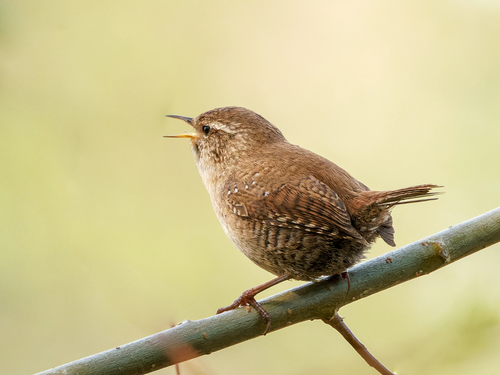 Eurasian Wren
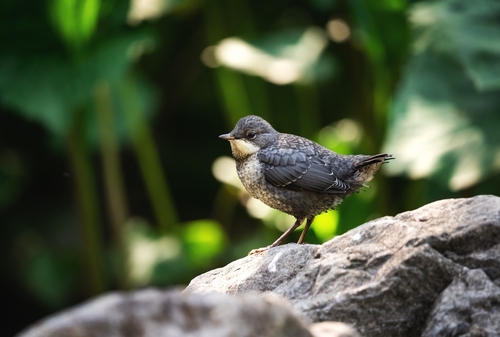 White-throated Dipper
In short
The most reliable field mark to separate Eurasian Wren from White-throated Dipper is overall size and the presence of a bold white throat and chestnut band on the dipper, versus the uniformly brown, finely barred plumage of the wren. Juvenile wrens are less distinctly barred but never show a white throat or chest band. Dippers are nearly twice as long, rotund, and always appear larger and heavier, especially when seen near water. Wrens are tiny, active, and often cock their short tails upright, while dippers perch on rocks by streams, bobbing and sometimes diving. The wren's song is a long, complex trill, much louder than expected for its size, while the dipper gives a sharp, repeated 'zil' call.
Identification tips
- Size is the fastest check: Dippers are nearly twice the length and several times the mass of wrens. If the bird looks small enough to be a mouse, it's a wren; if it seems thrush-sized, it's a dipper.
- White throat and chest band: Adult dippers always show a bold white throat and upper breast, with a chestnut or blackish band below. Wrens never show white or chestnut patches—only brown and grey barring.
- Juvenile confusion: Young wrens are mottled and less barred but never develop a white throat or chest band. Juvenile dippers are greyish brown and paler below, lacking the white throat, but still lack the fine barring of wrens.
- Tail shape and posture: Wrens have a very short tail, often held cocked upright. Dippers have a short tail but rarely cock it so steeply.
- Bill shape: Wrens have a thin, relatively long bill for their size, suited for probing; dippers have a stouter, almost black bill.
- Wing and body shape: Wrens are compact, with rounded wings and a short neck. Dippers are rotund, with a more robust body and proportionally longer wings.
- Behavior on perches: Wrens are restless, jerky, and often hidden in vegetation. Dippers perch openly on rocks in or by water, bobbing their bodies rhythmically.
- Foraging style: Wrens forage in dense cover or on the ground, rarely near water. Dippers are almost always seen near or in running water, diving and swimming.
- Flight style: Both species have fast, whirring flights, but wrens fly low and briefly, while dippers fly longer distances over water.
- Habitat context: If the bird is away from water, especially in gardens or woods, it's almost certainly a wren. If it's on a stream or river, especially on rocks, it's likely a dipper.
- Vocalizations: The wren's song is a long, complex trill, much louder than expected for its size, while the dipper gives a sharp 'zil, zil, zil' call.
- Plumage pitfalls: In poor light, dippers may look all dark, but the white throat usually stands out. Wrens never show any white or chestnut, even in bright light.
- Seasonal confusion: Both species are resident in much of their range, but dippers may move to lowlands in winter if streams freeze. Wrens are present year-round and may be flushed from under banks or logs.
- Sex differences: Not diagnostic in the field for either species with the information provided.
- Jizz: Wrens are mouse-like, quick, and secretive; dippers are bold, bobbing, and aquatic.
Size
Eurasian Wren is extremely small (9–10 cm length, 13–17 cm wingspan, ~10 g) [wikipedia], while White-throated Dipper is much larger (about 18 cm length) and noticeably heavier and bulkier. Even at a distance or in poor light, the size difference is striking: dippers are almost twice as long and several times the mass of a wren. In the field, a wren will look mouse-like and delicate, while a dipper is rotund and robust, closer in bulk to a thrush than a wren.
Plumage
Juvenile and adult Eurasian Wrens are rufous-brown above, greyer below, and finely barred with darker brown and grey throughout, including the wings and tail. Young wrens are less distinctly barred and have mottled underparts, but never show bold color patches. In contrast, adult White-throated Dippers have a distinctive white throat and upper breast, a chestnut or blackish pectoral band, and otherwise dark (slate-grey to brown) body and wings. Juvenile dippers are greyish brown overall, lacking the white throat and chestnut band, but still appear much paler below than wrens and never show the fine barring. In flight, wrens show rounded wings and a very short tail, while dippers have short tails but longer wings proportionally. No distinctive upperwing or flight pattern marks are noted for either species in immature plumages, but the overall color contrast and body shape are always different.
Behaviour
Eurasian Wrens are restless, constantly moving, probing into crevices, hopping on logs, and usually staying close to the ground or low vegetation. Their short flights are rapid, direct, and low, with whirring, rounded wings. Wrens often cock their tails upright and move with quick, jerky motions. White-throated Dippers are almost always found near fast-flowing water, perching on rocks or logs, bobbing their bodies ('dipping'), and frequently diving or swimming underwater using their wings. Dippers walk into water deliberately and can be seen swimming or foraging below the surface. In flight, dippers are direct and fast, with whirring wings, but their flights are longer and more sustained than the wren's.
Habitat
Eurasian Wrens are found in a wide range of habitats, from forests and gardens to old masonry and banks, but are not tied to water. They forage in dense vegetation, under logs, or near the ground. White-throated Dippers are strictly associated with running water—streams, rivers, and lakeshores—where they perch on rocks and forage in and around the water. Seeing a bird foraging or perching on rocks in a stream almost always points to dipper, not wren.
Voice
Eurasian Wren has a loud, complex, and musical song, often including repeated trills, and a sharp 'tic-tic-tic' call that is faster and less isolated than a robin's. When agitated, it gives a harsh churr. The song is remarkably loud for the bird's size and may be heard year-round. White-throated Dipper gives a sharp, repeated 'zil, zil, zil' call, especially in flight, but its song is not described here. The dipper's calls are less musical and more piercing compared to the wren's.