

Eurasian Skylark vs Song Thrush
Alauda arvensis versus Turdus philomelos
Play a quiz with Eurasian Skylark and Song Thrush
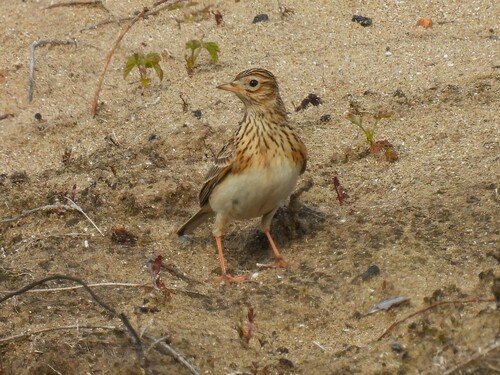 Eurasian Skylark
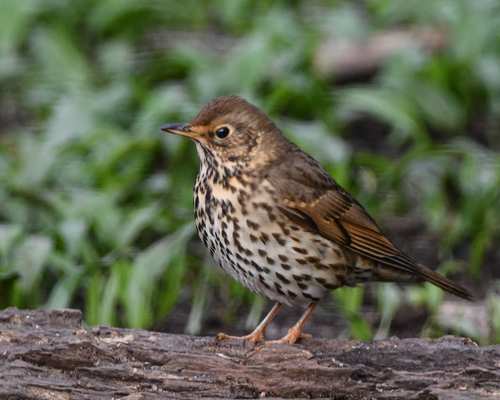 Song Thrush
In short
The most reliable way to separate Eurasian Skylark from Song Thrush in the field is by overall structure and flight style: skylarks are smaller, slimmer, and show a short tail with white edges and broad, rounded wings, while song thrushes are bulkier, longer-tailed, and have plain brown upperparts with bold black spots below. In flight, skylarks reveal white trailing edges on the wings and tail, especially when flying away, whereas song thrushes show warm yellow underwings and lack obvious white in the tail. Juveniles of both species resemble adults, but only the thrush has streaked upperparts as a juvenile. Skylarks are birds of open fields and often display by hovering and singing high above, while song thrushes are more likely to be seen perched in trees or foraging on the ground in wooded or garden habitats. Their songs are also very different: the skylark delivers a continuous, bubbling warble in hovering flight, while the thrush sings repeated musical phrases from a perch.
Identification tips
- Size and bulk: Song Thrush is noticeably larger and heavier than Eurasian Skylark. If the bird appears thrush-sized or larger than a sparrow, it's not a skylark.
- Tail shape and length: Skylark has a short tail with white edges visible in flight (especially when flying away); Song Thrush has a longer, more square-tipped tail with no white edges.
- Flight style: Skylark often hovers high in the air, singing; Song Thrush flies low and direct, never hovers, and sings from a perch.
- Upperwing and tail pattern in flight: Adult and juvenile skylarks show white trailing edges on the wings and tail when flying away; thrushes show warm yellow underwings but no white in the tail.
- Crest: Skylark has a short, blunt crest that can be raised; Song Thrush always has a smooth, rounded head.
- Underparts: Song Thrush has bold black spots on cream or buff underparts; skylark is paler below with fine streaking, never bold spots.
- Upperparts (adults): Skylark is streaked brown above; Song Thrush is plain brown above, sometimes with a colder tone in eastern birds.
- Juvenile plumage: Juvenile Song Thrush has buff/orange streaks on the back and wing coverts; juvenile skylark does not.
- Bill and legs: Song Thrush has a yellowish bill and pink legs; skylark's bill is finer and less colorful, legs less distinctly pink.
- Habitat: Skylark is found in open fields and grassland, rarely near trees; Song Thrush prefers wooded areas, gardens, and parks.
- Song: Skylark sings a long, continuous warble in flight; Song Thrush sings repeated musical phrases from a perch.
- Perching behavior: Song Thrush often perches in trees or shrubs; skylark almost never does, preferring the ground.
- Foraging: Song Thrush may be seen smashing snails on stones; skylark feeds on seeds and insects on open ground.
- Seasonal context: Both species are present year-round in much of Europe, but skylarks are less likely in urban or wooded areas at any season.
- Pitfalls: Beware of distant, flying birds: a skylark flying away may look larger due to its broad wings, but the white tail edges and hovering behavior are diagnostic. Juvenile thrushes can look warmer above, but always show bold spots below and lack the skylark's streaked upperparts.
Size
Song Thrush is distinctly larger and heavier than Eurasian Skylark. Song Thrush measures 20–23.5 cm in length and averages about 72 g in mass, while Eurasian Skylark is smaller at 18–19 cm (no mass given, but always lighter than a thrush). In the field, the thrush appears bulkier, with a more robust body and longer tail, compared to the more delicate, compact, and short-tailed skylark. This size difference is usually obvious when both species are seen in similar contexts.
Plumage
- Juvenile/immature birds: Juvenile Song Thrushes have buff or orange streaks on the back and wing coverts, in addition to the typical spotted underparts, while juvenile Eurasian Skylarks are similar to adults and lack such streaking. This makes juvenile thrushes look warmer and more patterned above than any skylark.
- Adults: Eurasian Skylark is overall brown above and paler below, with a short, blunt crest (sometimes raised), and shows white edges to the tail and rear wing in flight (especially when flying away). Song Thrush adults are plain brown above, with bold black spots on cream or buff underparts, and have a warm yellow underwing visible in flight. The thrush's tail lacks white edges and is longer and more square-tipped. Skylark's upperparts are more streaked and less uniform than the thrush's plain brown back. The thrush's bill is yellowish, and the legs are pink, while the skylark's bill is more delicate and less colorful.
Behaviour
Eurasian Skylark is famous for its display flight: males hover high above open fields, singing continuously for minutes at a time, often appearing as a distant dot in the sky. On the ground, skylarks are usually seen walking or running in open grassland, rarely perching in trees. In contrast, Song Thrushes are most often seen foraging on the ground in gardens, parks, or woodland edges, or perched in trees or shrubs. They do not hover or display in flight, and their flight is typically direct and low, with rapid wingbeats and a more robust, purposeful movement. Thrushes may also be seen smashing snails against stones, a behavior never shown by skylarks.
Habitat
Eurasian Skylark is a specialist of open farmland, grassland, and heath, avoiding wooded areas and rarely entering gardens. It prefers wide, open spaces with little or no tree cover. Song Thrush, on the other hand, is found in a variety of habitats including woodlands, parks, gardens, and hedgerows, often near trees or dense shrubs. It is much more likely to be encountered in suburban or urban settings than a skylark.
Voice
The songs of these two species are strikingly different and are among the best ways to separate them. Eurasian Skylark sings a long, continuous, bubbling warble, delivered in hovering flight high above open fields. The song can last several minutes and is often heard before the bird is seen. Song Thrush sings from a perch, usually in a tree or shrub, with a series of clear, musical phrases, each repeated two to four times before switching to a new phrase. The thrush's song is loud, carries far, and is interspersed with grating notes and mimicry. Calls also differ: the thrush gives a sharp 'tsip' or 'chook-chook', while the skylark's calls are less distinctive and rarely heard except in flight.