

Eurasian Skylark vs Common Starling
Alauda arvensis versus Sturnus vulgaris
Play a quiz with Eurasian Skylark and Common Starling
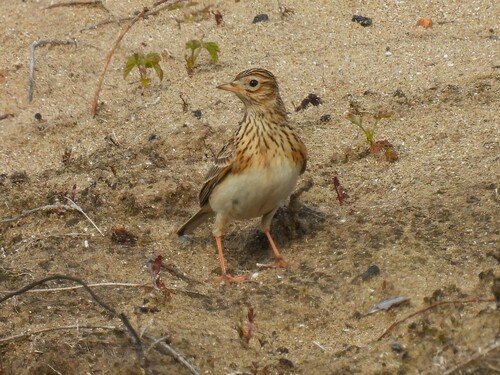 Eurasian Skylark
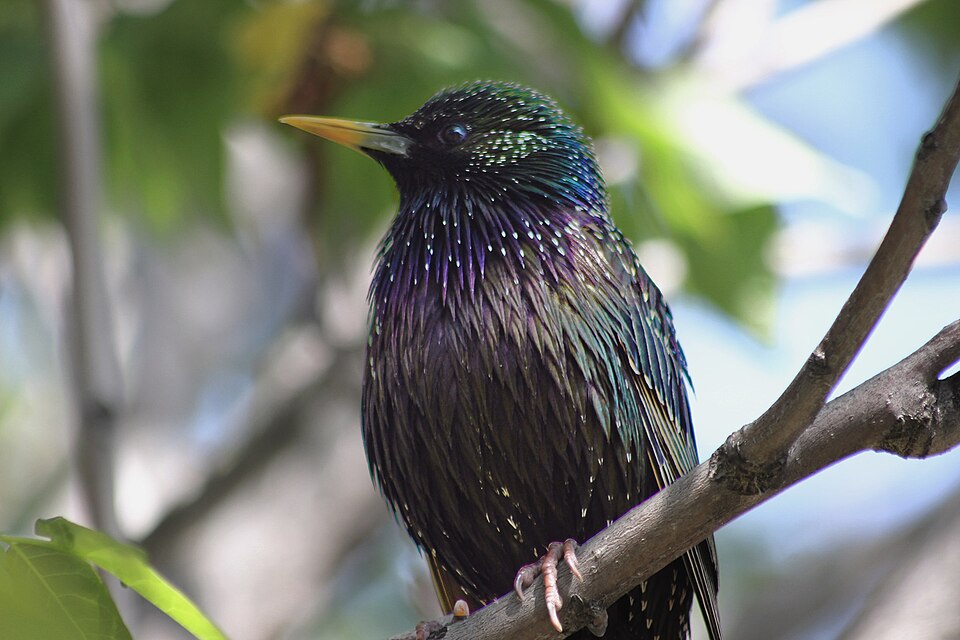 Common Starling
In short
The most reliable field mark to separate Eurasian Skylark from Common Starling is overall plumage: skylarks are streaky brown and pale, while starlings are glossy black with a metallic sheen and (in winter) white spots. In flight, Eurasian Skylark shows white edges on the tail and rear wing, visible from behind, while Common Starling has pointed wings and a short, squared tail with no white. Juvenile starlings are plain brownish-grey, but still lack the streaked look and crest of skylarks. Structure and behavior also help: skylarks have a short, blunt crest and often hover while singing, whereas starlings are heavier-bodied, walk with a waddling gait, and never hover. Both are common in open country, but starlings are more likely to be seen in flocks and around human habitation.
Identification tips
- Plumage contrast: Eurasian Skylark is always streaky brown above and pale below, with no iridescence or strong spotting; Common Starling is glossy black with a metallic sheen and (in winter) white spots.
- Crest: Skylark has a short, blunt crest on the head, which it can raise or lower; starlings never show a crest.
- Tail and wing pattern in flight: Skylark shows white edges on the tail and rear wing, visible when flying away; starling's tail is short, squared, and uniformly dark, with no pale edges.
- Wing shape: Starling has sharply pointed wings in flight, giving a triangular look; skylark's wings are shorter and broader, especially in males.
- Juvenile confusion: Young starlings are plain brownish-grey, lacking streaks and crest; young skylarks are already streaky and crested.
- Bill: Starling's bill is long, narrow, and sharp-tipped, turning yellow in summer; skylark's bill is shorter, stubbier, and always horn-colored.
- Leg color: Starlings have strong, pinkish or reddish legs, especially in breeding season; skylark's legs are less robust and not as brightly colored.
- Size and shape: Starlings are bulkier, round-bellied, and heavier; skylarks are slimmer and more delicate.
- Behavior on ground: Starlings walk with a waddling gait, often in flocks; skylarks walk or run more secretively, usually alone or in pairs.
- Flight style: Skylark often hovers and sings high in the air; starling flies with rapid, direct wingbeats and short glides, never hovers or sings in flight.
- Song: Skylark's song is a long, bubbling warble given in flight; starling's song is varied, harsh, and full of mimicry, delivered from a perch.
- Flock size: Starlings often form large, noisy flocks, especially in winter; skylarks are more solitary or in small groups.
- Habitat: Skylarks are more likely in open farmland and heath; starlings are common in towns, parks, and gardens as well as fields.
- Sex and age subtleties: Male starlings have longer throat feathers and less spotting, but this is not usually visible at a distance; male skylarks have broader wings, but this is subtle.
- Pitfalls: In poor light, starlings may appear dull, but still lack the streaks and crest of skylarks. Juvenile starlings can be confused with skylarks at a glance, but look for the plainness and lack of streaking or crest.
Size
Common Starling is slightly larger and heavier than Eurasian Skylark. Starlings measure 19–23 cm in length and weigh 58–101 g, with a wingspan of 31–44 cm. Eurasian Skylark is 18–19 cm long (so slightly shorter) and is generally slimmer and lighter. In the field, starlings appear chunkier, with a round-bellied shape and strong, thick legs, whereas skylarks are more slender and delicate. However, size alone is not always reliable due to overlap and viewing conditions.
Plumage
- Juvenile/First-winter: Juvenile starlings are plain grey-brown, lacking the streaked appearance of skylarks. Young skylarks are already streaky brown above and pale below, with a hint of a crest.
- Adult (non-breeding): Eurasian Skylark is brown above, heavily streaked, with a pale belly and a short, blunt crest. In flight, look for white edges on the tail and rear wing (visible from behind). Common Starling is glossy black with a metallic purple or green sheen, spangled with white spots in winter. The starling's wings are pointed and dark, with no pale edges, and the tail is short and squared.
- Adult (breeding): Skylark remains streaky brown and pale, while starlings lose much of their white spotting as feather tips wear off, becoming more uniformly glossy black. The starling's bill turns yellow in breeding season (blue-grey base in males, pink base in females), while skylark's bill remains short and horn-colored.
- Sex differences: Male skylarks have broader wings for hovering, but this is subtle. In starlings, males have longer, looser throat feathers and less spotting on the underparts than females, but these are not usually diagnostic at a distance.
Behaviour
Eurasian Skylark is famous for its hovering, singing flight, often high above open fields, sometimes appearing as a distant dot. On the ground, skylarks are more secretive, often walking or running through grass, and may raise their short crest. Common Starlings rarely hover and do not sing in flight; instead, they walk or run with a waddling gait, often in flocks, and are conspicuous when feeding on lawns or fields. In flight, starlings have rapid, direct wingbeats with short glides, and their flocks wheel and turn in tight, coordinated masses. Skylarks are more solitary or in small groups outside migration/winter.
Habitat
Both species can be found in open country, but Eurasian Skylark prefers open farmland, heath, and grassland, usually away from dense human habitation. Common Starlings are highly adaptable and often found in urban areas, parks, gardens, and agricultural land, frequently in large flocks. If you see a large, noisy flock in a town or city, it's almost certainly starlings; a single bird singing high above a field is likely a skylark.
Voice
Eurasian Skylark delivers a long, continuous, bubbling warble in a hovering, rising, or circling flight, often lasting several minutes and sometimes up to 20 minutes. The song is complex and musical, usually given from high in the air. Common Starling has a varied, often harsh and squeaky song, full of whistles, clicks, and mimicry, delivered from a perch rather than in flight. Starlings are also noisy in flocks, producing chattering and whistling calls, but never the long, unbroken aerial song of the skylark.