

Motmot

Eurasian Nightjar vs Violet-backed Starling

Caprimulgus europaeus versus Cinnyricinclus leucogaster

Play a quiz with Eurasian Nightjar and Violet-backed Starling
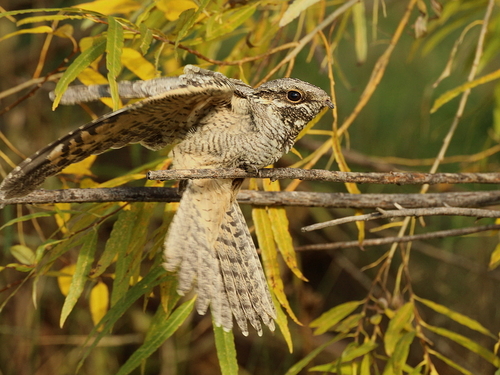
Eurasian Nightjar (Caprimulgus europaeus) Eurasian Nightjar
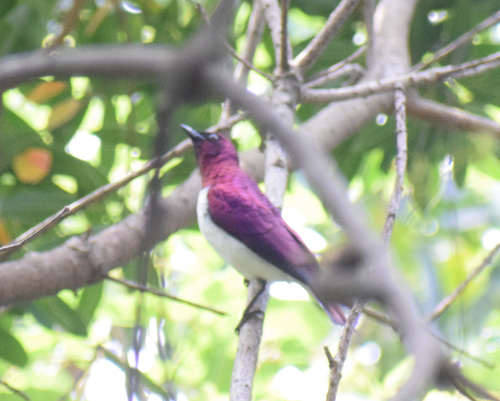
Violet-backed Starling (Cinnyricinclus leucogaster) Violet-backed Starling

Media

Loading…

In short

The most reliable field mark for separating Eurasian Nightjar from Violet-backed Starling is the nightjar's distinctive white wing patches (in adult males) and white tail corners seen in flight, which are absent in all starlings. Juvenile and female nightjars lack these white patches but still show cryptic, streaked, and barred plumage, while Violet-backed Starling males are unmistakably iridescent violet above and white below, and females are boldly streaked brown and white with a thrush-like look. Nightjars are much larger, long-winged, and have a unique buoyant, silent flight, while starlings are smaller, compact, and more direct in flight. Habitat and behavior also differ: nightjars are crepuscular/nocturnal ground-dwellers, starlings are active, noisy canopy birds.

Identification tips

  1. White wing patches in flight (nightjar adult male only): If you see a bird with a white patch across the primaries and white tail corners in flight at dusk/dawn, it is a male Eurasian Nightjar. Females and juveniles lack these marks, but no starling ever shows them.
  2. Iridescent violet and white (starling male only): Any bird with a gleaming violet back and pure white underparts is a male Violet-backed Starling. No nightjar is iridescent or has such clean white below.
  3. Streaked brown and white, thrush-like (starling female): Female Violet-backed Starlings are brown above, heavily streaked, and white below with bold streaks, resembling a small thrush. Nightjars are more cryptic, with finer streaking and barring, never bold white below.
  4. Cryptic, streaked and barred (nightjar): All nightjars (male, female, juvenile) are cryptically patterned with grey-brown, buff, and dark streaks and bars, blending into the ground or tree bark. Starlings are never this cryptic.
  5. Eye color: Nightjars have dark brown eyes; Violet-backed Starlings have yellow eyes. This is visible at close range.
  6. Bill shape: Nightjars have a tiny, wide-based bill adapted for catching insects in flight; starlings have a typical songbird bill, straight and pointed.
  7. Flight style: Nightjars fly with buoyant, silent, moth-like glides and flutters, often at dusk/dawn. Starlings fly directly and rapidly, often in flocks, and are active by day.
  8. Tail shape: Nightjars have long, rounded tails (with white corners in adult males); starlings have shorter, squarer tails.
  9. Size and jizz: Nightjars are much larger and longer-winged than Violet-backed Starlings. A nightjar at close range will dwarf a starling.
  10. Habitat and behavior: Nightjars are seen at dusk/dawn, on the ground or low branches, rarely in trees by day. Starlings are active in the canopy during the day, rarely on the ground.
  11. Song: Nightjar males produce a long, mechanical churring at dusk/dawn, sometimes with wing-clapping. Starlings are more likely to give musical, varied calls (not described in detail here).
  12. Nocturnal vs diurnal: Nightjars are strictly crepuscular/nocturnal; starlings are diurnal.
  13. Perched posture: Nightjars perch lengthwise along branches or on the ground, blending in; starlings perch upright on branches, often in groups.
  14. Geographic range: Nightjars breed in Europe and Asia; Violet-backed Starlings are sub-Saharan African. Overlap is extremely rare.
  15. Common pitfalls: Female/juvenile nightjars can be mistaken for streaky songbirds in poor light, but their cryptic pattern, large size, and nocturnal habits are distinctive. Male starlings are unmistakable if seen well; females could be confused with thrushes, but not with nightjars if size and behavior are noted.

Size

Eurasian Nightjar is significantly larger: 24.5–28 cm in length with a 52–59 cm wingspan (males 51–101 g, females 67–95 g) [wikipedia]. Violet-backed Starling is much smaller, about 17–18 cm in length [wikipedia], with a compact starling build. Nightjars appear long-winged and long-tailed both perched and in flight, while starlings are short-tailed and compact. The nightjar's size and proportions are especially obvious in flight, with long, pointed wings compared to the starling's shorter, more triangular wings.

Plumage

Juvenile and female Eurasian Nightjars are cryptically patterned: grey-brown upperparts with dark streaking, buff hindneck collar, and barred/buff-spotted underparts. Adult males show diagnostic white patches on three primaries and white tips to the outer tail feathers, visible in flight only. Females and juveniles lack these white areas but retain the overall cryptic, streaked look. In contrast, Violet-backed Starling is strongly sexually dimorphic: males are iridescent violet above with pure white underparts, never streaked or barred; females are brown above with bold streaks and white, heavily streaked underparts, resembling a small thrush. Both sexes of starling have yellow eyes, while nightjars have dark brown eyes. Nightjars' plumage is always camouflaged and never iridescent or boldly white below. In flight, nightjars' soft, patterned wings contrast with the starling's uniform, glossy wings.

Behaviour

Eurasian Nightjars are crepuscular or nocturnal, often seen at dusk or dawn, and spend the day motionless on the ground or low branches, relying on camouflage. Their flight is buoyant, silent, and moth-like, with glides and flutters. Violet-backed Starlings are active by day, foraging in the canopy, sometimes sallying for insects like flycatchers, and rarely on the ground. Starlings are social, often noisy, and move with direct, purposeful flight. Nightjars are solitary or in pairs, rarely vocal except at night, and almost never seen in the open during the day.

Habitat

Nightjars breed across open woodlands, heath, and forest edges in Europe and Asia, usually in habitats with bare ground or sparse vegetation for ground-nesting. They are strictly crepuscular/nocturnal and rarely seen in the open during the day. Violet-backed Starlings are found in sub-Saharan Africa, in woodlands and savannah forest edges, almost always in or near trees, and are active during the day. The two species do not overlap in range except as rare vagrants, and their preferred habitats are distinct: nightjars on the ground in open areas, starlings in the canopy.

Voice

Eurasian Nightjar males produce a long, mechanical churring trill at dusk and dawn, sometimes ending with a bubbling trill and wing-clapping. Both sexes give short 'cuick' calls in flight and various sharp or hissing alarm calls. Violet-backed Starling's vocalizations are not described in the provided notes, but as a starling, it is likely to be more varied and musical than the nightjar's insect-like churring. Nightjar song is ventriloquial and easily confused with insect sounds, while starling calls are more typical of songbirds.

Submit a better description

Use the same sections as the comparison. Your text is published immediately.

The most reliable field mark for separating Eurasian Nightjar from Violet-backed Starling is the nightjar's distinctive white wing patches (in adult males) and white tail corners seen in flight, which are absent in all starlings. Juvenile and female nightjars lack these white patches but still show cryptic, streaked, and barred plumage, while Violet-backed Starling males are unmistakably iridescent violet above and white below, and females are boldly streaked brown and white with a thrush-like look. Nightjars are much larger, long-winged, and have a unique buoyant, silent flight, while starlings are smaller, compact, and more direct in flight. Habitat and behavior also differ: nightjars are crepuscular/nocturnal ground-dwellers, starlings are active, noisy canopy birds.

  1. White wing patches in flight (nightjar adult male only): If you see a bird with a white patch across the primaries and white tail corners in flight at dusk/dawn, it is a male Eurasian Nightjar. Females and juveniles lack these marks, but no starling ever shows them.
  2. Iridescent violet and white (starling male only): Any bird with a gleaming violet back and pure white underparts is a male Violet-backed Starling. No nightjar is iridescent or has such clean white below.
  3. Streaked brown and white, thrush-like (starling female): Female Violet-backed Starlings are brown above, heavily streaked, and white below with bold streaks, resembling a small thrush. Nightjars are more cryptic, with finer streaking and barring, never bold white below.
  4. Cryptic, streaked and barred (nightjar): All nightjars (male, female, juvenile) are cryptically patterned with grey-brown, buff, and dark streaks and bars, blending into the ground or tree bark. Starlings are never this cryptic.
  5. Eye color: Nightjars have dark brown eyes; Violet-backed Starlings have yellow eyes. This is visible at close range.
  6. Bill shape: Nightjars have a tiny, wide-based bill adapted for catching insects in flight; starlings have a typical songbird bill, straight and pointed.
  7. Flight style: Nightjars fly with buoyant, silent, moth-like glides and flutters, often at dusk/dawn. Starlings fly directly and rapidly, often in flocks, and are active by day.
  8. Tail shape: Nightjars have long, rounded tails (with white corners in adult males); starlings have shorter, squarer tails.
  9. Size and jizz: Nightjars are much larger and longer-winged than Violet-backed Starlings. A nightjar at close range will dwarf a starling.
  10. Habitat and behavior: Nightjars are seen at dusk/dawn, on the ground or low branches, rarely in trees by day. Starlings are active in the canopy during the day, rarely on the ground.
  11. Song: Nightjar males produce a long, mechanical churring at dusk/dawn, sometimes with wing-clapping. Starlings are more likely to give musical, varied calls (not described in detail here).
  12. Nocturnal vs diurnal: Nightjars are strictly crepuscular/nocturnal; starlings are diurnal.
  13. Perched posture: Nightjars perch lengthwise along branches or on the ground, blending in; starlings perch upright on branches, often in groups.
  14. Geographic range: Nightjars breed in Europe and Asia; Violet-backed Starlings are sub-Saharan African. Overlap is extremely rare.
  15. Common pitfalls: Female/juvenile nightjars can be mistaken for streaky songbirds in poor light, but their cryptic pattern, large size, and nocturnal habits are distinctive. Male starlings are unmistakable if seen well; females could be confused with thrushes, but not with nightjars if size and behavior are noted.

Eurasian Nightjar is significantly larger: 24.5–28 cm in length with a 52–59 cm wingspan (males 51–101 g, females 67–95 g) [wikipedia]. Violet-backed Starling is much smaller, about 17–18 cm in length [wikipedia], with a compact starling build. Nightjars appear long-winged and long-tailed both perched and in flight, while starlings are short-tailed and compact. The nightjar's size and proportions are especially obvious in flight, with long, pointed wings compared to the starling's shorter, more triangular wings.

Juvenile and female Eurasian Nightjars are cryptically patterned: grey-brown upperparts with dark streaking, buff hindneck collar, and barred/buff-spotted underparts. Adult males show diagnostic white patches on three primaries and white tips to the outer tail feathers, visible in flight only. Females and juveniles lack these white areas but retain the overall cryptic, streaked look. In contrast, Violet-backed Starling is strongly sexually dimorphic: males are iridescent violet above with pure white underparts, never streaked or barred; females are brown above with bold streaks and white, heavily streaked underparts, resembling a small thrush. Both sexes of starling have yellow eyes, while nightjars have dark brown eyes. Nightjars' plumage is always camouflaged and never iridescent or boldly white below. In flight, nightjars' soft, patterned wings contrast with the starling's uniform, glossy wings.

Eurasian Nightjars are crepuscular or nocturnal, often seen at dusk or dawn, and spend the day motionless on the ground or low branches, relying on camouflage. Their flight is buoyant, silent, and moth-like, with glides and flutters. Violet-backed Starlings are active by day, foraging in the canopy, sometimes sallying for insects like flycatchers, and rarely on the ground. Starlings are social, often noisy, and move with direct, purposeful flight. Nightjars are solitary or in pairs, rarely vocal except at night, and almost never seen in the open during the day.

Nightjars breed across open woodlands, heath, and forest edges in Europe and Asia, usually in habitats with bare ground or sparse vegetation for ground-nesting. They are strictly crepuscular/nocturnal and rarely seen in the open during the day. Violet-backed Starlings are found in sub-Saharan Africa, in woodlands and savannah forest edges, almost always in or near trees, and are active during the day. The two species do not overlap in range except as rare vagrants, and their preferred habitats are distinct: nightjars on the ground in open areas, starlings in the canopy.

Eurasian Nightjar males produce a long, mechanical churring trill at dusk and dawn, sometimes ending with a bubbling trill and wing-clapping. Both sexes give short 'cuick' calls in flight and various sharp or hissing alarm calls. Violet-backed Starling's vocalizations are not described in the provided notes, but as a starling, it is likely to be more varied and musical than the nightjar's insect-like churring. Nightjar song is ventriloquial and easily confused with insect sounds, while starling calls are more typical of songbirds.

Discard your changes?

You have unsaved edits. If you leave now, those changes will be lost.

Eurasian Nightjar · Violet-backed Starling · My Tricky Birds