
Eurasian Nightjar vs Common Swift
Caprimulgus europaeus versus Apus apus
Play a quiz with Eurasian Nightjar and Common Swift
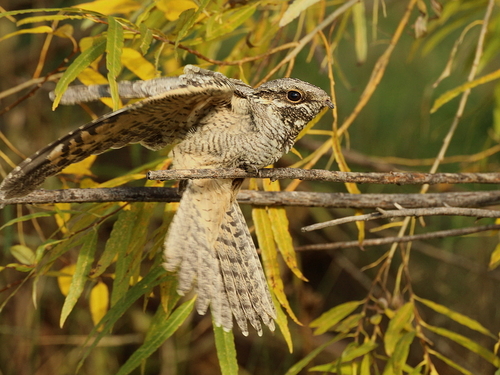 Eurasian Nightjar
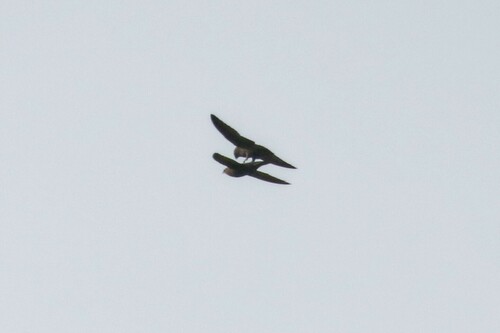 Common Swift
In short
The most reliable field mark is the presence of white patches on the wings and tail of adult male Eurasian Nightjars in flight, which are completely absent in Common Swifts of any age or sex. Juvenile and female nightjars lack these white marks but still show a cryptic, streaked brown plumage and a broad, rounded wing shape, while swifts are uniformly dark, with long, crescent-shaped wings and a small pale throat patch. Nightjars perch horizontally on the ground or branches, often motionless, while swifts are almost never seen perched except briefly at nest sites. In flight, nightjars are buoyant and moth-like, swifts are fast, direct, and scythe-winged. Voice is also a strong separator: nightjars churr or give soft 'cuick' calls, while swifts scream loudly in flight.
Identification tips
- White wing/tail patches (adult male nightjar): If you see bold white patches on the wings and tail in flight, it's a male Eurasian Nightjar. No swift ever shows this.
- Overall color and pattern: Nightjars (all ages/sexes) are cryptic, streaked, and mottled brown/grey with a pale collar and moustachial line. Swifts are uniform blackish-brown with only a small pale throat patch.
- Wing shape in flight: Nightjar wings are broad at the base, pointed at the tip, and look paddle-shaped or moth-like. Swift wings are long, narrow, and deeply swept back, forming a crescent or boomerang.
- Tail shape: Nightjar tail is long and rounded (with white corners in adult males); swift tail is short and shallowly forked.
- Flight style: Nightjars fly with buoyant, fluttery, moth-like flight, often low over open ground at dusk/dawn. Swifts are extremely fast, direct, and agile, usually high overhead.
- Perching behavior: Nightjars perch horizontally on the ground or branches, blending in perfectly. Swifts are almost never seen perched except at nest sites.
- Bill and head: Nightjars have a very short, wide bill and a large, flat head; swifts have a tiny, barely visible bill and a streamlined head.
- Voice: Nightjar males churr for long periods at dusk/dawn; both sexes give soft 'cuick' calls. Swifts scream loudly in flight, often in groups. If you hear a scream overhead, it's a swift.
- Time of activity: Nightjars are active at dusk, dawn, or night; swifts are active during the day.
- Habitat context: Nightjars are found in open woodland, heath, or clearings; swifts are common over towns, cities, and open country.
- Size impression: Nightjars are larger, bulkier, and longer-winged than swifts, which are compact and slender.
- Sex/age pitfalls: Female and juvenile nightjars lack white wing/tail patches, so rely on structure, flight style, and plumage pattern. Swifts never show any white except for the tiny throat patch.
- Confusion risk: At dusk, a distant nightjar in flight could be mistaken for a swift, but the broader wings, slower, buoyant flight, and lack of screaming calls point to nightjar.
- When perched: If you see a bird at rest on a branch or ground, it's a nightjar; swifts do not perch in the open.
- Group behavior: Swifts often fly in noisy groups; nightjars are usually solitary or in pairs, and silent when flying except for soft calls.
Size
Eurasian Nightjar is larger and bulkier: 24.5–28 cm long with a wingspan of 52–59 cm, and males weigh 51–101 g, females 67–95 g [wikipedia][avonet]. Common Swift is smaller and much lighter: 16–17 cm long, wingspan 38–40 cm, and is extremely lightweight for its size (not specified here, but much lighter than nightjar). Nightjars appear broad-winged and long-tailed compared to the compact, streamlined, and slender swift.
Plumage
- Juvenile/immature birds: Nightjar fledglings resemble adult females: cryptic grey-brown with streaks and bars, no white wing or tail marks. Swifts of all ages are uniformly blackish-brown with only a small pale throat patch, not visible at a distance.
- Adult males (nightjar): Show bold white patches on three primaries and white tips to outer tail feathers in flight, absent in females and all swifts.
- Adult females (nightjar): No white wing or tail patches, but still show overall streaky, mottled brown plumage with a pale buff hindneck collar and white moustachial line. Swifts never show such patterning, always appearing dark and uniform except for the throat.
- Wing shape: Nightjar wings are broad and rounded at the base, pointed at the tip; swift wings are long, narrow, and deeply swept back, forming a crescent or boomerang.
- Tail: Nightjar tail is fairly long and rounded (with white tips in adult males), swift tail is short and shallowly forked.
Behaviour
Nightjars are crepuscular/nocturnal, often seen at dusk or dawn, flying low and buoyantly over open ground or perching lengthwise on branches or the ground, where they are very hard to spot due to their camouflage. Swifts are almost always seen in fast, agile, high aerial flight, rarely perching except at nest sites (usually in buildings or cliffs). Swifts spend nearly all their non-breeding time on the wing, even sleeping in flight. Nightjars are silent and still when perched, swifts are noisy and active in groups overhead.
Habitat
Nightjars breed in open woodlands, heath, and clearings across Europe and Asia, usually in areas with bare ground or sparse vegetation. Swifts breed in urban areas, towns, and cliffs, nesting in crevices or buildings, and are most often seen over open country, lakes, or cities, rarely near dense woodland. Nightjars are more likely found in rural, semi-natural habitats at dusk; swifts are common over towns and cities during the day.
Voice
Nightjar males sing a long, mechanical churring trill at dusk or dawn, sometimes with bubbling trills or wing-clapping. Both sexes give soft 'cuick' calls in flight, and various hisses or chucks when alarmed. Swifts never churr; instead, they give loud, piercing screams in flight, often in groups, with two pitch levels (higher in females). Nightjar calls are soft and subtle; swift calls are loud and unmistakable.