

Eurasian Goshawk vs Black Kite
Astur gentilis versus Milvus migrans
Play a quiz with Eurasian Goshawk and Black Kite
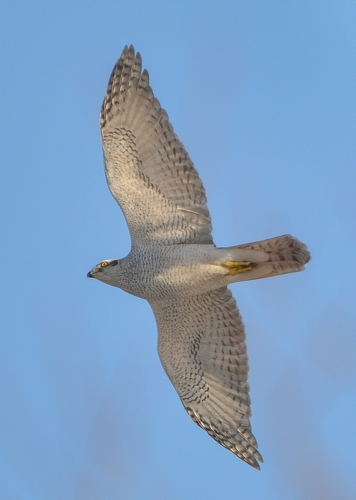 Eurasian Goshawk
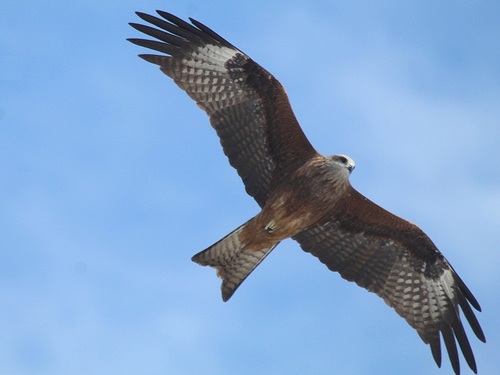 Black Kite
In short
The most reliable field mark to separate Eurasian Goshawk from Black Kite is the tail shape in flight: Goshawk shows a long, straight-edged or slightly rounded tail with bold dark barring, while Black Kite has a distinctly shallowly forked tail. Juvenile Goshawks can be confused with other raptors but not with Black Kite, which is overall darker and never shows the pale supercilium of Goshawk. In flight, Goshawk has broader, shorter wings and a more powerful, deep wingbeat, whereas Black Kite is more buoyant and glides on long, slightly angled wings. Goshawk is a woodland hunter, often seen dashing through trees or soaring with deliberate wingbeats, while Black Kite is most often seen soaring or circling in open country, especially near water or human habitation.
Identification tips
- Tail shape in flight: Goshawk has a long, straight-edged or slightly rounded tail with bold dark barring (all ages); Black Kite has a shallowly forked tail, never square or rounded, and lacks bold tail barring.
- Supercilium (eyebrow): Goshawk (all ages, especially adults) shows a prominent white supercilium; Black Kite never shows this feature.
- Wing shape: Goshawk has relatively short, broad wings with a rounded tip; Black Kite has long, slightly angled wings with a more pointed appearance in flight.
- Flight style: Goshawk uses deep, powerful wingbeats interspersed with short glides; Black Kite is buoyant, gliding and soaring for long periods with less flapping.
- Plumage (juveniles): Juvenile Goshawk is brown above, heavily streaked or barred below, with a barred tail and pale yellow eyes; juvenile Black Kite is dark brown overall, with paler head, streaked underparts, and a shallow forked tail.
- Plumage (adults): Adult Goshawk is blue-grey or brownish-grey above, finely barred below, with a white supercilium and orange/yellow eyes; adult Black Kite is dark brown with paler head and neck, dark patch behind the eye, and yellow legs.
- Bill and cere: Black Kite has a yellow cere and gape with a black bill; Goshawk's bill is relatively large and powerful, but cere color is less distinctive in the field.
- Leg color: Black Kite has yellow legs and black claws; Goshawk's legs are robust and thick, but color is not a primary field mark.
- Size and structure: Goshawk is bulkier and more powerful, with a shorter tail relative to body and thicker toes; Black Kite is more slender and elegant, with a longer, forked tail.
- Habitat: Goshawk is almost always in or near woodland; Black Kite is common in open country, urban areas, and near water.
- Behavior: Goshawk hunts by dashing through trees or along woodland edges; Black Kite is often seen soaring, circling, or scavenging in open areas.
- Vocalization: Black Kite gives a shrill, whistling call; Goshawk's calls are harsher and less likely to be heard away from the nest.
- Eye color: Goshawk's eye color changes with age (pale yellow in juveniles, orange/yellow in adults); Black Kite's eye color is not distinctive in the field.
- Moult: Goshawk's moult timing can lead to gaps in wing feathers, especially in females during incubation, but this is rarely a useful field mark.
- Common pitfalls: Female Sparrowhawk can be confused with male Goshawk due to size, but Black Kite is rarely confused with either except at great distance or in poor light. Always check tail shape, supercilium, and flight style for confirmation.
Size
Eurasian Goshawk is slightly heavier on average (926 g vs. 828 g), but the difference is subtle and hard to judge in the field. Structurally, Goshawk is bulkier and more robust, with a shorter tail relative to its body and broader wings, while Black Kite appears more slender, with longer wings and a longer, shallowly forked tail. Both are medium-large raptors, but Goshawk gives a more powerful, compact impression, especially when perched.
Plumage
Juvenile Goshawks are brown above with variable, often bold dark streaking or barring below, and always show a barred tail (3–5 dark bars) and a prominent white supercilium (eyebrow). Adults are blue-grey or brownish-grey above, with fine dark barring below and a clean white supercilium. Eye color changes from pale yellow in juveniles to orange or yellow in adults. Black Kite, in all plumages, is overall dark brown with paler head and neck, dark patch behind the eye, and a shallowly forked tail. The upperparts are brown, flight feathers are blackish with dark crossbars, and the lower parts are pale brown with dark shaft streaks. Black Kite never shows a white supercilium or bold tail barring. Juvenile Black Kites are similar to adults but may be slightly paler and streakier, especially on the head. In flight, Goshawk's underwing is paler with bold barring, while Black Kite's underwing is more uniformly dark with less contrast.
Behaviour
Goshawk hunts by stealth, often flying low and fast through woodland, with deep, powerful wingbeats and short glides. It may soar but is less buoyant than Black Kite. Black Kite is highly aerial, often seen circling or gliding on thermals, sometimes in groups, and is more likely to be seen in open country, near water, or urban areas. Its flight is more buoyant and less direct, with frequent soaring and less flapping. Goshawk rarely soars for long periods except on migration, while Black Kite is almost always seen soaring or gliding.
Habitat
Eurasian Goshawk is a woodland specialist, usually found in forests or at their edges, and rarely ventures far into open country. Black Kite prefers open habitats, including farmland, wetlands, and urban areas, and is especially common near water or human settlements. Seeing a raptor soaring over a city, dump, or river is much more likely to be a Black Kite than a Goshawk.
Voice
Black Kite gives a distinctive shrill whistle followed by a rapid whinnying call, often heard when circling or near the nest. Goshawk's calls are less likely to be heard except near the nest and are not described in the notes; they are generally harsher and less musical than the kite's.