

Eurasian Golden Oriole vs African Golden Oriole
Oriolus oriolus versus Oriolus auratus
Play a quiz with Eurasian Golden Oriole and African Golden Oriole
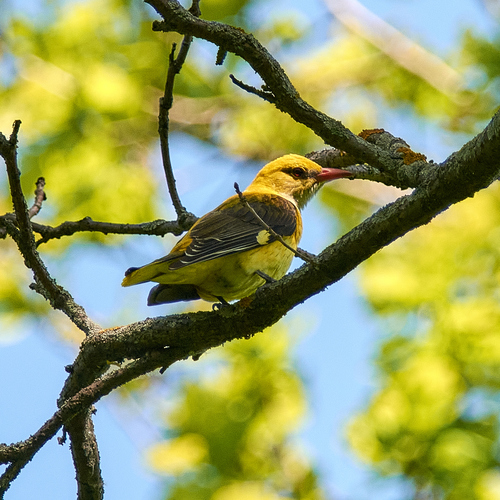 Eurasian Golden Oriole
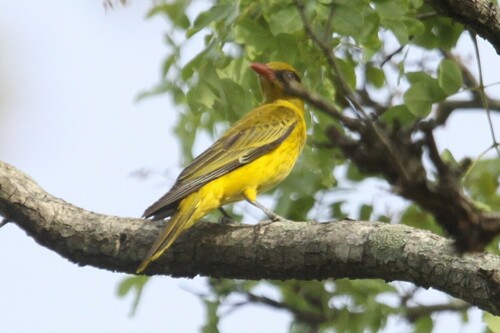 African Golden Oriole
In short
The most reliable field mark between Eurasian Golden Oriole and African Golden Oriole is the amount and placement of black and gold in the wings, especially on adult males: Eurasian males show more extensive black in the wings, while African males have more gold and confine black to the flight feathers and tail center. Females of both are greenish, but African females have more contrasting wings and a distinctive black around the eye. Both species can be surprisingly hard to spot in leafy canopies, and their strong, direct flight is similar. Vocalizations differ subtly, but plumage—especially in the wings and around the eye—is your best bet for separation.
Identification tips
- Male wing pattern: Adult Eurasian Golden Oriole males have more extensive black in the wings, making the yellow body and black wings strongly contrasting. African Golden Oriole males have more gold in the wings, with black limited to the flight feathers and tail center—look for a yellower, less contrasting wing.
- Female face pattern: Female African Golden Orioles show a distinct black area around the eye, while Eurasian females lack this feature. This is a crucial mark when viewing females or immatures.
- Female wing contrast: African females have more contrasting wings than Eurasian females, which can appear more uniformly greenish.
- Overall yellowness: African Golden Oriole males look overall yellower due to the gold in the wings, while Eurasian males have a sharper black-and-yellow contrast.
- Flight style: Both species fly with strong, direct, slightly dipping flight, so this is not a separator.
- Habitat and range: In Europe and the Palearctic during summer, only Eurasian Golden Oriole breeds; in sub-Saharan Africa outside migration, expect African Golden Oriole. Overlap occurs only in Africa during Eurasian migration/winter.
- Voice: Listen for subtle differences in song; Eurasian's 'weela-wee-ooo' vs African's 'fee-ooo fee-ooo'. Calls are harsher and more jay-like in African Golden Oriole.
- Canopy behavior: Both species are shy and hard to spot in foliage; do not rely on behavior for separation.
- Juvenile/immature plumage: No strong age-specific wing pattern differences are described, so focus on adult and female marks.
- Bill and structure: No reliable differences noted in bill color or shape between these two species.
- Size: Both are similar in size and shape; do not use size as a separator.
- Seasonal context: In Africa during the Eurasian oriole's wintering period, check for subtle plumage marks, as both species may be present.
- Plumage pitfalls: Beware of the greenish females and immatures of both species; use the eye mark and wing contrast for best separation.
- Mixed flocks: Unlikely, but if you see multiple orioles together in Africa, check each bird carefully for the above marks, especially in winter.
- Lighting and distance: Both species can appear more or less contrasting depending on light; always try for a clear view of the wings and head pattern.
Size
Direct size comparison is limited by available data. The African Golden Oriole averages about 73.7g in body mass [wikidata], but no comparable mass is given for Eurasian Golden Oriole. Both are medium-sized orioles, and Eurasian Golden Oriole is about 24cm in length with a 44–45cm wingspan [wikipedia]. In the field, they are very similar in size and overall shape, so size is not a reliable separator.
Plumage
- Adult males: Eurasian Golden Oriole males have bold black wings with less yellow, while African Golden Oriole males have wings with much more gold and restrict black to the flight feathers and tail center. This makes African males appear overall yellower and less contrasting in the wing than Eurasian males.
- Adult females: Both are drabber green, but African females show more contrasting wings and a clear black area around the eye, which Eurasian females lack. This eye mark is a key distinction.
- Immatures/Juveniles: No detailed age-specific wing pattern differences are described in the sources, so focus remains on adult plumage and female/immature head pattern.
- In all ages: Both species are shy and blend well in dappled foliage, but the African species tends to show more gold in the wing and more facial contrast in females.
Behaviour
Both species are canopy dwellers, often remaining hidden in leafy cover and moving with strong, direct, thrush-like flight that includes shallow dips over longer distances. They are both shy and difficult to observe well, even when calling. Feeding behavior is similar, with both picking insects and fruit from trees. No behavioral differences are highlighted in the sources that would aid field separation.
Habitat
Eurasian Golden Oriole breeds in temperate regions of Europe and the Palearctic, migrating to central and southern Africa for the winter [wikipedia]. African Golden Oriole is a resident breeder south of the Sahara, favoring thick bush and well-wooded areas. In Africa, Eurasian Golden Oriole is only present as a migrant, while African Golden Oriole is present year-round. Thus, outside the Eurasian species' breeding range, context and season can help: a golden oriole in Europe in summer is almost certainly Eurasian, while one in sub-Saharan Africa outside the migration period is likely African.
Voice
Both species have fluting, melodious songs that are distinctive but subtly different: Eurasian Golden Oriole sings a fluting 'weela-wee-ooo' or 'or-iii-ole', often with phrase variation, while African Golden Oriole gives a fluting 'fee-ooo fee-ooo'. Calls differ as well: Eurasian's is a harsh 'kweeaahk', while African's is a jay-like screech. These differences are best appreciated with experience, but the overall quality of the song is similar and may not be diagnostic in brief encounters.
Eurasian Golden Oriole · African Golden Oriole · My Tricky Birds