

Eurasian Curlew vs Bar-tailed Godwit
Numenius arquata versus Limosa lapponica
Play a quiz with Eurasian Curlew and Bar-tailed Godwit
 Eurasian Curlew
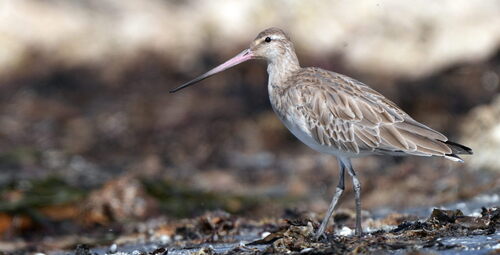 Bar-tailed Godwit
In short
The most reliable field mark between Eurasian Curlew and Bar-tailed Godwit is the bill: Curlew’s is extremely long, smoothly downcurved, and heavy, while Bar-tailed Godwit’s is noticeably shorter, thinner, and slightly upturned. In flight, Curlew’s long legs and feet project well beyond the tail, forming a clear 'point,' whereas Bar-tailed Godwit’s legs are shorter and do not extend past the tail tip. Adult Bar-tailed Godwits in breeding plumage show rich brick-red underparts, while Curlews remain streaky brown and white year-round. Both species can appear similar in non-breeding plumage, but size and structure remain reliable. Juvenile and immature birds are best separated by structure and bill shape, as both are mostly brownish and streaked.
Identification tips
- Bill shape and length: Curlew’s bill is extremely long, heavy, and smoothly downcurved; Godwit’s is shorter, thinner, and slightly upturned. This is the single most reliable field mark at all ages and seasons.
- Leg projection in flight: Curlew’s long legs and feet extend well beyond the tail, forming a noticeable point; Godwit’s legs do not project past the tail tip. This is diagnostic in flight for all ages.
- Size and bulk: Curlew is much larger and bulkier than Godwit. If seen side by side, Curlew towers over Godwit, but beware lone birds or distant flocks.
- Breeding plumage: Adult Bar-tailed Godwits (especially males) show rich brick-red underparts in spring/summer; Curlew never shows this color, remaining brown and streaked.
- Non-breeding and juvenile plumage: Both species are brownish and streaked, but Curlew is greyer and larger, with a white back. Godwit is more uniform grey-brown above and whitish below, with a subtly streaked look.
- Tail pattern: Godwit’s tail is barred, but this is hard to see unless the bird is close or the tail is fanned. Curlew’s tail is less distinctly marked.
- Bill color: Godwit’s bill is pink at the base and black-tipped, especially obvious in fresh plumage; Curlew’s bill is uniformly dark.
- Leg color and length: Both have blue-grey legs, but Godwit’s are relatively shorter and never project past the tail in flight.
- Flight style: Curlew flies with slow, deep wingbeats and looks heavy; Godwit is more agile and direct, with faster wingbeats.
- Voice: Curlew’s loud, bubbling 'curloo-oo' is distinctive; Godwit is quieter and lacks this call.
- Habitat context: In breeding season, Curlew is likely inland or on moorland; Godwit breeds in the Arctic and is strictly coastal outside breeding. In winter, both may be on estuaries, but Curlew is more likely to be found inland as well.
- Sex differences: Both species show some sexual dimorphism in size, but this is subtle and not reliable in the field except in direct comparison.
- Pitfalls: In poor light or at distance, non-breeding Godwits can look similar to Curlews, but bill shape and leg projection remain reliable. Beware especially of lone birds or mixed flocks.
- Juvenile confusion: Juvenile Godwits are buffier and more streaked on the breast than adults, but still show the same structural differences from Curlew. Juvenile Curlews are larger and greyer.
- Flock structure: Godwits often form tighter, more synchronized flocks, while Curlews are more loosely grouped.
Size
Eurasian Curlew is much larger and heavier: average body mass is about 805.5g compared to Bar-tailed Godwit’s 333.5g. Curlew’s length (50–60 cm) and wingspan (89–106 cm) far exceed Godwit’s (37–41 cm length, 70–80 cm wingspan). In the field, Curlew looks bulkier, longer-necked, and more imposing, while Bar-tailed Godwit is more compact and slender.
Plumage
Juvenile and non-breeding Bar-tailed Godwits are plain grey-brown above with paler underparts, and show a subtle streaked look, but lack any bold patterning on the upperwing or tail. Juvenile and non-breeding Curlews are also brown and streaked, but are generally greyer and larger, with a white back and no strong wing pattern. In breeding plumage, adult Bar-tailed Godwits are unmistakable with brick-red underparts (males brightest, females duller), while Curlews remain brown and streaky. Both species have blue-grey legs, but Godwit’s are relatively shorter. In flight, Curlew’s long legs and feet project well past the tail, while Godwit’s do not. The Godwit’s tail is barred (hence the name), but this can be hard to see except at close range or in good light; Curlew’s tail is less distinctly marked. Bill color is also helpful: Godwit’s bill is pink at the base and black-tipped, while Curlew’s is uniformly dark.
Behaviour
Both species forage on mudflats and wet meadows, probing for invertebrates, but Curlew’s foraging style is slower and more methodical, using its long bill to reach deeper prey. Bar-tailed Godwits are more active and can be seen running and probing rapidly. In flight, Curlews appear heavy and languid, with deep, slow wingbeats, while Godwits are more agile and direct. Curlew’s long legs trail conspicuously in flight, unlike Godwit’s. Both species are gregarious in migration and winter, but Godwits often form tighter flocks.
Habitat
Eurasian Curlew breeds in open grasslands, meadows, and moorland, and winters on estuaries and mudflats. Bar-tailed Godwit breeds on Arctic tundra and is strictly coastal in migration and winter, favoring tidal mudflats and sandy shores. While both can be found on estuaries outside the breeding season, Curlew is more likely inland or in rough grassland during breeding, while Godwit is almost never far from the coast.
Voice
Curlew has a loud, bubbling 'curloo-oo' call, often heard in flight or display, and is distinctive and far-carrying. Bar-tailed Godwit is quieter, with softer, more clipped calls, and does not give the evocative Curlew whistle. Voice is a reliable separator if heard well.