

Eurasian Crag Martin vs Rock Martin
Ptyonoprogne rupestris versus Ptyonoprogne fuligula
Play a quiz with Eurasian Crag Martin and Rock Martin
 Eurasian Crag Martin
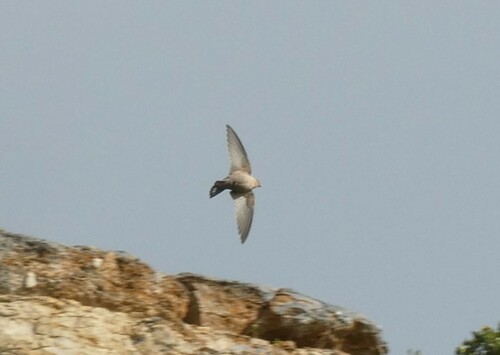 Rock Martin
In short
The most reliable field mark to separate Eurasian Crag Martin from Rock Martin is the size and prominence of the white tail spots: Eurasian Crag Martin shows significantly larger and more obvious white patches on the tail than Rock Martin, especially in flight. Both species have brown upperparts and short, square tails, but Eurasian Crag Martin is generally larger, bulkier, and paler below, while Rock Martin is drabber, with a more cinnamon-toned throat and underwing coverts. Juveniles of both species have pale tips to the upperparts, but the overall contrast and tail spot size remain the best clues. Flight style and subtle differences in underpart coloration can help, but tail pattern is the quickest separator for most observers.
Identification tips
- Tail spot size (all ages): Eurasian Crag Martin always shows large, bold white patches on the tail (except central and outermost feathers); Rock Martin's tail spots are much smaller and less obvious, often only visible as faint windows in flight.
- Tail spot visibility in flight: In gliding or fanned tail, Eurasian Crag Martin's white spots are striking and flash clearly; Rock Martin's are subdued and may be missed unless seen well.
- Overall size and build: Eurasian Crag Martin is larger, bulkier, and broader-winged; Rock Martin is slimmer and more delicate. This is most useful if both species are present or with experience.
- Underpart coloration: Eurasian Crag Martin is paler below, with a clear contrast to ash-brown upperparts; Rock Martin is more uniformly brown, with little contrast between upper- and underparts except for the cinnamon throat and underwing.
- Throat and underwing color: Rock Martin shows a cinnamon chin, throat, upper breast, and underwing coverts; Eurasian Crag Martin lacks this, instead having blackish underwing and undertail coverts.
- Juvenile plumage: Both species' juveniles have pale or buff tips to upperparts and flight feathers, but these are subtle and not a primary field mark; rely on tail spot size and underpart contrast instead.
- Flight style: Eurasian Crag Martin's flight is slower and heavier, with broader wings and less agility; Rock Martin is more acrobatic and nimble, especially near cliffs.
- Perched jizz: Eurasian Crag Martin appears bulkier and more upright when perched; Rock Martin is slimmer and may look more elongated.
- Habitat and range: Eurasian Crag Martin is found in southern Europe, northwestern Africa, and across the Palearctic; Rock Martin is resident in southern Africa. Location is often decisive.
- Habitat preference: Both use cliffs and rocky areas, but Rock Martin is more likely to be seen far from water and in urban or man-made settings.
- Vocalizations: Calls are not usually diagnostic, but Eurasian Crag Martin gives short, high notes; Rock Martin is quieter with a soft twitter and nasal or high-pitched calls.
- Sex and age: Sexes are alike in both species; age differences are subtle and not usually diagnostic in the field.
- Confusion with other swallows: Both lack a breast band (unlike sand martins) and have square tails with white spots, but only Eurasian Crag Martin's are large and obvious.
- Pitfalls: In poor light or distant views, Rock Martin may appear paler or Eurasian Crag Martin darker than reality; always look for tail spot size and underpart contrast.
- When in doubt: Focus on tail spot size in flight and overall underpart contrast; these are the most reliable field marks across all ages and seasons.
Size
Eurasian Crag Martin is the larger and stockier of the two, averaging about 14 cm in length and 20 g in mass, with a broader body, wings, and tail than any other European swallow. Rock Martin is slightly smaller (12–15 cm), and appears slimmer and less robust. In the field, Eurasian Crag Martin often looks noticeably bulkier and heavier-chested, while Rock Martin is more delicate. However, there is overlap in length, so size alone is not always diagnostic unless both species are seen together.
Plumage
- Juveniles: Both species' juveniles have pale or buff tips to the upperparts and flight feathers, but Eurasian Crag Martin juveniles show buff-brown tips on the head, upperparts, and wing coverts, while Rock Martin juveniles have pale edges to the upperparts and flight feathers. These differences are subtle and not always reliable at distance.
- Tail pattern (all ages): Eurasian Crag Martin has large, bold white patches near the tips of all but the central and outermost tail feathers; these are much more conspicuous than the small white spots of Rock Martin. In flight, Eurasian Crag Martin's tail spots flash clearly, while Rock Martin's are smaller and less obvious, sometimes appearing as faint 'windows.'
- Underparts: Eurasian Crag Martin is paler below, with a clear contrast between ash-brown upperparts and lighter underparts. Rock Martin is more uniform brown, with the underparts (except for the throat and underwing coverts) matching the upperparts in tone. Rock Martin's chin, throat, and upper breast are cinnamon, and the underwing coverts are also cinnamon, while Eurasian Crag Martin's underwing and undertail coverts are blackish.
- Other marks: Both have brown eyes, blackish bills, and brownish-pink legs. Sexes are alike in both species.
Behaviour
Both species have a slow, gliding flight style with rapid wingbeats interspersed with flat-winged glides. Eurasian Crag Martin's flight is relatively slow for a swallow, with broad wings and a heavier, more ponderous jizz. Rock Martin is more acrobatic and agile, often maneuvering deftly near cliffs. Eurasian Crag Martin tends to fly higher and shows its white tail spots more obviously when spreading the tail. Both species perch on rocks and buildings, but Eurasian Crag Martin may appear bulkier and more upright when perched.
Habitat
Eurasian Crag Martin breeds in mountains of southern Europe, northwestern Africa, and across the Palearctic, usually near cliffs or rocky outcrops. Rock Martin is resident in southern Africa, often in mountainous or rocky areas, but is more tolerant of lower altitudes and can be found far from water, including urban environments. If seen in Europe or Asia, the bird is almost certainly Eurasian Crag Martin; in southern Africa, Rock Martin is the default. Both species are associated with cliffs and rocky habitats, but Rock Martin is more likely to be found away from water and in man-made settings.
Voice
Eurasian Crag Martin gives short, high 'pli,' 'piieh,' and 'tshir' calls, somewhat reminiscent of linnet or house martin. Rock Martin is quieter, with a muffled twitter as song, and calls including a 'trrt' (like house martin), nasal 'vick,' and high-pitched 'twee.' Both species' calls are subtle and not usually diagnostic unless heard well and with experience.