

Motmot

Eurasian Blackbird vs Fieldfare

Turdus merula versus Turdus pilaris

Play a quiz with Eurasian Blackbird and Fieldfare
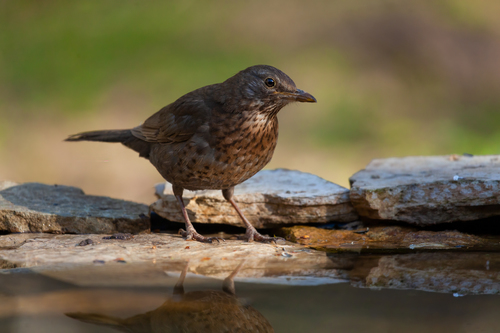
Eurasian Blackbird (Turdus merula) Eurasian Blackbird
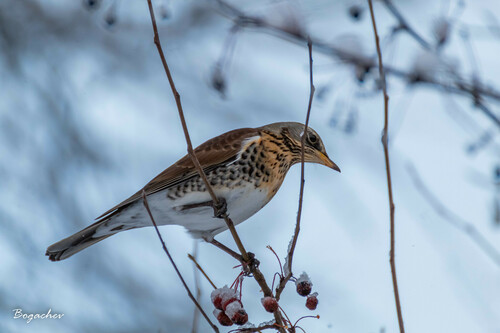
Fieldfare (Turdus pilaris) Fieldfare

Media

Loading…

In short

The most reliable field mark to separate Eurasian Blackbird from Fieldfare is overall coloration: adult male Blackbirds are entirely glossy black with a bright yellow-orange bill, while Fieldfares are boldly patterned with a grey head, chestnut back, and heavily spotted breast. In flight, Fieldfares show striking white underwing coverts and axillaries, a feature never present in Blackbirds of any age. Juvenile Blackbirds are brownish with pale spots above, but still lack the Fieldfare's grey head and white underwings. Structure and behavior also differ: Blackbirds are more solitary and often seen low or on the ground, while Fieldfares are gregarious, often in flocks, and have a harsher, chattering flight call. Both are medium-sized thrushes, but Fieldfares are slightly bulkier and longer-winged.

Identification tips

  1. White underwing coverts in flight: Fieldfares of all ages show prominent white underwing coverts and axillaries, especially visible in flight or when stretching wings. Eurasian Blackbirds never show this feature.
  2. Grey head and rump: Fieldfares (adult and juvenile) have a slate-grey head, nape, and rump, contrasting with a chestnut back. Blackbirds (all ages) lack any grey on the head or rump.
  3. Overall coloration: Adult male Blackbirds are entirely glossy black with a yellow-orange bill and eye-ring; females are sooty-brown with a duller bill. Fieldfares are boldly patterned with a grey head, chestnut back, blackish tail, and heavily spotted creamy-buff breast.
  4. Juvenile confusion: Juvenile Blackbirds are brownish with pale spots on the upperparts and a speckled breast, but never show grey or white underwings. Juvenile Fieldfares are duller but still have a greyish tinge to the head and rump and pale streaks on the body feathers.
  5. Bill color: Adult male Blackbirds have a bright yellow-orange bill (duller in winter), females and juveniles have a duller yellowish or brownish bill. Fieldfares have an orange-yellow bill in winter, more yellow in summer, with a brownish upper mandible and dark tip.
  6. Breast pattern: Fieldfares have a boldly spotted and streaked creamy-buff breast, with spots concentrated on the upper breast. Blackbirds have a plain (male) or weakly mottled (female/juvenile) breast, never as boldly marked as Fieldfare.
  7. Tail color and shape: Fieldfares have a blackish tail with a rounded tip and some grey fringing at the base; Blackbirds have a long, all-black tail (male) or brownish tail (female/juvenile) with a more slender appearance.
  8. Flight style: Fieldfares fly in flocks with bounding, direct flight and frequent calling. Blackbirds fly singly or in pairs, with bursts of rapid wingbeats and more agile, solitary movement.
  9. Social behavior: Fieldfares are highly gregarious in winter, often in large, noisy flocks. Blackbirds are usually solitary or in pairs, even in winter.
  10. Habitat context: In open fields or large flocks in winter, Fieldfare is more likely; in gardens, parks, or solitary in woodland, Blackbird is more probable.
  11. Vocalization: Listen for the Fieldfare's harsh 'tsak tsak' call, especially from flocks in flight or perched. Blackbird calls are softer and less chattering.
  12. Eye-ring: Adult male Blackbirds have a distinct yellow eye-ring; Fieldfares do not show a strong eye-ring.
  13. Sex differences: Female Blackbirds are browner and duller than males, but still lack the Fieldfare's grey head and white underwings. Female Fieldfares are similar to males but paler and with fewer breast markings.
  14. Seasonal context: Fieldfares are mostly present in winter in much of Europe, often in flocks; Blackbirds are resident year-round in many areas.
  15. Pitfalls: Beware of juvenile Blackbirds, which can appear spotted and brownish, but always lack the grey head and white underwing of Fieldfare. In poor light, Fieldfare's bold pattern and flocking habit are key.

Size

Both species are medium-sized thrushes, but Fieldfares are marginally larger and heavier on average (adult Fieldfare body mass around 105 g [wikidata], Blackbird 80–125 g [wikipedia]). Fieldfares have a slightly longer wingspan (39–42 cm) and a more robust, upright posture, especially in flocks. Blackbirds appear more slender and have a proportionally longer tail. In the field, the size difference is subtle and rarely diagnostic on its own, but Fieldfares can look bulkier, especially when seen in groups.

Plumage

Juvenile and immature birds are often confused. Juvenile Blackbirds are brownish overall with pale spots on the upperparts and a speckled breast, but lack any grey on the head or rump and have no white on the underwing. First-year male Blackbirds are similar to adults but with a duller, darker bill and weaker eye-ring, and their folded wings are brown, not black. In contrast, juvenile Fieldfares are duller than adults but still show a greyish tinge to the head and rump, and pale streaks on the body feathers. Adult Fieldfares are unmistakable with a slate-grey head, nape, and rump, chestnut-brown back, blackish tail, and a boldly speckled breast on a creamy-buff background. In flight, Fieldfares always show white underwing coverts and axillaries, a unique feature among these two. Adult male Blackbirds are entirely glossy black with a yellow-orange bill and eye-ring, while females are sooty-brown with a duller bill and weak mottling below. No Blackbird of any age or sex shows the Fieldfare's grey head, chestnut back, or white underwings.

Behaviour

Eurasian Blackbirds are usually solitary or in pairs, especially during breeding season, and are often seen foraging low in vegetation or on the ground. They defend territories aggressively, especially males, and have a direct, agile flight with bursts of rapid wingbeats. Fieldfares are highly gregarious outside the breeding season, often forming large, noisy flocks that move between trees and open ground. Their flight is more bounding and direct, and they are much more likely to be seen in open fields or perched high in trees with other thrushes. Fieldfares are also more migratory, with large winter movements and flocking behavior.

Habitat

Both species breed in woodland and scrub, but Eurasian Blackbirds are more adaptable and common in gardens, parks, and urban areas across Europe, western Asia, and North Africa. Fieldfares breed further north and east, preferring open woodland and forest edges, and are strongly migratory, wintering in more southern areas. In winter, Fieldfares are often found in open fields, orchards, and hedgerows, usually in flocks, while Blackbirds remain in a wider range of habitats, often singly or in pairs.

Voice

Fieldfares have a distinctive harsh, chattering flight call ('tsak tsak'), often heard from flocks in flight or perched in trees. Their song is weak and mixed with whistles and guttural notes, but rarely heard except on breeding grounds. Eurasian Blackbirds have a rich, melodious song (not diagnostic here), but their calls are softer, less harsh, and lack the Fieldfare's chattering quality. In the field, the presence of a harsh 'tsak tsak' call from a flock is a strong indicator of Fieldfare.

Submit a better description

Use the same sections as the comparison. Your text is published immediately.

The most reliable field mark to separate Eurasian Blackbird from Fieldfare is overall coloration: adult male Blackbirds are entirely glossy black with a bright yellow-orange bill, while Fieldfares are boldly patterned with a grey head, chestnut back, and heavily spotted breast. In flight, Fieldfares show striking white underwing coverts and axillaries, a feature never present in Blackbirds of any age. Juvenile Blackbirds are brownish with pale spots above, but still lack the Fieldfare's grey head and white underwings. Structure and behavior also differ: Blackbirds are more solitary and often seen low or on the ground, while Fieldfares are gregarious, often in flocks, and have a harsher, chattering flight call. Both are medium-sized thrushes, but Fieldfares are slightly bulkier and longer-winged.

  1. White underwing coverts in flight: Fieldfares of all ages show prominent white underwing coverts and axillaries, especially visible in flight or when stretching wings. Eurasian Blackbirds never show this feature.
  2. Grey head and rump: Fieldfares (adult and juvenile) have a slate-grey head, nape, and rump, contrasting with a chestnut back. Blackbirds (all ages) lack any grey on the head or rump.
  3. Overall coloration: Adult male Blackbirds are entirely glossy black with a yellow-orange bill and eye-ring; females are sooty-brown with a duller bill. Fieldfares are boldly patterned with a grey head, chestnut back, blackish tail, and heavily spotted creamy-buff breast.
  4. Juvenile confusion: Juvenile Blackbirds are brownish with pale spots on the upperparts and a speckled breast, but never show grey or white underwings. Juvenile Fieldfares are duller but still have a greyish tinge to the head and rump and pale streaks on the body feathers.
  5. Bill color: Adult male Blackbirds have a bright yellow-orange bill (duller in winter), females and juveniles have a duller yellowish or brownish bill. Fieldfares have an orange-yellow bill in winter, more yellow in summer, with a brownish upper mandible and dark tip.
  6. Breast pattern: Fieldfares have a boldly spotted and streaked creamy-buff breast, with spots concentrated on the upper breast. Blackbirds have a plain (male) or weakly mottled (female/juvenile) breast, never as boldly marked as Fieldfare.
  7. Tail color and shape: Fieldfares have a blackish tail with a rounded tip and some grey fringing at the base; Blackbirds have a long, all-black tail (male) or brownish tail (female/juvenile) with a more slender appearance.
  8. Flight style: Fieldfares fly in flocks with bounding, direct flight and frequent calling. Blackbirds fly singly or in pairs, with bursts of rapid wingbeats and more agile, solitary movement.
  9. Social behavior: Fieldfares are highly gregarious in winter, often in large, noisy flocks. Blackbirds are usually solitary or in pairs, even in winter.
  10. Habitat context: In open fields or large flocks in winter, Fieldfare is more likely; in gardens, parks, or solitary in woodland, Blackbird is more probable.
  11. Vocalization: Listen for the Fieldfare's harsh 'tsak tsak' call, especially from flocks in flight or perched. Blackbird calls are softer and less chattering.
  12. Eye-ring: Adult male Blackbirds have a distinct yellow eye-ring; Fieldfares do not show a strong eye-ring.
  13. Sex differences: Female Blackbirds are browner and duller than males, but still lack the Fieldfare's grey head and white underwings. Female Fieldfares are similar to males but paler and with fewer breast markings.
  14. Seasonal context: Fieldfares are mostly present in winter in much of Europe, often in flocks; Blackbirds are resident year-round in many areas.
  15. Pitfalls: Beware of juvenile Blackbirds, which can appear spotted and brownish, but always lack the grey head and white underwing of Fieldfare. In poor light, Fieldfare's bold pattern and flocking habit are key.

Both species are medium-sized thrushes, but Fieldfares are marginally larger and heavier on average (adult Fieldfare body mass around 105 g [wikidata], Blackbird 80–125 g [wikipedia]). Fieldfares have a slightly longer wingspan (39–42 cm) and a more robust, upright posture, especially in flocks. Blackbirds appear more slender and have a proportionally longer tail. In the field, the size difference is subtle and rarely diagnostic on its own, but Fieldfares can look bulkier, especially when seen in groups.

Juvenile and immature birds are often confused. Juvenile Blackbirds are brownish overall with pale spots on the upperparts and a speckled breast, but lack any grey on the head or rump and have no white on the underwing. First-year male Blackbirds are similar to adults but with a duller, darker bill and weaker eye-ring, and their folded wings are brown, not black. In contrast, juvenile Fieldfares are duller than adults but still show a greyish tinge to the head and rump, and pale streaks on the body feathers. Adult Fieldfares are unmistakable with a slate-grey head, nape, and rump, chestnut-brown back, blackish tail, and a boldly speckled breast on a creamy-buff background. In flight, Fieldfares always show white underwing coverts and axillaries, a unique feature among these two. Adult male Blackbirds are entirely glossy black with a yellow-orange bill and eye-ring, while females are sooty-brown with a duller bill and weak mottling below. No Blackbird of any age or sex shows the Fieldfare's grey head, chestnut back, or white underwings.

Eurasian Blackbirds are usually solitary or in pairs, especially during breeding season, and are often seen foraging low in vegetation or on the ground. They defend territories aggressively, especially males, and have a direct, agile flight with bursts of rapid wingbeats. Fieldfares are highly gregarious outside the breeding season, often forming large, noisy flocks that move between trees and open ground. Their flight is more bounding and direct, and they are much more likely to be seen in open fields or perched high in trees with other thrushes. Fieldfares are also more migratory, with large winter movements and flocking behavior.

Both species breed in woodland and scrub, but Eurasian Blackbirds are more adaptable and common in gardens, parks, and urban areas across Europe, western Asia, and North Africa. Fieldfares breed further north and east, preferring open woodland and forest edges, and are strongly migratory, wintering in more southern areas. In winter, Fieldfares are often found in open fields, orchards, and hedgerows, usually in flocks, while Blackbirds remain in a wider range of habitats, often singly or in pairs.

Fieldfares have a distinctive harsh, chattering flight call ('tsak tsak'), often heard from flocks in flight or perched in trees. Their song is weak and mixed with whistles and guttural notes, but rarely heard except on breeding grounds. Eurasian Blackbirds have a rich, melodious song (not diagnostic here), but their calls are softer, less harsh, and lack the Fieldfare's chattering quality. In the field, the presence of a harsh 'tsak tsak' call from a flock is a strong indicator of Fieldfare.

Discard your changes?

You have unsaved edits. If you leave now, those changes will be lost.

Eurasian Blackbird · Fieldfare · My Tricky Birds