

Motmot

Eleonora's Falcon vs Peregrine Falcon

Falco eleonorae versus Falco peregrinus

Play a quiz with Eleonora's Falcon and Peregrine Falcon
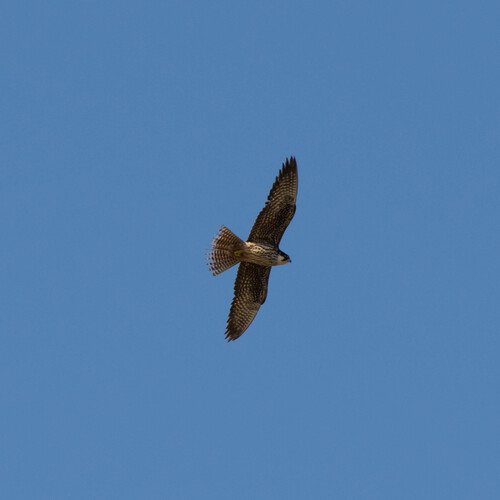
Eleonora's Falcon (Falco eleonorae) Eleonora's Falcon
Peregrine Falcon (Falco peregrinus) Peregrine Falcon

Media

Loading…

In short

Juvenile and light-morph Eleonora's Falcons can be confused with Peregrine Falcons, especially in flight, but Eleonora's always shows a striking contrast between black underwing coverts and paler flight feathers, while Peregrine never does. Eleonora's is slimmer, longer-winged, and longer-tailed, with two distinct color morphs (sooty dark and pale buff/light). Peregrine is bulkier, with a blue-grey back, barred white underparts, and a black hood. Structure and wing shape are as important as plumage for separation, especially at a distance or in poor light. Both species are fast, aerial hunters, but Eleonora's is more specialized for catching small birds on migration, often seen cruising coastal cliffs, while Peregrine is more widespread and versatile. Voice is not a reliable separator in the field.

Identification tips

  1. Underwing pattern in flight (all ages except dark-morph Eleonora's): Eleonora's Falcon (light morph and juveniles) shows a strong contrast between black underwing coverts and paler flight feathers—look for this bold two-tone effect, which Peregrine never shows.
  2. Dark morph Eleonora's: Uniformly sooty brown overall, including underparts and underwing, unlike any Peregrine (which is never sooty all over). Beware: at distance, dark morph can look like a shadowy Peregrine, but lacks the barred underparts and black hood.
  3. Peregrine Falcon adult plumage: Blue-grey back, black hood, and cleanly barred white underparts. No color morphs. Juveniles are browner above and streaked below, but still lack the underwing contrast of Eleonora's.
  4. Structure and jizz: Eleonora's is noticeably slimmer, with longer, narrower wings and a longer tail, giving it a more buoyant, hobby-like flight. Peregrine is bulkier, with broader wings and a shorter tail, and appears more powerful and compact in flight.
  5. Tail shape: Eleonora's tail is longer and more tapered, especially obvious when perched or gliding. Peregrine's tail is shorter and more squared-off.
  6. Bill and head: Peregrine has a more robust bill and a larger, blockier head with a prominent black hood. Eleonora's head is smaller and less blocky, with no strong hood effect.
  7. Perched birds: Eleonora's looks slim and long-winged, with wingtips often reaching or exceeding the tail tip. Peregrine appears more compact, with shorter wings relative to tail.
  8. Color morphs: Only Eleonora's shows dark and light morphs; Peregrine never does. If you see a sooty-brown falcon with pointed wings, consider Eleonora's.
  9. Habitat and context: Eleonora's is almost always coastal or on Mediterranean islands during breeding. Peregrine can be found in a much wider range of habitats, including far inland and urban areas.
  10. Season: Eleonora's breeds in late summer/early autumn, coinciding with peak bird migration. Peregrine breeds earlier and is present year-round in many regions.
  11. Behavior: Eleonora's often cruises along cliffs with steady, level wingbeats, scanning for migrants. Peregrine is more likely to be seen soaring high or performing dramatic stoops.
  12. Feeding: Eleonora's is known for catching and sometimes imprisoning live prey for later. Peregrine typically kills prey outright in mid-air.
  13. Voice: Both species give a 'kek-kek-kek' call; do not rely on voice for separation.
  14. Sexual dimorphism: Peregrine females are much larger than males, but this is only useful if you see a pair together.
  15. Pitfalls: Juvenile Peregrines can be confused with light-morph Eleonora's, but lack the sharp underwing contrast. Dark-morph Eleonora's can look like a shadowy Peregrine, but is always sooty all over, never barred or hooded.

Size

Eleonora's Falcon is a medium-sized falcon, with a body mass around 334 g [wikidata], and is shaped like a large Eurasian hobby or a small, slender Peregrine. Peregrine Falcon is larger and bulkier overall (no direct mass given, but described as 'large, crow-sized' [wikipedia]), with a more powerful build, especially in females. Eleonora's is distinctly slimmer, with proportionally longer wings and tail, giving it a more elegant, buoyant jizz in flight compared to the more compact, muscular Peregrine.

Plumage

Juvenile and light-morph Eleonora's Falcons (and young birds) show pale underparts with a strong contrast to the dark underwing coverts and darker wingtips/coverts—this contrast is visible in flight and is a key mark for all non-dark-morph Eleonora's. Dark-morph Eleonora's is uniformly sooty brown, with black underwing coverts, lacking the pale underparts of the light morph. Peregrine Falcon adults have a blue-grey back, barred white underparts, and a black head/hood, with no morph variation. Juvenile Peregrines are browner above and streaked below, but still lack the strong underwing contrast of Eleonora's. In all ages, Peregrine shows a more uniform underwing, without the black coverts/pale flight feather contrast. Both species have pointed wings and long tails, but Eleonora's is longer-winged and more slender overall.

Behaviour

Both species are highly aerial and hunt birds on the wing, but Eleonora's Falcon is more specialized for catching small migratory birds, often seen patrolling coastal cliffs with steady, buoyant wingbeats. It is unique in sometimes imprisoning live prey for later feeding. Peregrine Falcon is more versatile, hunting a wide range of birds and some mammals, often using high-speed stoops from altitude and powerful, direct flight. Peregrine is more likely to be seen hunting over open landscapes, cities, or wetlands, while Eleonora's is closely tied to coastal and island habitats during breeding.

Habitat

Eleonora's Falcon breeds almost exclusively on Mediterranean islands and coastal cliffs, especially in Greece and nearby regions, and is rarely seen inland except on migration. Peregrine Falcon is cosmopolitan, found in a wide range of open habitats including cliffs, cities, wetlands, tundra, and open country. If you are far from the Mediterranean or not near a coastal cliff during the breeding season, Eleonora's is unlikely.

Voice

Both species have a typical falcon 'kek-kek-kek' call, and voice is not a reliable field separator between the two.

Submit a better description

Use the same sections as the comparison. Your text is published immediately.

Juvenile and light-morph Eleonora's Falcons can be confused with Peregrine Falcons, especially in flight, but Eleonora's always shows a striking contrast between black underwing coverts and paler flight feathers, while Peregrine never does. Eleonora's is slimmer, longer-winged, and longer-tailed, with two distinct color morphs (sooty dark and pale buff/light). Peregrine is bulkier, with a blue-grey back, barred white underparts, and a black hood. Structure and wing shape are as important as plumage for separation, especially at a distance or in poor light. Both species are fast, aerial hunters, but Eleonora's is more specialized for catching small birds on migration, often seen cruising coastal cliffs, while Peregrine is more widespread and versatile. Voice is not a reliable separator in the field.

  1. Underwing pattern in flight (all ages except dark-morph Eleonora's): Eleonora's Falcon (light morph and juveniles) shows a strong contrast between black underwing coverts and paler flight feathers—look for this bold two-tone effect, which Peregrine never shows.
  2. Dark morph Eleonora's: Uniformly sooty brown overall, including underparts and underwing, unlike any Peregrine (which is never sooty all over). Beware: at distance, dark morph can look like a shadowy Peregrine, but lacks the barred underparts and black hood.
  3. Peregrine Falcon adult plumage: Blue-grey back, black hood, and cleanly barred white underparts. No color morphs. Juveniles are browner above and streaked below, but still lack the underwing contrast of Eleonora's.
  4. Structure and jizz: Eleonora's is noticeably slimmer, with longer, narrower wings and a longer tail, giving it a more buoyant, hobby-like flight. Peregrine is bulkier, with broader wings and a shorter tail, and appears more powerful and compact in flight.
  5. Tail shape: Eleonora's tail is longer and more tapered, especially obvious when perched or gliding. Peregrine's tail is shorter and more squared-off.
  6. Bill and head: Peregrine has a more robust bill and a larger, blockier head with a prominent black hood. Eleonora's head is smaller and less blocky, with no strong hood effect.
  7. Perched birds: Eleonora's looks slim and long-winged, with wingtips often reaching or exceeding the tail tip. Peregrine appears more compact, with shorter wings relative to tail.
  8. Color morphs: Only Eleonora's shows dark and light morphs; Peregrine never does. If you see a sooty-brown falcon with pointed wings, consider Eleonora's.
  9. Habitat and context: Eleonora's is almost always coastal or on Mediterranean islands during breeding. Peregrine can be found in a much wider range of habitats, including far inland and urban areas.
  10. Season: Eleonora's breeds in late summer/early autumn, coinciding with peak bird migration. Peregrine breeds earlier and is present year-round in many regions.
  11. Behavior: Eleonora's often cruises along cliffs with steady, level wingbeats, scanning for migrants. Peregrine is more likely to be seen soaring high or performing dramatic stoops.
  12. Feeding: Eleonora's is known for catching and sometimes imprisoning live prey for later. Peregrine typically kills prey outright in mid-air.
  13. Voice: Both species give a 'kek-kek-kek' call; do not rely on voice for separation.
  14. Sexual dimorphism: Peregrine females are much larger than males, but this is only useful if you see a pair together.
  15. Pitfalls: Juvenile Peregrines can be confused with light-morph Eleonora's, but lack the sharp underwing contrast. Dark-morph Eleonora's can look like a shadowy Peregrine, but is always sooty all over, never barred or hooded.

Eleonora's Falcon is a medium-sized falcon, with a body mass around 334 g [wikidata], and is shaped like a large Eurasian hobby or a small, slender Peregrine. Peregrine Falcon is larger and bulkier overall (no direct mass given, but described as 'large, crow-sized' [wikipedia]), with a more powerful build, especially in females. Eleonora's is distinctly slimmer, with proportionally longer wings and tail, giving it a more elegant, buoyant jizz in flight compared to the more compact, muscular Peregrine.

Juvenile and light-morph Eleonora's Falcons (and young birds) show pale underparts with a strong contrast to the dark underwing coverts and darker wingtips/coverts—this contrast is visible in flight and is a key mark for all non-dark-morph Eleonora's. Dark-morph Eleonora's is uniformly sooty brown, with black underwing coverts, lacking the pale underparts of the light morph. Peregrine Falcon adults have a blue-grey back, barred white underparts, and a black head/hood, with no morph variation. Juvenile Peregrines are browner above and streaked below, but still lack the strong underwing contrast of Eleonora's. In all ages, Peregrine shows a more uniform underwing, without the black coverts/pale flight feather contrast. Both species have pointed wings and long tails, but Eleonora's is longer-winged and more slender overall.

Both species are highly aerial and hunt birds on the wing, but Eleonora's Falcon is more specialized for catching small migratory birds, often seen patrolling coastal cliffs with steady, buoyant wingbeats. It is unique in sometimes imprisoning live prey for later feeding. Peregrine Falcon is more versatile, hunting a wide range of birds and some mammals, often using high-speed stoops from altitude and powerful, direct flight. Peregrine is more likely to be seen hunting over open landscapes, cities, or wetlands, while Eleonora's is closely tied to coastal and island habitats during breeding.

Eleonora's Falcon breeds almost exclusively on Mediterranean islands and coastal cliffs, especially in Greece and nearby regions, and is rarely seen inland except on migration. Peregrine Falcon is cosmopolitan, found in a wide range of open habitats including cliffs, cities, wetlands, tundra, and open country. If you are far from the Mediterranean or not near a coastal cliff during the breeding season, Eleonora's is unlikely.

Both species have a typical falcon 'kek-kek-kek' call, and voice is not a reliable field separator between the two.

Discard your changes?

You have unsaved edits. If you leave now, those changes will be lost.

Eleonora's Falcon · Peregrine Falcon · My Tricky Birds