

Egyptian Nightjar vs Savanna Nightjar
Caprimulgus aegyptius versus Caprimulgus affinis
Play a quiz with Egyptian Nightjar and Savanna Nightjar
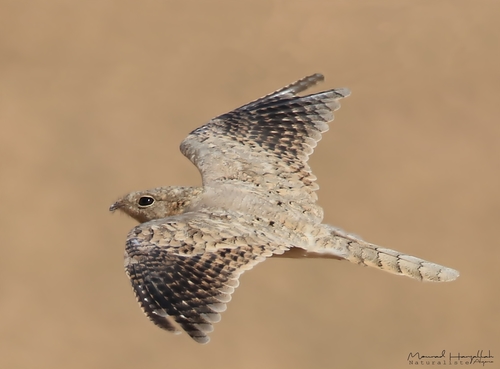 Egyptian Nightjar
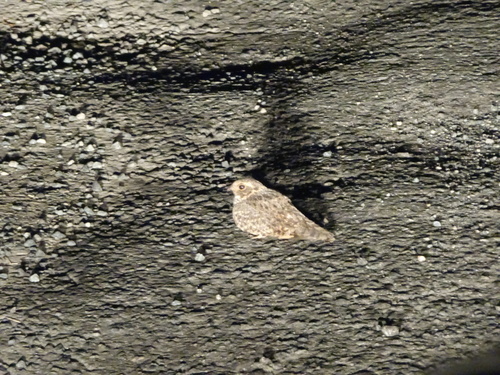 Savanna Nightjar
In short
The most reliable field mark between Egyptian Nightjar and Savanna Nightjar is overall plumage tone: Egyptian Nightjar is much paler, with sandy or whitish underparts and a sand-colored, lightly marked upper side, while Savanna Nightjar is distinctly darker and more vermiculated grey-brown. In flight, adult male Savanna Nightjars show white patches on the throat, tail, and wings, which are absent or much less obvious in Egyptian Nightjar. Juveniles and females of Savanna Nightjar lack these white patches and can be confused with Egyptian, but the latter always appears paler and more uniform. Structure also helps: Egyptian Nightjar is relatively longer-winged and longer-tailed for its size, giving it a more elegant jizz. Both species are cryptic on the ground, but habitat and range rarely overlap. Voice is very different, with Egyptian Nightjar giving a mechanical, repetitive call, while Savanna Nightjar is known for its loud, booming nocturnal song.
Identification tips
- Overall color tone: Egyptian Nightjar is much paler, with sandy or whitish underparts and sand-colored upperparts, while Savanna Nightjar is darker, more vermiculated grey-brown. This is the most reliable mark in all ages and sexes.
- White patches (adult males): Male Savanna Nightjars show bold white patches on the throat, tail, and wings; Egyptian Nightjar males may have tiny white wing spots but lack the extensive white of Savanna. This is diagnostic for adult males in good light or flight views.
- Female and juvenile confusion: Female and immature Savanna Nightjars lack white tail patches and have a reddish tint, but are always darker and more mottled than Egyptian Nightjar. Egyptian Nightjar remains pale and sandy in all plumages.
- Underpart color: Egyptian Nightjar has sandy or whitish underparts, contrasting with the darker, more mottled underparts of Savanna Nightjar. Useful in perched birds or birds seen from below.
- Tail and wing structure: Egyptian Nightjar is relatively longer-winged and longer-tailed for its size, giving a more elegant, stretched jizz, especially in flight. Savanna Nightjar may appear more compact or robust.
- Facial pattern: Both have cryptic faces, but Savanna Nightjar males have a white throat patch, while Egyptian Nightjar's face is more uniform and pale.
- Flight style: Egyptian Nightjar flies with strong, deliberate wingbeats and glides, appearing moth-like and silent. Savanna Nightjar's flight is also agile, but not described as particularly moth-like.
- Habitat context: Egyptian Nightjar is found in open desert and sandy steppe, while Savanna Nightjar prefers open rocky ground, grassland, or urban rooftops. If seen in true desert, Egyptian is more likely; in urban or rocky grassland, Savanna is expected.
- Geographic range: Egyptian Nightjar is native to North Africa and the Middle East; Savanna Nightjar is found in South and Southeast Asia. Out-of-range records are rare and should be scrutinized.
- Vocalization: Egyptian Nightjar's call is a repetitive, mechanical "kroo-kroo-kroo…"; Savanna Nightjar gives a loud, booming nocturnal song. If heard, this is diagnostic.
- Camouflage on ground: Egyptian Nightjar blends with pale sandy soils; Savanna Nightjar is better camouflaged on darker, rocky ground.
- Urban adaptation: Savanna Nightjar may be found nesting on flat urban rooftops, a behavior not recorded for Egyptian Nightjar.
- Distraction display: Savanna Nightjar parents may feign injury to distract predators from the nest; this is not specifically noted for Egyptian Nightjar.
- Bill and gape: Both have wide gapes and rictal bristles, but this is not a reliable field mark for separation.
- Size: Savanna Nightjar can be slightly larger and bulkier, but overlap is considerable and not diagnostic in the field.
Size
Savanna Nightjar is slightly larger on average, with a wingspan up to 64 cm and body mass ranging from 54–110 g (mean 82.5 g) [wikidata], compared to Egyptian Nightjar's 25 cm length and 55 cm wingspan [wikipedia]. Egyptian Nightjar is described as medium-small and relatively long-winged and long-tailed for its size, while Savanna Nightjar varies more in size depending on subspecies, from small to medium-large. In the field, the difference is subtle and not always reliable for separation, but Savanna Nightjar may appear a bit bulkier, especially at close range.
Plumage
- Juvenile/Immature birds: Both species' juveniles are cryptic, but Savanna Nightjar immatures resemble adult females, lacking white patches and showing mottled, darker coloration. Egyptian Nightjar juveniles are not described in detail, but the species is always paler overall, with sandy or whitish underparts and less contrast.
- Adult males: Savanna Nightjar males have distinct white patches on the throat, tail, and wings, which are absent or much reduced in Egyptian Nightjar. Egyptian Nightjar males may show tiny white wing spots, but these are much less conspicuous.
- Adult females: Female Savanna Nightjars lack white tail patches, have only subtle throat patches, and show a reddish tint to the feathers; Egyptian Nightjar females remain paler and more uniform, lacking any reddish tones.
- General coloration: Egyptian Nightjar is always paler, sand-colored above, with buff and brown barring and streaking, and sandy or whitish underparts. Savanna Nightjar is more vermiculated, with a grey-brown, heavily mottled appearance, blending more with darker soils or rocks. Both are cryptic, but Egyptian Nightjar is much better camouflaged on pale sandy ground.
Behaviour
Both species are nocturnal and crepuscular, feeding mainly on flying insects (especially moths) by sallying from the ground or low perches. Egyptian Nightjar is described as flying with strong, deliberate wingbeats alternating with glides, giving a moth-like, silent flight. Savanna Nightjar also hunts by sallying, but is noted for its booming nocturnal calls, especially in urbanized populations. Both nest on the ground without constructing a nest, relying on camouflage and distraction displays to protect eggs and chicks. Savanna Nightjar parents are known to feign injury to lure predators away from the nest, a behavior not specifically mentioned for Egyptian Nightjar.
Habitat
Egyptian Nightjar is found in open desert, sandy steppe, and dry countryside with sparse vegetation, typically in North Africa, the Middle East, and parts of southwest Asia. It prefers sandy soils and is often near water or in areas with scattered bushes. Savanna Nightjar, by contrast, is native to South and Southeast Asia, favoring open and exposed places with rocky soils, grassland, or even urban rooftops in some areas. Their ranges do not overlap except as rare vagrants, and their habitat preferences are distinct: Egyptian Nightjar is a desert specialist, while Savanna Nightjar is more generalist and adaptable, including urban environments.
Voice
Egyptian Nightjar gives a repetitive, mechanical "kroo-kroo-kroo…" call, rising and falling as the bird turns its head. This is quite different from the Savanna Nightjar, which is famous for its loud, booming nocturnal calls that can reach up to 90 decibels and are often considered a nuisance in urban areas. The Savanna Nightjar's song is much more forceful and far-carrying, while Egyptian Nightjar is softer and more mechanical.