

Eastern Woodhaunter vs Tawny Tit-Spinetail
Automolus subulatus versus Sylviorthorhynchus yanacensis
Play a quiz with Eastern Woodhaunter and Tawny Tit-Spinetail
 Eastern Woodhaunter
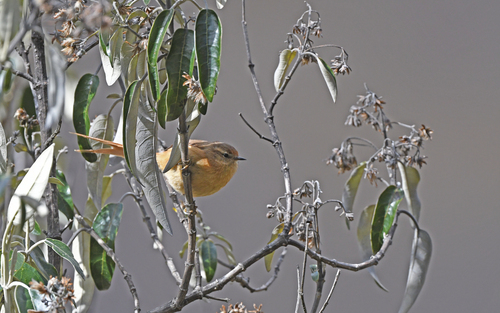 Tawny Tit-Spinetail
In short
The most reliable field mark to separate Eastern Woodhaunter from Tawny Tit-Spinetail is overall structure: the Woodhaunter is much heavier-bodied with a short, thick bill, while the Tit-Spinetail is slender, long-tailed, and fine-billed. In plumage, Woodhaunter shows a dark, streaked face and crown with a pale eyering, contrasting with the Tit-Spinetail's bright cinnamon-buff face and tawny tones throughout. In flight or perched, the Tit-Spinetail’s long, graduated rufous tail is distinctive, while the Woodhaunter’s tail is shorter and more even. Both species are brownish with rufous in the wings and tail, but their shapes and facial patterns are quite different. Habitat is also a strong clue: Woodhaunter is a lowland Amazonian forest bird, while Tit-Spinetail is restricted to high-elevation Polylepis woodlands and adjacent scrub.
Identification tips
- Structure is the most immediate clue: Woodhaunter is heavy-bodied with a short, thick bill; Tit-Spinetail is slim, fine-billed, and long-tailed. This is obvious in both perched and flight views.
- Tail shape and length: Tit-Spinetail’s tail is long, rufous, and strongly graduated (outer feathers much shorter than central), often fanned or cocked. Woodhaunter’s tail is shorter, chestnut, and more squared-off.
- Facial pattern: Woodhaunter has a dark brownish face with golden-buff streaks, a pale eyering, and a pale stripe behind the eye. Tit-Spinetail has a bright cinnamon-buff face, with a tawny rufous forehead and (in Peru) a narrow buff or (in Bolivia) whitish supercilium.
- Crown and back: Woodhaunter’s crown is dark brown with golden streaks, blending into a rich dark brown upper back. Tit-Spinetail’s crown is tawny brown, matching the back, with no streaking.
- Underparts: Woodhaunter’s breast is dull brown with wide, blurry golden-buff streaks, fading to a tawny brown belly. Tit-Spinetail’s underparts are bright cinnamon buff, paler in Bolivian birds, and unstreaked.
- Rump and uppertail: Both species have rufous/rich chestnut rumps and tails, but the Tit-Spinetail’s is more extensive and brighter, matching the tail, while Woodhaunter’s is more limited and darker.
- Bill color and shape: Woodhaunter’s bill is short, thick, and dark above with a paler lower mandible. Tit-Spinetail’s is fine, pointed, and dark brown to black.
- Wing pattern: Both have rufous in the wings, but no distinctive panels or age-specific marks are described for either; focus on overall color and structure.
- Juvenile confusion: Juvenile Woodhaunter is paler below and less streaked, but still bulkier and darker-faced than Tit-Spinetail. Juvenile Tit-Spinetail is not described but is likely similar to adult.
- Behavior: Tit-Spinetail is active, acrobatic, often in small groups, and may hang upside down; Woodhaunter is solitary or in mixed flocks, heavier, and probes methodically.
- Habitat: Woodhaunter is strictly a lowland Amazonian forest bird; Tit-Spinetail is only in high-elevation Andean Polylepis woodland and scrub.
- Voice: If you hear a rapid, accelerating chatter, it is Tit-Spinetail. Woodhaunter’s vocalizations are not described here.
- Geographic range: Overlap is limited to parts of Peru and Bolivia, but only in very different habitats and elevations.
- Sexes: Both species are sexually monomorphic—males and females look alike.
- Season: No seasonal plumage variation is described for either species.
Size
Eastern Woodhaunter is significantly bulkier, measuring 17–18 cm in length and weighing 25–38 g. In contrast, Tawny Tit-Spinetail is slightly shorter at 16–17.5 cm but much lighter, only 10–12 g. This difference is obvious in the field: Woodhaunter appears robust and heavyset, while Tit-Spinetail is slim and delicate. Bill structure is also very different: Woodhaunter’s bill is short and thick, whereas Tit-Spinetail’s is fine and pointed. Tail shape further distinguishes them: Tit-Spinetail has a long, graduated tail, while Woodhaunter’s tail is shorter and more squared-off.
Plumage
No age-specific upperwing or flight marks are described for either species, so separation relies on overall plumage and structure. Adult Eastern Woodhaunter has a dark brownish face with golden-buff streaks, a pale eyering, and a dark brownish crown with golden streaks. The back is dark brown, with chestnut lower back and tail. Underparts are brown with blurry golden-buff streaks on the breast, fading to a tawny brown belly. Juveniles are similar but with less distinct streaking and paler underparts. In contrast, Tawny Tit-Spinetail adults have a bright cinnamon-buff face, tawny rufous forehead, and tawny brown crown. The back is tawny brown, rump and tail are rufous, and underparts are bright cinnamon buff. The tail is long, rufous, and graduated. Peruvian birds show a narrow buff supercilium, while Bolivian birds have a whitish one. Juvenile plumage is not described, but no major differences are noted. In summary, Woodhaunter is darker, more streaked, and less rufous overall, while Tit-Spinetail is brighter, more cinnamon/tawny, and has a much longer, rufous tail.
Behaviour
Eastern Woodhaunter forages singly or in mixed-species flocks, usually in the forest understory and mid-levels, searching for prey along large branches and vines, often probing among dead leaves and epiphytes. It is methodical and sometimes 'burrows' into clumps of debris. Tawny Tit-Spinetail forages in pairs or small groups, often in mixed flocks, gleaning insects from leaves, twigs, and bark, sometimes hanging upside down or foraging on the ground. Tit-Spinetail is more active and acrobatic, while Woodhaunter is heavier and slower-moving.
Habitat
Habitat is a strong separator. Eastern Woodhaunter occurs in lowland Amazonian forests across Bolivia, Brazil, Colombia, Ecuador, Peru, and Venezuela, favoring dense forest interiors. Tawny Tit-Spinetail is found only in high-elevation (2,800–4,600 m) Polylepis woodlands, montane scrub, and grasslands in the Andes of Peru, Bolivia, and Argentina. If you are in humid lowland rainforest, it is almost certainly Woodhaunter; if in high Andean Polylepis or scrub, it is Tit-Spinetail.
Voice
Only Tawny Tit-Spinetail’s song is described: a series of rapid, loud, sharp chips accelerating into a chatter, with additional chatters and short notes. Woodhaunter’s vocalizations are not detailed in the provided notes. Thus, song is only useful if you hear the distinctive Tit-Spinetail chatter.