

Eastern Olivaceous Warbler vs Upcher's Warbler
Iduna pallida versus Hippolais languida
Play a quiz with Eastern Olivaceous Warbler and Upcher's Warbler
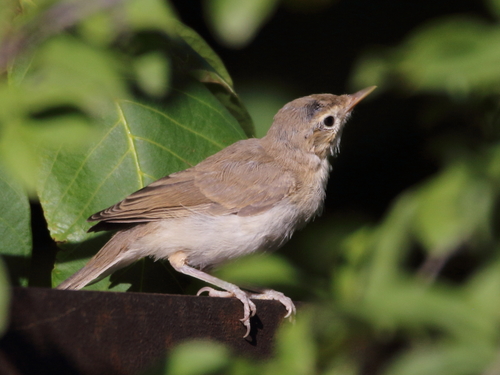 Eastern Olivaceous Warbler
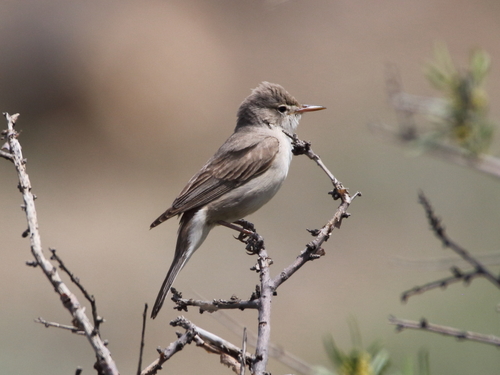 Upcher's Warbler
In short
The most reliable field mark between Eastern Olivaceous Warbler and Upcher's Warbler is behavioral: Upcher's Warbler shows frequent, chat-like tail movements, which are much more pronounced than the characteristic but subtler downward tail flick of Eastern Olivaceous. Structurally, Upcher's is larger, with a longer tail and bill, and a generally greyer appearance, while Eastern Olivaceous is paler and more delicate. Both species are similar in overall coloration, but Upcher's has a greyer tone and a jizz reminiscent of a Sylvia warbler. Vocalizations are very different, with Upcher's song being distinctive among Hippolais and nothing like the nasal babble of Eastern Olivaceous. Separation is challenging on plumage alone, especially for immatures, so focus on structure and tail behavior.
Identification tips
- Tail movement is diagnostic: Upcher's Warbler frequently flicks, fans, and raises its long tail in a chat-like manner; Eastern Olivaceous Warbler only gives a simple downward tail flick. Watch for this behavior when the bird is perched or foraging.
- Structure and jizz: Upcher's is larger, with a noticeably longer tail and bill, and a more robust, lanky appearance. Eastern Olivaceous is more compact, with a finer bill and shorter tail. Assess proportions carefully, especially in side view.
- Overall coloration: Upcher's is rather grey above and below, lacking the pale brown or greenish tinge sometimes shown by Eastern Olivaceous. If the bird looks warm-toned or pale, favor Eastern Olivaceous; if cold and grey, favor Upcher's.
- Underpart color: Eastern Olivaceous has whitish underparts (buffier in juveniles), while Upcher's is more uniformly greyish below. This is subtle and best used in good light.
- Bill shape: Upcher's bill is longer and heavier, especially at the base, compared to the strong but finer bill of Eastern Olivaceous. Use this in combination with tail length.
- Leg color: Both have grey legs; this is not a separator.
- Song: If singing, Eastern Olivaceous gives a fast nasal babbling, while Upcher's has a distinctive, non-babbling Hippolais song. Use song as a primary separator in spring and early summer.
- Flight jizz: Upcher's looks longer-tailed and more buoyant in flight; Eastern Olivaceous is more compact and less showy.
- Juvenile/immature plumage: No strong upperwing pattern differences are described for either species, so do not rely on wing panels or covert markings in young birds.
- Sex differences: Both species are sexually monomorphic; do not use sex as a separator.
- Seasonal context: In southeastern Europe and western Asia, both may occur in migration; check range and season, but do not rely solely on location.
- Habitat: Both use dry scrub and open woodland, but Upcher's may prefer drier, more open areas in its eastern range. Not diagnostic in overlap zones.
- Pitfalls: Both can appear drab and similar in poor light or at distance. Always prioritize tail movement and structure over subtle plumage tones.
- Young birds: Juvenile Eastern Olivaceous can look buffier below, but this is not a strong separator from Upcher's, which is always more uniform grey.
- When in doubt: If you see frequent, energetic tail movements and a long-tailed, greyish warbler, favor Upcher's. If the bird is more static, with a pale, compact look and only a downward tail flick, favor Eastern Olivaceous.
Size
Upcher's Warbler is the larger of the two, with a body size similar to Icterine Warbler, featuring a longer bill, longer tail, and shorter wings. Eastern Olivaceous Warbler is medium-sized for a warbler but noticeably more delicate, with a smaller, finer bill and shorter tail. In the field, Upcher's will look lankier and longer-tailed, while Eastern Olivaceous appears more compact and slim-billed. Both are similar in size to other Hippolais/Iduna warblers, but Upcher's is distinctly more robust.
Plumage
There are no strongly diagnostic juvenile or immature upperwing patterns described for either species, so separation relies on overall coloration and subtle differences. Adult Eastern Olivaceous Warbler is plain pale brown above with whitish underparts, sometimes showing a faint greenish tinge on the upperparts, and young birds have a buffier belly. Upcher's Warbler is rather grey overall, lacking the brown or greenish tones, and is never as pale below. Both have plain plumage, but Upcher's is always greyer and more uniform, while Eastern Olivaceous tends to look paler and slightly warmer, especially in fresh plumage. Bill and leg color are similar (grey legs, strong pointed bill), but Upcher's bill is longer and more robust. Sexes are alike in both species.
Behaviour
Tail movement is the key behavioral separator: Upcher's Warbler constantly flicks and fans its long tail in a manner reminiscent of Sylvia warblers or chats, often raising and lowering it with energy. Eastern Olivaceous Warbler also flicks its tail, but the movement is more restrained and typically a simple downward flick. In flight, Upcher's looks longer-tailed and more buoyant, while Eastern Olivaceous is more compact and less showy. Both forage in similar fashion, gleaning insects from foliage, but Upcher's is more conspicuous due to its tail action.
Habitat
Both species breed in overlapping regions of southeastern Europe and western Asia, often in dry scrub, open woodland, or bushy areas. Eastern Olivaceous tends to be more widespread in southeastern Europe and the Middle East, while Upcher's is more strictly eastern, from Turkey to Pakistan. In winter, both migrate to Africa, but Upcher's is found farther east and south. Habitat is not strongly diagnostic in overlap zones, but Upcher's may prefer slightly drier, more open scrub.
Voice
The songs are very different and can be diagnostic if heard. Eastern Olivaceous Warbler gives a fast, nasal babbling song, typical of Iduna warblers. Upcher's Warbler, in contrast, has a distinctive song among Hippolais warblers, described as unmistakable and entirely unlike the olivaceous's babble. Calls are less well described, but song is a strong separator where heard.
Eastern Olivaceous Warbler · Upcher's Warbler · My Tricky Birds