

Eared Dove vs Spectacled Thrush
Zenaida auriculata versus Turdus nudigenis
Play a quiz with Eared Dove and Spectacled Thrush
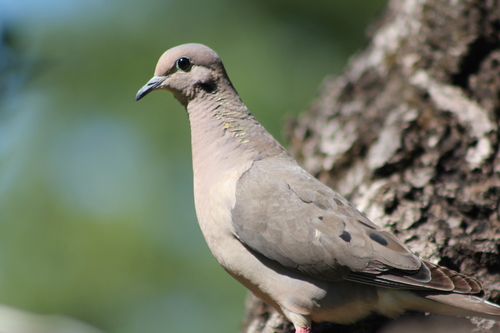 Eared Dove
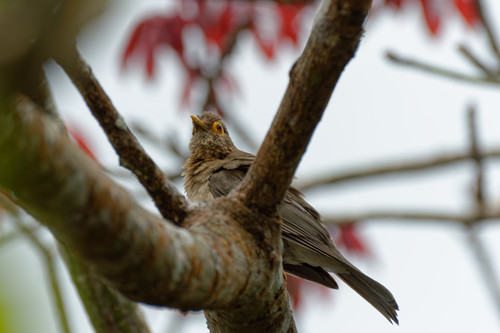 Spectacled Thrush
In short
The most reliable way to separate Eared Dove from Spectacled Thrush is by focusing on the head pattern: Eared Dove has a distinctive black line behind the eye and a dark patch on the lower ear coverts, while Spectacled Thrush shows a bold yellow eye-ring with no black facial markings. In flight or perched, Eared Dove’s long, wedge-shaped tail and black-spotted wings are unlike the plain, thrush-like appearance of Spectacled Thrush. Juvenile plumages can be confusingly dull, but the dove’s structure and facial marks remain distinctive. Both species are similar in length, but Eared Dove is much heavier and more compact, with a distinctly different jizz.
Identification tips
- Facial pattern is key: Eared Dove always shows a black line behind the eye and a dark patch on the lower ear coverts (all ages), while Spectacled Thrush has a bold yellow eye-ring and no black facial markings.
- Wing pattern: Eared Dove (adult) has black spots on the wings, visible both perched and in flight; Spectacled Thrush has plain wings with no spots or panels at any age.
- Tail shape: Eared Dove has a long, wedge-shaped tail with a cinnamon tip; Spectacled Thrush’s tail is straight-edged and lacks color at the tip.
- Underparts: Eared Dove’s underparts are vinous (pinkish-brown), while Spectacled Thrush is paler brown below, with a whitish lower belly and streaked throat.
- Juvenile confusion: Young Eared Doves are dull and barred, but still have the black facial marks; juvenile Spectacled Thrushes are flecked above, spotted below, and have a thinner yellow eye-ring but never black facial marks.
- Size and structure: Eared Dove is much heavier and more compact, with a shorter neck and rounder body; Spectacled Thrush is slimmer and more elongated, with typical thrush proportions.
- Bill: Eared Dove has a short, black bill; Spectacled Thrush has a longer, thrush-like bill, often with a paler base (not always visible at distance).
- Leg color: Eared Dove’s legs are dark red; Spectacled Thrush’s legs are not described as distinctive, but are not red.
- Flight style: Eared Dove flies fast and direct with sharp flicks; Spectacled Thrush flies with more labored, undulating motion typical of thrushes.
- Flocking: Eared Dove is often in large flocks, especially in open areas; Spectacled Thrush is usually solitary or in pairs.
- Habitat: Open fields, wires, and urban parks favor Eared Dove; woodland, gardens, and shrubby areas favor Spectacled Thrush.
- Voice: Deep, soft cooing for Eared Dove; musical warble or cat-like calls for Spectacled Thrush.
- Sex differences: Only Eared Dove shows slight sexual dimorphism (male brighter), but both sexes have the same key marks; Spectacled Thrush sexes are similar.
- Seasonal context: Both are resident, but Eared Dove is much more likely in large open flocks, especially in agricultural areas.
- Common pitfalls: Dull juveniles can confuse, but the dove’s black facial marks and the thrush’s yellow eye-ring are always present. Always check the head pattern first.
Size
Both species are similar in length, with Eared Dove at about 24 cm and Spectacled Thrush at 23–24 cm [wikipedia]. However, Eared Dove is much heavier (about 112 g vs. 60 g) [wikipedia], giving it a chunkier, more compact appearance compared to the slimmer, more elongated thrush. The dove also has a longer, wedge-shaped tail, while the thrush’s tail is more typical for a Turdus: straight-edged and less pointed.
Plumage
- Juvenile/immature birds: Young Eared Doves are very dull greyish-brown with pale barring, but still show the characteristic black line behind the eye and dark ear patch. Juvenile Spectacled Thrushes are flecked above and spotted below, with a thinner but still present yellow eye-ring. The thrush never shows black facial marks.
- Adults: Eared Dove males have olive-brown upperparts with black spots on the wings, a grey crown, black line behind the eye, and a blue-black patch on the lower ear coverts. Underparts are vinous, and the tail is long, wedge-shaped, and cinnamon-tipped. Females are similar but duller. Spectacled Thrush adults are plain olive-brown above, paler brown below, with a brown-streaked off-white throat, whitish lower belly, and a prominent yellow eye-ring. No wing spots or black facial marks are present. Both sexes look alike in the thrush.
Behaviour
Eared Doves are highly gregarious, often forming large flocks, especially in open country and agricultural areas. Their flight is high, fast, and direct, with regular wingbeats and occasional sharp flicks. They are often seen perched on wires or posts. Spectacled Thrushes are more solitary or found in pairs, foraging on the ground or in low vegetation, and move with typical thrush hops rather than the rapid, direct flight of doves. The thrush’s behavior is more furtive and less likely to be seen in large flocks.
Habitat
Eared Dove thrives in open areas, savannahs, farmland, and even urban spaces, readily adapting to human-modified habitats. They are common in public spaces, fields, and even beach resorts. Spectacled Thrush prefers woodland, forest edges, gardens, and shrubby areas, and is less likely to be seen in open agricultural fields or large urban spaces. If you see a bird in a large open field or flocking in the sky, it is much more likely to be an Eared Dove.
Voice
Eared Dove gives a deep, soft 'oo-ah-oo' call, typical of doves and quite different from thrushes. Spectacled Thrush has a musical warble, slower and lower-pitched than Cocoa Thrush, and also gives a cat-like 'queeoow' and a harsh 'kereel' when alarmed. If you hear a soft, repetitive cooing, think dove; if you hear a warbling song or cat-like call, think thrush.