

Dusky Thrush vs Naumann's Thrush
Turdus eunomus versus Turdus naumanni
Play a quiz with Dusky Thrush and Naumann's Thrush
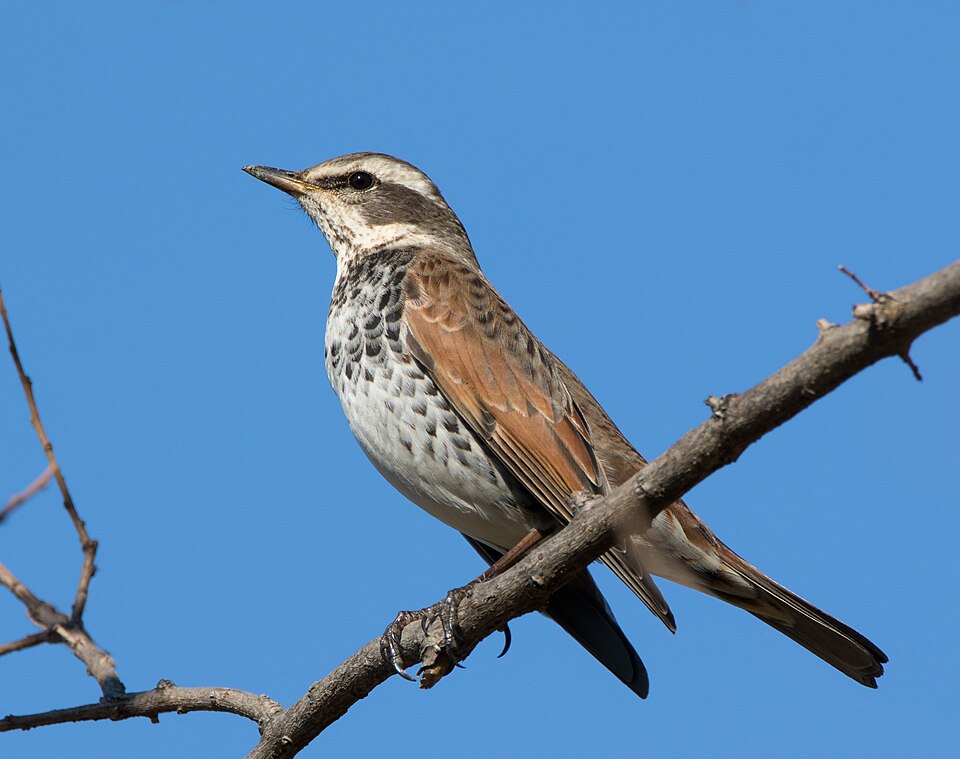 Dusky Thrush
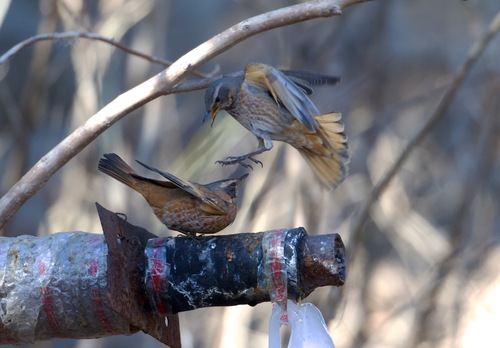 Naumann's Thrush
In short
The most reliable field mark between Dusky Thrush and Naumann's Thrush is the color of the back, rump, and the face and breast markings: Dusky Thrush shows a dark brown back and rump with blackish face, breast, and flank spots, while Naumann's Thrush has a paler brown back and head with reddish face, breast, flank spots, and rump. Both species have a pale supercilium and white belly/undertail, but the tone and extent of dark versus reddish coloration is the key. Immature birds of both species are less distinctly marked, but the overall color theme (dusky/blackish vs. rufous/reddish) still separates them. Structure and size are very similar, so focus on plumage contrasts, especially in the upperparts and face.
Identification tips
- Back and rump color: Dusky Thrush always shows a dark brown back and rump; Naumann's Thrush has a paler brown back and a distinctly reddish rump. This is the most consistent field mark in all ages.
- Face and breast markings: Dusky Thrush has blackish face, breast, and flank spots; Naumann's Thrush has reddish or rufous tones in these areas. Look for the overall color theme: dusky/blackish vs. rufous/reddish.
- Immature birds: Both species have weaker patterning when immature, but the color theme holds: Dusky is darker and more blackish, Naumann's is paler and more rufous. Even in first-winter birds, check for reddish vs. blackish face and rump.
- White belly and undertail: Both species have this feature; it is not a separator.
- Supercilium: Both show a pale supercilium; do not use this for separation.
- Underwing color: Both have reddish brown underwings, so this is not diagnostic.
- Sex differences: Males and females are similar in both species; do not rely on sex for identification.
- Flight views: No unique upperwing or flight pattern differences are described. Focus on the color of the back, rump, and face even in flight.
- Structure and size: Both are medium-sized, stocky thrushes with similar proportions. Structure is not helpful for separation.
- Habitat: Slight tendency for Dusky Thrush in more mountainous/tundra-edge areas and Naumann's in open woodland, but both overlap widely, especially in winter. Do not rely on habitat alone.
- Song: Dusky Thrush has a simple, fluted, redwing-like song; Naumann's Thrush may differ, but field separation by song is not practical unless you know both species well.
- Flock composition: Both can form mixed flocks in migration or winter, so do not assume a single species based on flocking.
- Season: Both species migrate and winter in overlapping regions; season does not reliably separate them.
- Pitfall: Immature birds are less distinct, but even then, the presence or absence of reddish tones on the face and rump is the best clue.
- Quick check: If the bird looks overall dark and blackish with a dark rump and face, it's likely Dusky Thrush; if it looks paler brown with obvious reddish on the face, breast, and rump, it's Naumann's Thrush.
Size
Both Dusky Thrush and Naumann's Thrush are medium-sized, stocky thrushes, reminiscent of a small fieldfare. There are no reliable size or structural differences noted between the two: bill, tail, and body proportions are essentially the same. Use plumage rather than size for identification.
Plumage
- Immature/juvenile birds: Both species have weaker and less distinct patterning than adults, but the underlying color differences remain: Dusky Thrush immatures are generally darker brown with blackish markings, while Naumann's Thrush immatures are paler brown with more rufous or reddish tones, especially on the face, breast, and rump.
- Adults (all seasons): Dusky Thrush has a dark brown back and rump, with blackish face, breast, and flank spots. Naumann's Thrush has a paler brown back and head, with reddish face, breast, flank spots, and rump. Both have a white belly and undertail, and a pale supercilium. The underwing is reddish brown in both, so this is not a separating mark.
- Sexes: Females are similar to males in both species, but with slightly less intense patterning. This does not affect the main color contrasts.
- Flight views: No unique upperwing or flight pattern differences are described; focus on the back, rump, and face color even in flight.
Behaviour
Both species behave similarly: they are medium-sized thrushes, often seen foraging on the ground or perching in trees. Both can form small flocks, especially in migration or winter. There are no described behavioral differences that aid identification.
Habitat
Habitat overlap is extensive, but there is a slight tendency for Dusky Thrush to be more tolerant of mountainous and tundra-edge habitats, while Naumann's Thrush favors open woodland. However, both winter in similar areas (Korea, China, Japan, and neighboring countries) and can be found together, so habitat is not a reliable separator in most field situations.
Voice
Both species have songs that are broadly similar, but the Dusky Thrush's song is described as a simple fluted or whistling song, reminiscent of a redwing. There are suggestions that Naumann's Thrush has a different song, but details are not provided. Song is not a reliable field mark for separation unless you are very familiar with both.