

Dunlin vs White-winged Black Tern
Calidris alpina versus Chlidonias leucopterus
Play a quiz with Dunlin and White-winged Black Tern
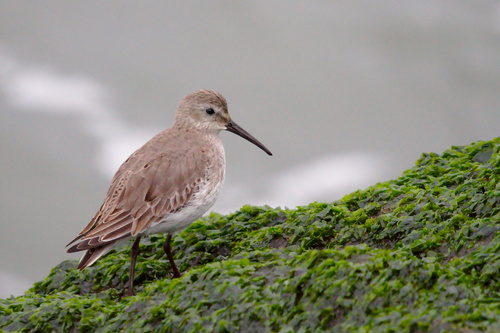 Dunlin
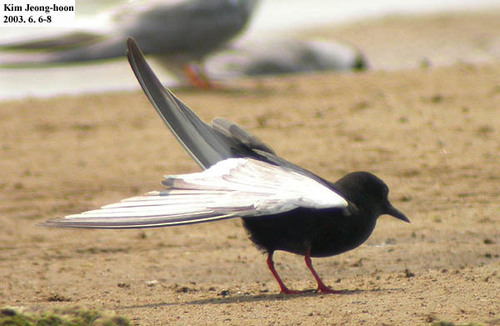 White-winged Black Tern
In short
The most reliable field mark is the white wing pattern in flight: White-winged Black Tern (WWBT) of all ages shows strikingly pale wings with a white rump and tail, while Dunlin always has a narrow white wingbar and dark outer wings, never all-white. Juvenile and non-breeding Dunlin can be confused with non-breeding or juvenile WWBT at a distance, but Dunlin is a compact, short-necked sandpiper with a slightly decurved black bill and dark legs, feeding on mudflats, while WWBT is a small, buoyant tern with a short, stubby bill, red legs, and a more swallow-like flight. In breeding plumage, Dunlin's black belly is unique among small waders and never shown by WWBT. Use structure, flight style, and habitat as backup if plumage is ambiguous.
Identification tips
- Wing pattern in flight (all ages): Dunlin always shows a narrow white wingbar on otherwise dark wings; WWBT has mostly white wings with grayish inner wing and brown-tipped coverts, and a pale gray rump and tail. If the wings look all-white or very pale, it's WWBT, not Dunlin.
- Rump and tail: Dunlin's rump and tail are never white; WWBT shows a white or pale gray rump and tail, especially obvious in flight and in juveniles.
- Bill shape: Dunlin has a longer, slightly decurved black bill (blunt-tipped in life), while WWBT's bill is short, stubby, and straight—noticeably shorter than the head.
- Leg color: Dunlin has black legs; WWBT has short red legs (especially obvious in breeding plumage, less so in non-breeding or at a distance).
- Body structure: Dunlin is compact, short-necked, and starling-like; WWBT is more slender, with a short neck and a swallow- or tern-like jizz.
- Breeding plumage belly: Only Dunlin shows a solid black belly in breeding plumage. WWBT may have a black neck and belly, but the overall pattern is different, with white wings and rump.
- Juvenile back pattern: Dunlin juveniles have two weak whitish 'V' shapes on the back; WWBT juveniles have a dark brown saddle isolated by white collar and rump.
- Underwing: WWBT in non-breeding plumage retains blackish underwing-coverts, contrasting with pale wings; Dunlin's underwing is plain, with only the white wingbar.
- Feeding behavior: Dunlin probes mud with a 'sewing machine' action; WWBT picks insects from the water surface or in flight, rarely landing on mud.
- Habitat: Dunlin is on coastal mudflats and beaches; WWBT is over freshwater lakes and marshes. Context is a strong clue.
- Flight style: Dunlin's flight is direct and purposeful; WWBT is buoyant, with shallow, leisurely wingbeats typical of marsh terns.
- Voice: A sandpiper-like 'chreep' or harsh trill points to Dunlin. WWBT's calls are not described here but are not sandpiper-like.
- Seasonal confusion: In winter, Dunlin is plain grey-brown above and white below; WWBT is mostly white or pale grey, but always with pale wings and rump.
- Flock behavior: Large, dense, swirling flocks on mudflats are Dunlin; scattered, buoyant birds over water are WWBT.
- Bill length and sex: Dunlin females have longer bills than males, but both are longer and more decurved than WWBT's stubby bill. Bill length is not a reliable sex or species separator in the field, but the shape is diagnostic.
Size
Dunlin is slightly larger and heavier (16–20 cm length, 34–77 g, 38–43 cm wingspan [wikipedia]) than White-winged Black Tern, which is a small tern (bill 22–25 mm, shorter than head [wikipedia]). Dunlin is stouter and more compact, with a proportionally longer, decurved bill and relatively short neck. WWBT is more delicate, with a shorter, stubby bill, shorter neck, and a more buoyant, tern-like jizz. Both are small birds, but Dunlin is more starling-like in build, while WWBT is more swallow-like.
Plumage
- Juvenile/First-winter:
- Dunlin juveniles are brown above with two weak whitish 'V' shapes on the back (less obvious than in Little Stint), and usually have black marks on the flanks or belly. In flight, all ages show a narrow white wingbar, never a wholly white wing. The upperwing is otherwise dark, with no pale panels or rump.
- WWBT juveniles have a pale gray rump and tail, with a dark brown 'saddle' (mantle) isolated by the white collar and rump. The wings are mainly white, with grayish inner wings and brown-tipped coverts. The tail often looks 'square' in juveniles. In flight, the wings appear much paler than Dunlin's, and the rump and tail are distinctly pale.
- Adult breeding:
- Dunlin: Unique black belly, greyish-brown upperparts, white underparts outside the belly patch. Black legs and slightly decurved black bill.
- WWBT: Black neck and belly, very dark grey back, white rump and tail, mainly white wings. Short red legs and short black bill. Face tinged yellowish.
- Adult non-breeding:
- Dunlin: Greyish-brown above, white below, no black belly. All ages keep the narrow white wingbar in flight.
- WWBT: Most black replaced by white or pale grey, but blackish underwing-coverts remain. Head is black with a white forehead, crown flecked with white, and a broad white collar. Rump is pale gray. Wings remain pale, with dark underwing patches.
Behaviour
Dunlin is a methodical feeder, moving along mudflats with a 'sewing machine' action, probing for invertebrates. It is highly gregarious in winter, forming large, dense flocks that swirl in synchronized flight. WWBT, like other marsh terns, flies slowly over water, picking insects from the surface or catching them in flight, with shallow, leisurely wingbeats. It does not dive for fish like 'white' terns. WWBT is rarely seen probing mud or feeding on the ground like Dunlin. In flight, Dunlin appears purposeful and direct, while WWBT is buoyant and tern-like.
Habitat
Dunlin is almost always found on coastal mudflats, sandy beaches, or estuaries, especially in winter. It is rarely seen far from tidal habitats. WWBT is a freshwater marsh tern, usually found over lakes, marshes, or large inland ponds, rarely on open coastlines. If you see a small wader on a tidal mudflat, it is almost certainly a Dunlin; a pale-winged, swallow-like bird over a freshwater marsh is likely a WWBT.
Voice
Dunlin gives a typical sandpiper 'chreep' call and, in display, a harsh trill. WWBT's calls are not described in the provided notes, but as a tern, its voice is generally higher-pitched and less sandpiper-like. If you hear a sandpiper's call, suspect Dunlin.