

Dull-mantled Antbird vs Zeledon's Antbird
Sipia laemosticta versus Hafferia zeledoni
Play a quiz with Dull-mantled Antbird and Zeledon's Antbird
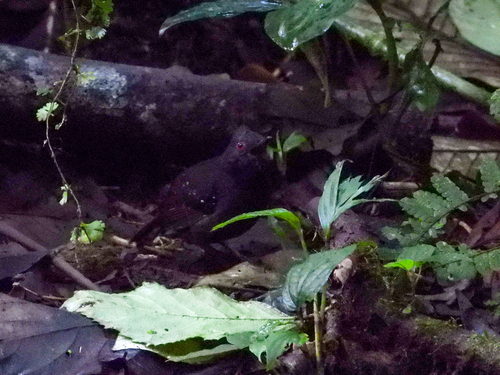 Dull-mantled Antbird
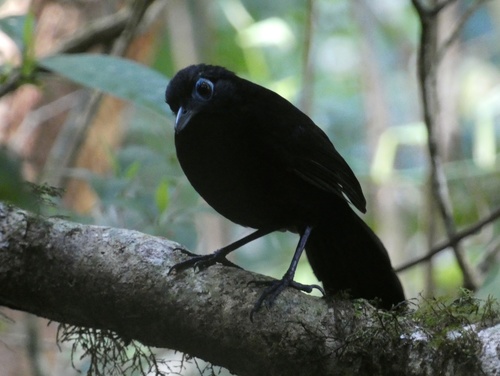 Zeledon's Antbird
In short
The most reliable field mark is overall size and structure: Zeledon's Antbird is much larger and bulkier than Dull-mantled Antbird, with a noticeably heavier build and a prominent pale blue eye-ring. Adult male plumage is also a strong separator—Zeledon's is nearly all black (with a blue eye-ring), while Dull-mantled shows a slate-black head but rich reddish-brown upperparts and flanks. Females are trickier: both are brownish, but Zeledon's is paler below and lacks the black-and-white throat pattern of Dull-mantled. Immature males of both species resemble females, so size and the blue eye-ring are especially important. Both species overlap in range and habitat, so careful attention to these features is essential.
Identification tips
- Size and bulk are the most consistent field marks: Zeledon's Antbird is much larger and heavier than Dull-mantled; if the bird appears notably bulky or large-headed, suspect Zeledon's, especially in direct comparison.
- Pale blue eye-ring (Zeledon's only): Both sexes and all ages of Zeledon's Antbird show a wide, pale blue ring around the eye, which is absent in Dull-mantled. This is often visible even in poor light or at a distance.
- Adult male plumage: Zeledon's males are almost entirely black, while Dull-mantled males have a slate-black head and upper mantle but rich reddish brown or chestnut upperparts and flanks. Look for contrast between the head and back/flanks in Dull-mantled.
- Female and immature plumage: Dull-mantled females have a black throat with many white spots or bars, while Zeledon's females are plain dark brown above and paler below, with a black face and lores but no throat spotting. Immature males of both species resemble females, so use size and eye-ring.
- Wing covert markings: Dull-mantled has dark reddish brown greater coverts with cinnamon/rufous tips, and black median/lesser coverts with white tips (cinnamon-tinged in females); Zeledon's has variable white on the wing coverts, usually hidden, and this is more extensive in the H. z. berlepschi subspecies.
- Iris color: Both species have a red iris, but only Zeledon's has the blue eye-ring.
- Bill color: Dull-mantled males have a black bill; females have a black maxilla and gray mandible. Zeledon's bill color is not described as diagnostic.
- Tail behavior: Dull-mantled often beats its tail down forcefully and slowly raises it; Zeledon's pumps its tail while hopping between feeding stops. Subtle, but may help with prolonged views.
- Army ant swarms: Zeledon's is more likely to be seen in larger groups at ant swarms, while Dull-mantled is usually solitary or in pairs/family groups.
- Vocalizations: If you hear a rapidly delivered, loud, slightly descending series of clear whistled notes, it's Zeledon's. Dull-mantled's song is not described here, so absence of this song is not diagnostic.
- Hidden scapular patch: Dull-mantled may show a hidden white patch between the scapulars; Zeledon's does not.
- Underparts color: Dull-mantled has dark gray/slate underparts with reddish brown sides/flanks; Zeledon's female is paler brown below, male is all black.
- Geographic range: Only use range if outside the overlap zone (e.g., Zeledon's in Ecuador or Nicaragua); otherwise, not helpful.
- Habitat: Both species use similar dense forest undergrowth; do not rely on habitat for separation.
- Mixed flocks: Both rarely join mixed-species flocks, so this is not useful for separation.
Size
Zeledon's Antbird is significantly larger and heavier, measuring 17–20 cm in length and weighing 40–56 g (average 48 g) [wikidata], while Dull-mantled Antbird is much smaller at 12.5–15 cm and about 25 g [wikipedia]. In the field, Zeledon's appears bulkier and more robust, with a larger head and body. This size difference is often apparent even at a distance, especially if both species are seen in quick succession or near each other.
Plumage
Juveniles and immatures: Both species' immature males resemble adult females, so sex-based plumage cues are unreliable in young birds. Dull-mantled young males have a brown wash on the head and faint buff mottling on the throat, lacking the adult's black underparts. Zeledon's immature males look like adult females—dark brown above, paler below, with black face and lores.
Adult males: Dull-mantled Antbird males have a blackish gray to slate-black head, neck, and upper mantle, but the rest of the upperparts and flanks are dark reddish brown to chestnut, with a usually hidden white scapular patch. The throat and chin are black, and the underparts are dark gray to slate. Zeledon's Antbird males are almost entirely black, with variable and usually hidden white on the wing coverts, and a striking pale blue eye-ring.
Adult females: Dull-mantled females are similar to males but with less blackish gray, a smaller interscapular patch, cinnamon-tinged median coverts, and a black throat with many white spots or bars. Zeledon's females are dark brown above, paler and brighter brown below, with a black face and lores, and lack the spotted throat. Both sexes of Zeledon's have a pale blue eye-ring and deep red iris, while Dull-mantled has a red iris but no blue eye-ring.
Behaviour
Both species forage in dense vegetation, mostly on or near the ground, and both may follow army ant swarms. Zeledon's Antbird is more likely to be seen at ant swarms in larger groups (sometimes 10+ individuals), while Dull-mantled is more solitary or in small family groups and only occasionally attends swarms. Both species pump their tails while foraging, but Dull-mantled is described as beating its tail down forcefully and slowly raising it, whereas Zeledon's hops between feeding stops and pumps its tail. Both species rarely join mixed-species flocks.
Habitat
Both species occur in humid forest undergrowth in Central and northern South America, and their ranges overlap in Colombia, Costa Rica, and Panama. Habitat is not a reliable separator: both are found in dense, low vegetation, often within 1 meter of the ground. Zeledon's range extends further south into Ecuador and Nicaragua, but this is not useful for field separation within the overlap zone.
Voice
Zeledon's Antbird has a distinctive song: a rapidly delivered, loud, slightly descending series of clear whistled notes ('peer-peer-peer-peer-peer-peer-peer-peer'), slowing at the end. Both sexes give an explosive 'cheek!' call and a fast scolding 'jee-jee-jit.' Dull-mantled Antbird's vocalizations are not described in the provided notes, so song is only a reliable separator if Zeledon's distinctive whistled series is heard.