
Double-toothed Kite vs Roadside Hawk
Harpagus bidentatus versus Rupornis magnirostris
Play a quiz with Double-toothed Kite and Roadside Hawk
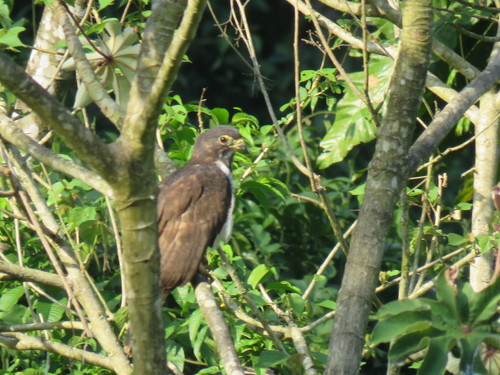 Double-toothed Kite
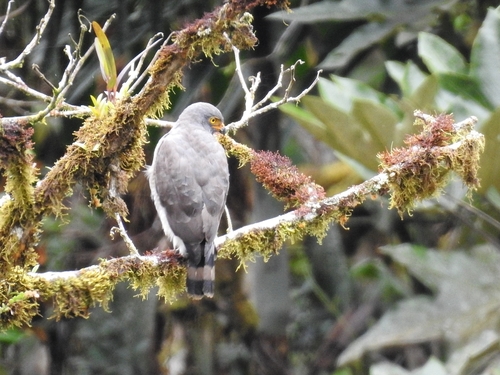 Roadside Hawk
In short
Immature Double-toothed Kites show deep brown upperparts and bold vertical streaks below, while immature Roadside Hawks are more variable but generally lack such strong vertical streaking. In adults, the best field mark is the combination of head and underpart pattern: Double-toothed Kite has a dark gray head with a white throat and central dark stripe, plus rufous underparts with barring, while Roadside Hawk is browner or grayer overall with a less contrasting head and more extensive brown-and-white barring below. In flight, Roadside Hawk shows a relatively long tail and short, broad wings, often with a rufous tinge on the wings, while Double-toothed Kite appears slimmer and more Accipiter-like. Eye color also differs: Double-toothed Kite has red eyes, Roadside Hawk yellow or whitish. Both species can be found in overlapping ranges, but Roadside Hawk is much more common and vocal.
Identification tips
- Immature plumage: Immature Double-toothed Kites have deep brown upperparts and bold vertical brown streaks on whitish to buff underparts—look for this strong vertical streaking, which is not matched by immature Roadside Hawks, which show more diffuse barring or mottling.
- Head pattern (adults): Double-toothed Kite has a dark gray head with a white throat and a distinctive central dark stripe; Roadside Hawk's head is less contrasting, blending into the brown or gray upperparts.
- Underparts (adults): Double-toothed Kite shows rufous on the breast and belly, with gray and whitish barring (especially in H. b. fasciatus); Roadside Hawk has brown-and-white barred underparts, usually without extensive rufous.
- Tail pattern: Double-toothed Kite has a blackish tail with three grayish bands and a gray tip; Roadside Hawk's tail is brown with four or five gray bars—counting the bars can help but may be hard in the field.
- Eye color: Adult Double-toothed Kite has red eyes; Roadside Hawk's are yellow or whitish. This is subtle but can be diagnostic at close range.
- Bill and cere: Double-toothed Kite has a greenish-yellow cere and a bill with tooth-like notches on the maxilla (not usually visible in the field); Roadside Hawk has a relatively large bill and a less distinctive cere.
- Wing and tail shape in flight: Roadside Hawk has relatively short, broad wings and a long tail, giving a compact, chunky look; Double-toothed Kite is slimmer with longer wings relative to tail, appearing more Accipiter-like.
- Rufous on wings: Roadside Hawk often shows a rufous tinge on the wings in flight, which Double-toothed Kite lacks.
- Perching behavior: Roadside Hawk often perches in the open on wires, posts, or exposed branches; Double-toothed Kite is more secretive and usually stays in forest or at the edge.
- Soaring and flight style: Roadside Hawk frequently soars, sometimes high over open areas, and does not hover. Double-toothed Kite is less likely to soar in the open and is more agile in forested settings.
- Vocalization: Roadside Hawk is very vocal with a high-pitched squeak; Double-toothed Kite is much quieter. Persistent calling from a small raptor is a strong clue for Roadside Hawk.
- Habitat: Roadside Hawk is common in open country, forest edge, and near human habitation; Double-toothed Kite is mostly in mature or tall secondary forest, rarely in open areas.
- Association with monkeys: If you see a small raptor following monkey troops, it is likely a Double-toothed Kite, as Roadside Hawk does not show this behavior.
- Relative abundance: Roadside Hawk is much more common and likely to be seen in most habitats outside dense forest; Double-toothed Kite is uncommon and mostly restricted to forested areas.
- Sexual dimorphism: Both species have similar plumage between sexes, but female Double-toothed Kites are slightly richer in color; this is subtle and rarely useful in the field.
Size
Double-toothed Kite is slightly smaller and lighter, with a body mass around 195 g and a length of 29–35 cm (wingspan 60–72 cm). Roadside Hawk is heavier (250–300 g) and longer (31–41 cm), and females are about 20% larger than males. In the field, Roadside Hawk often looks bulkier and more robust, especially in the chest and bill, while Double-toothed Kite is slimmer and more delicate. Roadside Hawk's tail is relatively long for its body, and its wings are proportionally shorter and broader, giving it a compact, chunky appearance, especially when perched.
Plumage
Immature Double-toothed Kites are deep brown above with bold vertical brown streaks on whitish to buff underparts—this strong vertical streaking is a key mark for young birds. Immature Roadside Hawks are more variable but typically do not show such pronounced vertical streaks; instead, they tend to have more diffuse barring or mottling below. Adult Double-toothed Kites have a dark gray head, white throat with a central dark stripe, lighter gray upperparts, and a blackish tail with three grayish bands and a gray tip. Their underparts are rufous with gray and whitish barring (more extensive and paler in H. b. fasciatus). Roadside Hawk adults are brown or gray above (depending on subspecies), with a less contrasting head, brown-and-white barred underparts, and a tail with four or five gray bars. In flight, Roadside Hawk often shows a rufous tinge to the wings, which is absent in Double-toothed Kite. Eye color is also a clue: Double-toothed Kite has red eyes, while Roadside Hawk's are yellow or whitish.
Behaviour
Roadside Hawk is much more likely to be seen perched conspicuously on wires, posts, or exposed branches along roadsides and open areas, often vocalizing. It frequently soars with its relatively short, broad wings and long tail, but does not hover. Double-toothed Kite is more secretive, typically found in forested habitats, and is less likely to be seen in open country or perched in the open. It often follows monkey troops to catch prey flushed by their movement, a behavior not shared by Roadside Hawk. In flight, Double-toothed Kite appears slimmer and more Accipiter-like, while Roadside Hawk looks chunkier and more Buteo-like.
Habitat
Roadside Hawk is highly adaptable and often the most common raptor in its range, especially in open country, forest edges, and near human habitation. It is frequently seen along roadsides, as its name suggests. Double-toothed Kite is more restricted to forested habitats, especially mature or tall secondary forest, and is much less likely to be seen in open or disturbed areas. If you see a small raptor in a city park, pasture, or roadside, it is far more likely to be a Roadside Hawk; Double-toothed Kite is more likely inside forest or at the edge, often in association with monkey troops.
Voice
Roadside Hawk is very vocal, with a high-pitched, piercing squeak that is often heard even when the bird is not visible. Double-toothed Kite is much quieter and less likely to be detected by voice. If you hear a persistent, high-pitched squeal from a perched raptor, Roadside Hawk is the likely culprit.