

Double-striped Thick-knee vs Lineated Foliage-gleaner
Hesperoburhinus bistriatus versus Syndactyla subalaris
Play a quiz with Double-striped Thick-knee and Lineated Foliage-gleaner
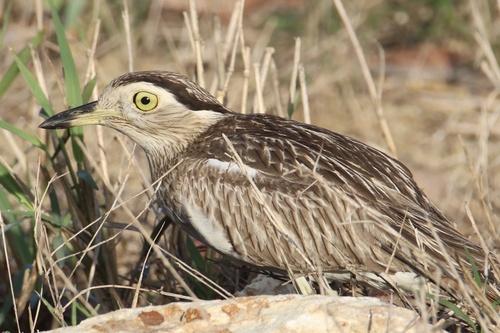 Double-striped Thick-knee
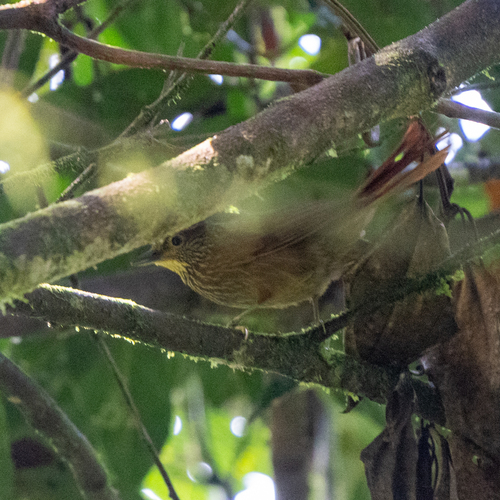 Lineated Foliage-gleaner
In short
The most reliable field mark is overall structure and size: Double-striped Thick-knee is a massive, long-legged wader with a heavy bill and cryptic, streaked plumage, while Lineated Foliage-gleaner is a much smaller, compact forest bird with a slender bill and strong buff streaking. In flight, Thick-knee shows a bold white patch on the dark upperwing and a white underwing with a black rear edge (all ages), which is never matched by the Foliage-gleaner. Perched, Thick-knee’s strong head stripes and huge yellow eyes contrast with the Foliage-gleaner’s streaked face and dark eyes. Habitat is also a strong clue: Thick-knee is found in open, arid grasslands, while Foliage-gleaner stays in humid forests.
Identification tips
- Size and structure: Double-striped Thick-knee is enormous, with long, greenish-grey legs and a heavy, strong bill; Foliage-gleaner is small, compact, and short-legged. Size alone is diagnostic if seen together or with a sense of scale.
- Flight pattern (all ages): Thick-knee shows a bold white patch on the dark upperwing and a white underwing with a black rear edge—unique and never matched by Foliage-gleaner, which has uniformly dark brown wings with some rufous at the bend.
- Leg color and length: Thick-knee’s legs are very long and greenish-grey, often visible even when crouched; Foliage-gleaner’s legs are much shorter and olive-green to greenish gray, usually hidden by foliage.
- Bill shape and color: Thick-knee has a strong, black and yellow bill, suited for grabbing prey on the ground; Foliage-gleaner has a slender, dark bill, adapted for probing bark and leaf litter.
- Eye color: Thick-knee’s eyes are large and bright yellow, standing out even at dusk; Foliage-gleaner’s eyes are brown to dark brown and much less prominent.
- Head pattern: Thick-knee has a bold white supercilium bordered above by a black stripe, giving a double-striped look; Foliage-gleaner has a discontinuous buff supercilium and a more streaked, less sharply marked face.
- Upperparts streaking: Thick-knee’s upperparts are finely streaked grey-brown; Foliage-gleaner’s back and crown are heavily and boldly streaked with buff, especially in juveniles.
- Underparts: Thick-knee’s breast is pale brown merging into a white belly; Foliage-gleaner’s breast and belly are dark brown with buff streaks, fading towards the rear.
- Tail: Thick-knee’s tail is not distinctive; Foliage-gleaner’s tail is dark chestnut, sometimes visible when fanned.
- Juvenile differences: Juvenile Thick-knee is slightly darker above with a whitish nape; juvenile Foliage-gleaner is brighter, more reddish, with a blacker, cinnamon-streaked crown and ochraceous tones below.
- Habitat: Thick-knee is found in open, dry grasslands and pastures; Foliage-gleaner is restricted to humid forests. Context is often decisive.
- Behavior: Thick-knee stands or crouches in open, rarely flies, and is often seen at dusk or night; Foliage-gleaner is active, foraging in dense foliage, rarely seen on the ground in the open.
- Vocalization: If you hear a loud 'kee-kee-kee' at night, it is Thick-knee. Foliage-gleaner’s call is not described here.
- Perching/flying posture: Thick-knee appears upright, almost goose-like, when standing; Foliage-gleaner is more horizontal, often clinging to trunks or branches.
- Pitfalls: At a distance, both can appear brown and streaky, but the combination of size, structure, and habitat will always separate them if carefully observed.
Size
Double-striped Thick-knee is dramatically larger and heavier (body mass ~675 g) than Lineated Foliage-gleaner (~29 g). Thick-knee reaches 46–50 cm in length, towering over the Foliage-gleaner’s 17–19 cm. The Thick-knee’s bulk, long legs, and large head are unmistakable in the field, while the Foliage-gleaner is a small, slim, short-legged bird. Even at a distance or in poor light, the size gap is extreme and diagnostic.
Plumage
In flight, Double-striped Thick-knee (all ages) shows a striking white patch on the otherwise dark upperwing and a white underwing with a black rear edge—this is never seen in Lineated Foliage-gleaner, which has uniformly dark brown wings with some rufescent tones at the bend and no bold contrast. Perched, Thick-knee adults and juveniles have finely streaked grey-brown upperparts, a pale brown neck and breast merging into a white belly, and a bold white supercilium bordered above by a black stripe. Juvenile Thick-knees are slightly darker above with a whitish nape. Foliage-gleaner adults have a discontinuous buff supercilium, a dark brown crown with thin buff streaks, a rich brown back with long buff streaks, and a chestnut tail; juveniles are brighter and more reddish, with a blacker, cinnamon-streaked crown and more ochraceous tones. The Foliage-gleaner’s streaking is much bolder and more extensive on the face, crown, back, and underparts, while Thick-knee’s streaking is finer and more limited to the upperparts. The Thick-knee’s white belly and bold head stripes contrast with the Foliage-gleaner’s overall streaky brown look.
Behaviour
Double-striped Thick-knee is largely nocturnal and crepuscular, often seen standing motionless or crouching in open ground, relying on camouflage and flying only when pressed. Its movements are slow and deliberate, and it is rarely seen in trees. Lineated Foliage-gleaner is an active, restless bird, foraging energetically in dense forest undergrowth or mid-levels, often climbing trunks and branches, and rarely seen on open ground. The Foliage-gleaner’s behavior is typical of ovenbirds: quick, agile, and almost always in cover.
Habitat
Habitat is a strong separator. Double-striped Thick-knee inhabits arid grasslands, savannas, and other dry, open habitats, often in cleared pastures or semi-open country. It avoids forests and dense vegetation. In contrast, Lineated Foliage-gleaner is strictly a bird of humid forests, including foothill and montane zones, and is never found in open grasslands. If you see the bird in open, dry country, it is almost certainly a Thick-knee; if in dense forest, it is a Foliage-gleaner.
Voice
Double-striped Thick-knee gives a loud, repeated 'kee-kee-kee' call at night. There is no description of the Foliage-gleaner’s voice in the provided notes, so vocalization is not a reliable separator here unless you hear the Thick-knee’s distinctive call.
Double-striped Thick-knee · Lineated Foliage-gleaner · My Tricky Birds