

Diamond Dove vs Peaceful Dove
Geopelia cuneata versus Geopelia placida
Play a quiz with Diamond Dove and Peaceful Dove
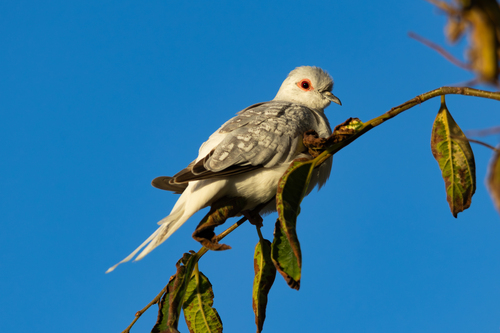 Diamond Dove
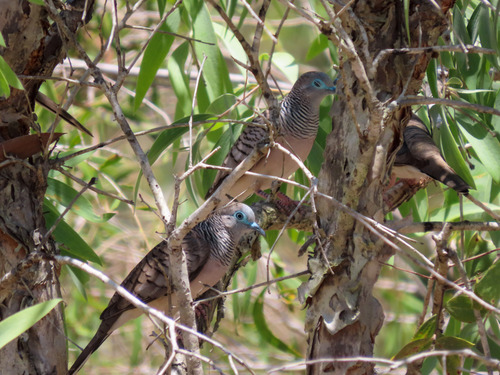 Peaceful Dove
In short
The most reliable field mark to separate Diamond Dove from Peaceful Dove is the presence of bold white spots with black edges on the wings of adult Diamond Doves, which are entirely absent in Peaceful Doves. Juvenile Diamond Doves lack these spots, but even then, the Peaceful Dove’s strong black striations on the neck and nape, and its blue-grey eye-ring, set it apart. Both are small, ground-feeding doves, but Diamond Dove is slightly lighter and more compact, with a red or orange eye-ring and a paler, blue-grey face in males. Peaceful Dove shows a more uniform chequered wing, pink-grey breast, and extensive black neck barring. Flight style and calls are similar, but subtle differences in structure and plumage are key.
Identification tips
- White wing spots (adults): Adult Diamond Doves have prominent white spots with black edges on the wings; Peaceful Doves never show these, regardless of age or sex.
- Juvenile confusion: Juvenile Diamond Doves lack wing spots, but also lack the strong black neck striations of Peaceful Dove. Juvenile Peaceful Doves are paler but still show some fine black neck lines.
- Neck and nape striations: Peaceful Dove (all ages) has thin black striations on the neck, nape, and upper back, giving a 'barred' look. Diamond Dove has a plain neck and nape.
- Eye-ring color: Diamond Dove has a red or orange eye-ring (brighter in males, duller in females and juveniles); Peaceful Dove has a blue-grey eye-ring that merges with the bill/cere.
- Eye color: Diamond Dove’s eye is red (adults) or fawn (juveniles); Peaceful Dove’s is greyish-white.
- Face and breast color: Male Diamond Dove has a blue-grey face and breast; female is browner. Peaceful Dove has a pink-grey breast and a less contrasting face.
- Bill color: Diamond Dove’s bill is dark grey (adults) or light grey (juveniles); Peaceful Dove’s bill is not specifically diagnostic.
- Belly and underparts: Diamond Dove has a creamy belly; Peaceful Dove’s underparts are more uniformly pink-grey.
- Wing pattern in flight: In all ages, Diamond Dove’s white spots are visible in flight (except juveniles); Peaceful Dove’s wings are chequered but lack spots.
- Tail shape: Peaceful Dove often shows a longer, more graduated tail than the compact Diamond Dove.
- Leg and foot color: Diamond Dove has pink legs and feet (adults), grey in juveniles; Peaceful Dove’s leg color is not highlighted as diagnostic.
- Habitat context: Diamond Dove is much more likely in open, arid or semi-arid areas near water; Peaceful Dove is common in gardens, woodlands, and urban edges.
- Behavior: Diamond Doves often run with a waddling gait on the ground; Peaceful Doves are more likely to be seen perching in trees when not feeding.
- Vocalizations: If heard, Diamond Dove’s call is slow and mournful; Peaceful Dove’s is higher-pitched and more repetitive, but overlap can occur.
- Group size: Both can be seen in pairs or small groups, but Peaceful Dove is more likely to be found in larger flocks, especially in urban or disturbed areas.
Size
Both species are among Australia’s smallest pigeons, with similar body lengths (19–21 cm). Diamond Dove is slightly lighter (31 g) than Peaceful Dove (no precise mass given, but similar or slightly heavier per community consensus). In the field, Diamond Dove may appear more delicate and compact, while Peaceful Dove is a touch bulkier and has a longer, more graduated tail.
Plumage
-
Juvenile/immature: Juvenile Diamond Doves lack the white wing spots and have a plain grey breast and fawn eye-ring, but still show a relatively pale face and lack the strong neck striations of Peaceful Dove. Juvenile Peaceful Doves are paler and less striated than adults, but still show some fine black lines on the neck and nape, and a dull blue-grey eye-ring.
-
Adult: Adult Diamond Doves (both sexes) have obvious white spots with black edges on the wings, a pale creamy belly, and a blue-grey (male) or brownish (female) head and breast. The eye-ring is vivid orange-red in males, duller in females. Peaceful Doves have chequered grey-brown wings (no white spots), a pink-grey breast, and extensive thin black striations on the neck, nape, and upper back. Their eye-ring is blue-grey and merges with the bill, and their face is less contrasting than Diamond Dove. The nape and throat are both striated in Peaceful Dove, unlike some similar species.
Behaviour
Both species are often seen feeding on the ground, sometimes in pairs or small groups. Diamond Dove tends to run with a waddling gait and is often seen in more open, arid areas. Peaceful Dove is more likely to be found in urban settings, gardens, and woodlands, and also roosts in trees. Both species have strong, direct, sometimes undulating flight, and their wings make a whistling or flushing 'frrr' noise in flight.
Habitat
Diamond Dove prefers lightly arid or semi-arid regions near water, especially in Central, West, and Northern Australia. Peaceful Dove is more adaptable, occurring in a wider range of habitats including gardens, urban areas, scrublands, woodlands, watercourses, and even the edges of rainforests. Overlap is possible, but Diamond Dove is much less likely in dense vegetation or heavily urbanized areas compared to Peaceful Dove.
Voice
Both species have soft, mournful cooing calls. Diamond Dove’s call is described as slow, falsetto, and mournful, often two long coos followed by a pause and a longer coo. Peaceful Dove’s calls are higher-pitched and include 'doodle-doo', 'co-co-coo', and 'croorrr!'. Alarm calls are short and loud in Diamond Dove. In practice, calls can be similar and are not the most reliable field mark, but Peaceful Dove’s voice is generally higher and more repetitive.