
Dartford Warbler vs Common Firecrest
Curruca undata versus Regulus ignicapilla
Play a quiz with Dartford Warbler and Common Firecrest
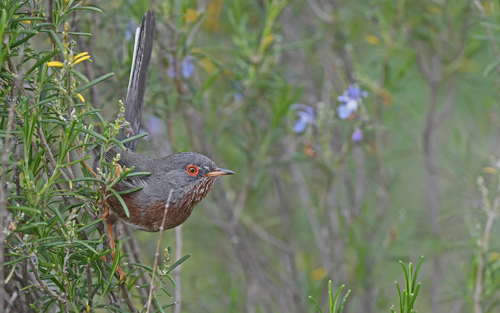 Dartford Warbler
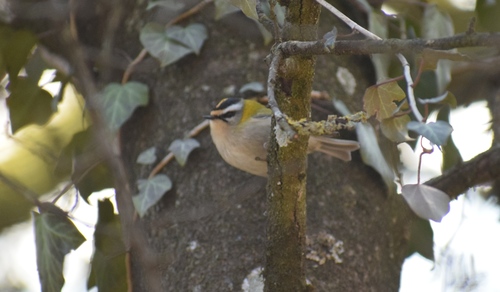 Common Firecrest
In short
The most reliable way to separate Dartford Warbler from Common Firecrest is by overall structure and head pattern: Dartford Warbler is a slim, long-tailed warbler with muted colors and a plain, reddish face, while Firecrest is a tiny, plump bird with a striking head pattern—bold white supercilium, black eye-stripe, and a bright yellow or orange crown stripe. Juvenile Firecrests may lack the colored crown but still show a strong face pattern, while Dartford Warbler juveniles resemble duller females and never have a bold face. In flight or perched, the Dartford Warbler’s long tail and thin bill are obvious, contrasting with the Firecrest’s short tail, tiny bill, and compact jizz. Both species can occur in similar regions of western Europe, but their preferred habitats and behaviors are quite different.
Identification tips
- Head pattern is the fastest check: Firecrest always shows a bold white supercilium, black eye-stripe, and (in adults) a bright yellow or orange crown stripe; Dartford Warbler has a plain, reddish face with no strong pattern, only a red eye.
- Juvenile Firecrest still shows a strong face: Even young Firecrests have a dull but clear supercilium and eye-stripe, while Dartford Warbler juveniles are plain-faced and resemble duller females.
- Wingbars: Firecrest always shows two prominent white wingbars on the folded wing; Dartford Warbler lacks wingbars entirely at all ages.
- Tail length and shape: Dartford Warbler has a very long, thin tail often held cocked or flicked; Firecrest has a very short tail, adding to its round appearance.
- Bill shape: Dartford Warbler has a long, thin, pointed bill suited for insect gleaning in shrubs; Firecrest has a tiny, fine, pointed bill, proportionally much shorter.
- Body structure: Dartford Warbler is slim and elongated, with a long tail and narrow body; Firecrest is extremely small, plump, and compact.
- Upperpart color: Dartford Warbler is grey-brown or brownish-grey above (males greyer, females browner); Firecrest is bright olive-green with a bronze shoulder patch.
- Underparts: Dartford Warbler is dull reddish-brown below with a dirty white belly patch; Firecrest is whitish below, with a brownish-grey wash on breast and flanks.
- Throat markings: Dartford Warbler has a reddish throat with white speckles (more obvious in males); Firecrest’s throat is plain whitish, blending into the face pattern.
- Eye color: Dartford Warbler has a red eye; Firecrest has a dark eye, but the bold face pattern dominates.
- Perched jizz: Dartford Warbler often perches upright on top of bushes, tail cocked; Firecrest is usually seen moving rapidly in foliage, often high up, with a horizontal posture.
- Flight style: Dartford Warbler flies low and direct over shrubs; Firecrest has a weak, whirring, fluttery flight, often with quick turns and short hovers.
- Habitat context: Dartford Warbler is almost always in open heath, gorse, or scrub; Firecrest is in woodland, especially conifers, and rarely in open scrub.
- Sex differences: Male Firecrest has an orange crown stripe, female yellow; Dartford Warbler sexes are similar, females duller and paler.
- Seasonal confusion: Both species are resident or only partially migratory in their ranges, but Firecrest is more likely to be seen in winter in southern areas, while Dartford Warbler is usually resident year-round in its core range.
Size
Dartford Warbler is noticeably larger and longer than Firecrest: it measures about 13 cm (5.1 in) in length [wikipedia], while Firecrest is only 9 cm (3.5 in) [wikipedia]. Dartford Warbler has a proportionally much longer tail and a slim, elongated body. Firecrest is extremely small, plump, and round-bodied, with a short tail and tiny bill. In the hand or with a direct comparison, Dartford Warbler is almost twice as heavy as Firecrest (Dartford Warbler: not specified here, but Firecrest: 4–7 g [wikipedia]).
Plumage
- Juvenile/First-winter: Juvenile Firecrests lack the colored crown but still show a dull version of the strong head pattern (white supercilium, black eye-stripe), while Dartford Warbler juveniles resemble adult females—plain-faced, with paler underparts and browner-grey above, lacking any bold facial markings. No distinctive upperwing pattern is described for either species at this age, but Firecrest always shows two white wingbars.
- Adult male Dartford Warbler: Grey-brown upperparts, long thin tail, dull reddish-brown below with a dirty white belly patch, reddish throat with white speckles, and a red eye. The face is plain and muted, blending into the body color.
- Adult female Dartford Warbler: Similar to male but paler below, browner-grey above, and less distinct throat spotting. Juveniles are similar to females.
- Adult Firecrest: Bright olive-green upperparts with a bronze shoulder patch, two bold white wingbars, whitish underparts, and a very striking head pattern: black eye-stripe, long white supercilium, and a crest (bright yellow in females, mainly orange in males). The face is always strongly marked, unlike Dartford Warbler. Juveniles have a duller version of this pattern, but still show the supercilium and eye-stripe.
Behaviour
Dartford Warbler typically perches upright on top of shrubs or low vegetation, often flicking its long tail and moving with a restless, skulking manner. It may be seen flitting low over heathland or bushy areas. Firecrest is much more active and restless, usually hopping rapidly among branches and foliage, often high in trees, with a horizontal body posture. Its flight is weak and whirring, with quick, evasive turns. Firecrest often hovers briefly while foraging, a behavior not shown by Dartford Warbler.
Habitat
Dartford Warbler is found in dry, open heathland, gorse, and scrubby areas, especially in western and southern Europe. It prefers low, bushy vegetation and is rarely seen in dense woodland. Firecrest, by contrast, breeds in a wide range of woodland habitats, especially mature coniferous and mixed forests, and is often found high in trees. While both species can occur in overlapping regions, their habitat preferences are quite distinct: Dartford Warbler is a bird of open, shrubby landscapes; Firecrest is a bird of woodland canopy.