

Dark-throated Seedeater vs Marsh Seedeater
Sporophila ruficollis versus Sporophila palustris
Play a quiz with Dark-throated Seedeater and Marsh Seedeater
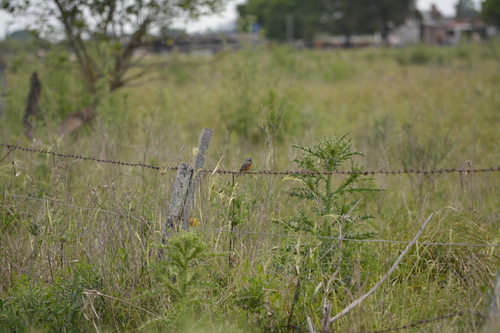 Dark-throated Seedeater
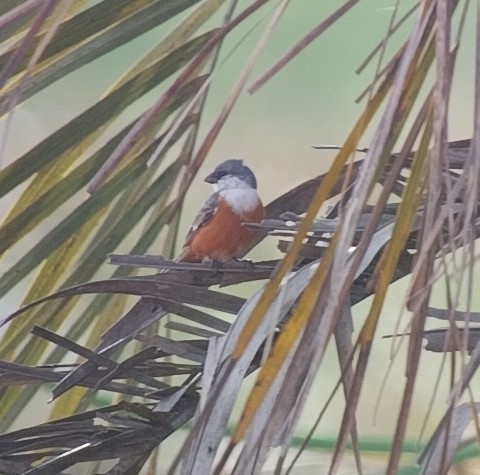 Marsh Seedeater
In short
The most reliable field mark for separating Dark-throated Seedeater from Marsh Seedeater is the color of the throat and breast in adult males: Dark-throated shows a blackish-brown throat and upper breast, while Marsh has a white throat and breast. Both species have a small white patch at the base of the primaries visible on the folded wing, but their head patterns and underpart coloration differ markedly in adult males. Females and juveniles are more challenging, as both are brownish overall, but bill color and subtle differences in underpart tone can help. Both are small Sporophila with similar size and structure, so careful attention to plumage and context is essential, especially outside the breeding season.
Identification tips
- Adult male throat and breast color is the best field mark: Dark-throated Seedeater males have a blackish-brown throat and upper breast, while Marsh Seedeater males have a white throat and breast. This is the quickest and most reliable check in breeding plumage.
- Head pattern in adult males: Dark-throated shows a gray crown and nape with a blackish-brown face, giving a helmeted look; Marsh has a plumbeous gray crown and nape but the rest of the head is white, creating a striking contrast.
- Underpart color in adult males: Dark-throated has rufous or dark cinnamon underparts below the blackish-brown throat; Marsh has dark brown to cinnamon lower underparts below the white breast.
- Female and juvenile confusion: Both are brownish above and paler below, but female Dark-throated is warm brown with a buff face and underparts, while female Marsh is brownish (sometimes olive-tinged) above and ochraceous below. Juveniles resemble females in both species, so age must be considered.
- Bill color in females: Female Dark-throated has a dark horn to blackish bill; female Marsh has a brown maxilla and pale yellowish mandible, which can be seen at close range.
- White primary patch: Both species show a small white patch at the base of the primaries on the folded wing in all plumages, so this feature does not separate them.
- Tail and wing color: Both have blackish tails and dark wings with paler edges, but these are not reliable for separation.
- Iris and leg color: Both have dark irises and blackish legs, not useful for separation.
- Habitat preference (contextual): Marsh Seedeater is more likely in seasonally flooded grasslands and marshes, while Dark-throated can occur in drier grasslands and scrubby areas, but there is significant overlap.
- Geographic range: Dark-throated is also found in Bolivia and as a vagrant to Peru; Marsh is not.
- Seasonal context: Both species are sexually dimorphic, so non-breeding males may look more like females and be harder to separate.
- Size and structure: Both are tiny, short-billed seedeaters with similar structure; do not rely on size or shape.
- Behavior: Both forage low in grasslands and perch on stems; no distinctive behavioral differences noted.
- Voice: No diagnostic vocal differences are described in the sources.
- When in doubt: Focus on adult male head and throat pattern in breeding season; for females and juveniles, use bill color and subtle underpart tone, but expect some uncertainty without close views.
Size
Both species are among the smallest Sporophila, with nearly overlapping measurements. Dark-throated Seedeater is 10–11 cm long and weighs 7–9.7 g, while Marsh Seedeater is 10.5–11.5 cm and weighs 7.5–9 g. In the field, size is not a reliable separator, as both are tiny, short-billed seedeaters with similar proportions. Bill shape and size are also very similar, with both having a small, rounded culmen.
Plumage
Juveniles and females of both species are brownish above and paler below, making them difficult to separate. Both sexes and all ages show a small white patch at the base of the primaries on the folded wing, so this feature does not distinguish them. In adult males, the head and throat pattern is diagnostic: Dark-throated has a gray crown and nape with a blackish-brown face and throat, giving a 'helmeted' look, and rufous underparts; Marsh has a plumbeous gray crown and nape, but the rest of the head, throat, and breast are white, with dark brown to cinnamon on the lower underparts. Female Dark-throated is warm brown above with a buff face and underparts, while female Marsh is brownish above (sometimes olive-tinged) and ochraceous below, with a two-toned bill (brown maxilla, pale yellowish mandible) compared to the darker bill of female Dark-throated. Juveniles resemble adult females in both species.
Behaviour
Both species forage in tall grasslands and similar open habitats, often low in vegetation. There are no strong behavioral differences noted in the sources, and both can be seen perched or feeding on grass seeds. Flight style and general jizz are not described as distinctive between these two.
Habitat
Both species occur in Argentina, Brazil, Paraguay, and Uruguay, often in tall grasslands. Dark-throated Seedeater can also be found in Bolivia and as a vagrant to Peru, and is somewhat less tied to wet areas, sometimes using drier or scrubbier grasslands, roadsides, and Cerrado. Marsh Seedeater is more closely associated with seasonally flooded grasslands and marshes, and is more threatened by habitat loss in these wetland areas. In overlapping regions, habitat alone is not diagnostic, but Marsh is more likely in wetter, marshy grasslands.