

Dark-necked Tailorbird vs Ashy Tailorbird
Orthotomus atrogularis versus Orthotomus ruficeps
Play a quiz with Dark-necked Tailorbird and Ashy Tailorbird
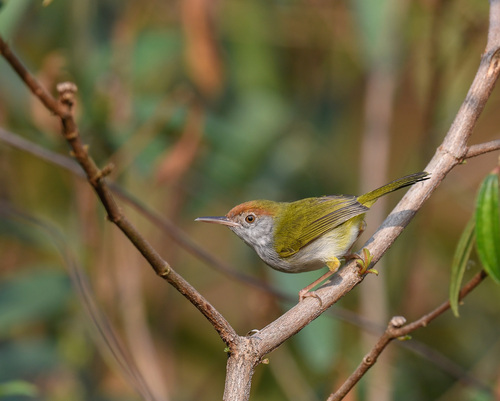 Dark-necked Tailorbird
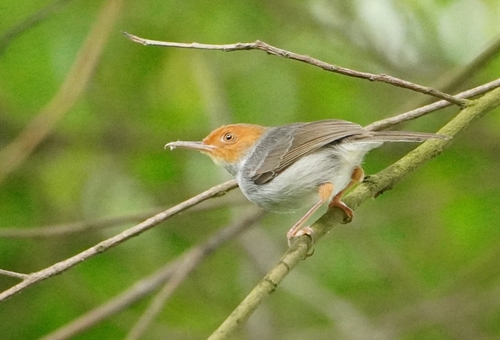 Ashy Tailorbird
In short
The most reliable field mark between Dark-necked Tailorbird and Ashy Tailorbird is the head and throat coloration in adults: Ashy Tailorbird males show a distinctive rufous-chestnut face and forecrown with ashy grey upperparts, while Dark-necked Tailorbird lacks this combination. Female Ashy Tailorbirds have a white chin and throat, unlike the darker neck of Dark-necked. Juvenile Ashy Tailorbirds lack red on the head and have olive-green upperparts, which can cause confusion with Dark-necked, but the latter generally appears darker and lacks the ashy-grey tones. Both species are small, active insectivores in Southeast Asia, but Ashy Tailorbird is slightly lighter in mass. Habitat overlap is possible, but Ashy Tailorbird adapts more readily to disturbed and plantation environments.
Identification tips
- Adult male Ashy Tailorbird shows a rufous-chestnut face, chin, and forecrown—this is the single best field mark for separating it from Dark-necked Tailorbird, which never shows this combination.
- Female Ashy Tailorbird has a white chin and throat; Dark-necked Tailorbird has a darker neck area, which is diagnostic in good views.
- Juvenile Ashy Tailorbird lacks red on the head and has olive-green upperparts, which can look similar to Dark-necked, but note the paler underparts and absence of any dark neck patch.
- Ashy Tailorbird upperparts are ashy grey (male) or paler grey (female), while Dark-necked Tailorbird is generally darker and lacks the ashy tone.
- Ashy Tailorbird tail is lighter grey, while Dark-necked's tail is not specifically described but is unlikely to match the ashy tone.
- Bill structure is similar in both species—long and slightly decurved—so not a reliable separator.
- No distinctive flight or upperwing pattern is described for either species, so rely on head and body coloration even in flight.
- Ashy Tailorbird adapts well to disturbed and plantation habitats; if seen in palm oil plantations or heavily altered landscapes, Ashy is more likely.
- Both species are small and active, so behavior is not a strong separator, but Ashy is more often seen in open or edge habitats.
- Subspecies variation in Ashy Tailorbird can affect the intensity of rufous and grey, but the basic male/female pattern remains.
- If you see a tailorbird with a clearly dark neck patch, favor Dark-necked, especially if rufous is absent from the head.
- If the bird is olive-green above with no rufous and pale below, consider juvenile Ashy, but check for any hint of a dark neck to rule out Dark-necked.
- Size is not a reliable field mark, as both are similarly small, but Ashy Tailorbird is slightly lighter on average.
- Both species build leaf-stitched nests, so nest structure is not a separator.
- Vocalizations are not described in the available notes, so do not rely on song or call for separation here.
Size
Ashy Tailorbird is slightly lighter, with a recorded adult body mass of 7.0 g [wikidata]. No mass is provided for Dark-necked Tailorbird, but both are similarly small. Ashy Tailorbird is noted as being around 7 cm in length and weighing up to 12 g in some sources, but use 7.0 g as the best comparative figure. Size alone is not a reliable separator in the field.
Plumage
Juvenile Ashy Tailorbirds lack the red head of adults and instead show olive-green upperparts, which can resemble Dark-necked Tailorbird, but they still tend to have paler underparts and lack any dark neck patch. Adult male Ashy Tailorbirds are distinctive with a rufous-chestnut face, chin, and forecrown, ashy grey back, upperwing, and throat, fading to almost white on the belly, and a lighter grey tail. Females are similar but have a white chin and throat, paler upperparts, and a pale grey wash across the breast. Dark-necked Tailorbird, by contrast, lacks the rufous-chestnut head and instead has a darker neck area (as the name suggests), which is not present in Ashy. Subspecies of Ashy Tailorbird vary in the intensity of the red and grey, but the basic pattern holds. No specific flight or upperwing pattern is described for either species, so separation in flight relies on overall coloration and head pattern.
Behaviour
Ashy Tailorbird is often seen foraging in pairs or small family groups, moving actively in both canopy and undergrowth, and is known to adapt well to disturbed habitats such as palm oil plantations. Both species are insectivorous and share similar foraging behaviors, but Ashy Tailorbird's adaptability to human-altered landscapes is notable. Nesting behavior is similar, with both species constructing nests by stitching leaves together.
Habitat
Both species occur in Southeast Asia and can overlap in range. Dark-necked Tailorbird is found in Bangladesh, Northeast India, and Southeast Asia, inhabiting subtropical or tropical moist lowland and mangrove forests. Ashy Tailorbird is also widespread in Southeast Asia but is particularly notable for thriving in disturbed habitats, including palm oil plantations, where it can be common. If seen in heavily modified landscapes, Ashy Tailorbird is more likely.