

Curve-billed Thrasher vs Sage Thrasher
Toxostoma curvirostre versus Oreoscoptes montanus
Play a quiz with Curve-billed Thrasher and Sage Thrasher
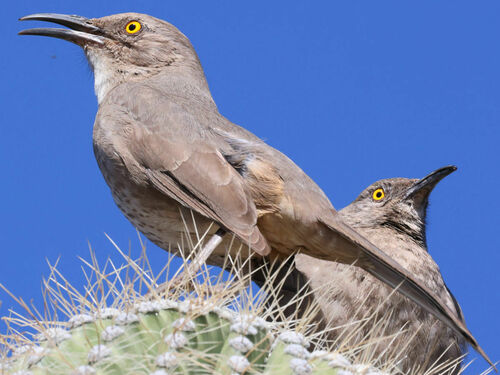 Curve-billed Thrasher
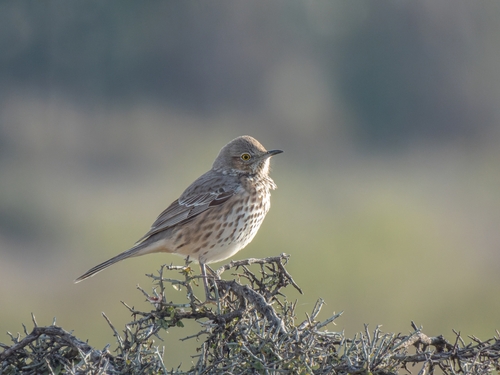 Sage Thrasher
In short
The most reliable field mark between Curve-billed Thrasher and Sage Thrasher is the bill: Curve-billed has a long, sickle-shaped, all-dark bill, while Sage Thrasher's bill is shorter and only slightly curved. Juvenile and adult plumages can overlap in overall brownish tones, but Curve-billed shows rounder, larger spots on the breast, while Sage Thrasher has fine, dark streaks. Eye color is helpful but variable: Curve-billed usually has orange to golden eyes, Sage Thrasher's are lemon-yellow to amber. In flight or perched, Curve-billed appears bulkier with a longer, more downcurved bill and a relatively shorter tail for a thrasher; Sage Thrasher is smaller, slimmer, and more delicate overall. Habitat and behavior also help: Curve-billed is common in arid Southwest suburbs and deserts, Sage Thrasher is tied to open sagebrush or grasslands.
Identification tips
- Bill shape and length: Curve-billed Thrasher has a long, sickle-shaped, all-black bill; Sage Thrasher's bill is shorter, thinner, and only slightly curved. This is reliable in all ages and seasons.
- Breast markings: Curve-billed shows round, often larger spots on the breast (especially in eastern subspecies), while Sage Thrasher has fine, dark streaks. Juvenile Curve-billed can show less distinct spots, but Sage Thrasher's streaks are always narrower and more linear.
- Eye color: Curve-billed usually has orange to golden eyes; Sage Thrasher's are lemon-yellow to amber. Both can show some variation, so use with caution, especially in poor light.
- Size and build: Curve-billed is bulkier, with a larger head and body; Sage Thrasher is smaller, slimmer, and more delicate. Useful when seen side-by-side or with experience.
- Tail length: Curve-billed has a relatively short tail for a thrasher, but still longer than Sage Thrasher's short tail. Tail shape is not as diagnostic as bill or breast pattern.
- Juvenile plumage: Juvenile Curve-billeds lack pale tips and are rufous-washed above, with unkempt abdominal feathers; Sage Thrasher juveniles are paler above and show lightly streaked underparts. Focus on breast pattern and bill shape in young birds.
- Bill color: Curve-billed's bill is all black; Sage Thrasher's is dark but not as heavy or curved. This is consistent in all ages.
- Habitat: Curve-billed is found in arid deserts, often near human habitation; Sage Thrasher is almost always in open sagebrush or grassland. If you see a thrasher in a suburban yard in Arizona, it's almost certainly Curve-billed.
- Behavior: Curve-billed is more conspicuous, often singing from exposed perches; Sage Thrasher is more secretive, running or hopping low in open country.
- Vocalization: Listen for Curve-billed's sharp 'whit-wheet' call, especially from high perches. Sage Thrasher's song is not described here, but Curve-billed's call is distinctive.
- Subspecies variation: Eastern Curve-billeds have more distinct spots and more white in the tail; western forms are plainer. Sage Thrasher shows little regional variation.
- Flight jizz: Curve-billed appears heavier and more direct in flight; Sage Thrasher is lighter and more buoyant. Not always diagnostic but can help with experience.
- Context and range: Sage Thrasher is migratory and absent from breeding areas in winter; Curve-billed is resident year-round.
- Overlap: Where ranges overlap (e.g., New Mexico, Arizona), rely on bill shape, breast pattern, and habitat for best separation.
- Pitfalls: Beware of juvenile Curve-billeds with less distinct spots and some rufous wash, which can look superficially like Sage Thrasher. Always check bill shape and breast pattern together.
Size
Sage Thrasher is the smallest thrasher, weighing about 44g and measuring 20–23 cm in length [wikidata]. Curve-billed Thrasher is heavier and bulkier, though exact mass is not provided here. In the field, Curve-billed looks more robust and large-headed, while Sage Thrasher is noticeably smaller, slimmer, and more delicate. Tail length is relatively short for Curve-billed compared to other thrashers, but still longer than Sage Thrasher's. Bill size and shape further accentuate the size difference: Curve-billed's bill is much longer and more deeply curved.
Plumage
Juvenile and immature birds are most easily confused. Juvenile Curve-billed Thrashers lack pale tips and have rufous-washed upperparts; their breast spots are round and often larger, but can be variable. Juvenile Sage Thrashers have paler upperparts and lightly streaked underparts, with streaks finer and more linear than the spots of Curve-billed. Adult Curve-billeds are grayish-brown above with round, brown-gray breast spots, while adult Sage Thrashers are brownish-gray above and white below with crisp, dark streaks. Eye color is variable but Curve-billed usually shows orange to golden eyes, while Sage Thrasher's are lemon-yellow to amber. Bill color is diagnostic: Curve-billed's is all black, Sage Thrasher's is dark but shorter and less curved. No distinctive upperwing or flight pattern is described for either species, so separation relies on these body and head features.
Behaviour
Curve-billed Thrasher is more likely to be seen in suburban areas, foraging on the ground or singing from high perches, and is generally more conspicuous and approachable. Sage Thrasher prefers open sagebrush or grassland, often running or hopping on the ground and is more secretive. Curve-billed is non-migratory and often seen year-round in its range, while Sage Thrasher migrates and may be absent from breeding grounds in winter. In flight, Curve-billed appears heavier and more direct, Sage Thrasher lighter and more buoyant.
Habitat
Curve-billed Thrasher is common in deserts of the southwestern US and Mexico, often in suburban settings, desert scrub, and areas with scattered cacti or mesquite. It avoids dense grasslands. Sage Thrasher is strongly tied to open sagebrush habitats and grasslands of western North America, breeding in the Great Basin and wintering further south. It avoids dense vegetation and is rarely found in suburban or heavily wooded areas. Habitat context is often a strong clue: Sage Thrasher in sagebrush, Curve-billed in arid towns or desert scrub.
Voice
Curve-billed Thrasher is best known for its sharp, whistled 'whit-wheet' call, often given from a prominent perch. Its song is varied, pleasant, and mimetic, with phrases that are nasal and buzzy but less abrupt than a mockingbird's. Sage Thrasher's song is not described here, but is generally more melodic and continuous in related literature. Calls are less distinctive for Sage Thrasher in this context, so Curve-billed's 'whit-wheet' is a useful field cue.