

Curlew Sandpiper vs Purple Sandpiper
Calidris ferruginea versus Calidris maritima
Play a quiz with Curlew Sandpiper and Purple Sandpiper
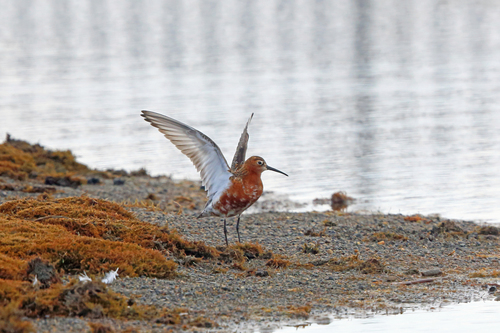 Curlew Sandpiper
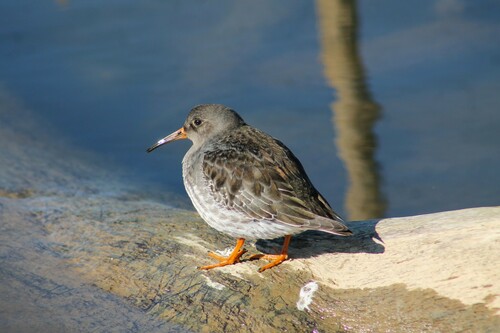 Purple Sandpiper
In short
The most reliable field mark to separate Curlew Sandpiper from Purple Sandpiper in any plumage is the Curlew Sandpiper’s bold white rump and uppertail, visible in flight, contrasting with the Purple Sandpiper’s black rump. Juvenile and non-breeding Curlew Sandpipers show a scaly, buff-tinged upperpart pattern and a long, downcurved black bill, while Purple Sandpipers are darker above with a slight purplish gloss, shorter yellowish legs, and a stouter, straighter bill with a yellow base. Curlew Sandpipers are slimmer and longer-legged, often found on open mudflats, whereas Purple Sandpipers prefer rocky coastal habitats and appear chunkier. These differences are most obvious when birds are in flight or actively feeding, but can be subtle in poor light or at distance.
Identification tips
- White rump in flight (all ages): Curlew Sandpiper always shows a large white rump and uppertail, often extending onto the lower back, visible as a bold flash when the bird takes off. Purple Sandpiper has a black rump and tail, with no white flash.
- Upperwing pattern (all ages): Curlew Sandpiper displays a prominent white wing stripe in flight, contrasting with the darker wing. Purple Sandpiper’s upperwing is more uniformly dark, lacking a strong white stripe.
- Bill shape and length: Curlew Sandpiper has a long, slender, and distinctly downcurved black bill. Purple Sandpiper’s bill is shorter, stouter, and only slightly decurved, with a yellow base (especially obvious at close range).
- Leg color: Purple Sandpiper has short, yellow legs, while Curlew Sandpiper’s legs are longer and dark grey to black. This is most useful on perched or feeding birds.
- Body shape and posture: Curlew Sandpiper is slim, long-legged, and elegant, often appearing taller and more upright. Purple Sandpiper is chunkier, with a lower profile and shorter legs.
- Juvenile/first-winter upperparts: Juvenile Curlew Sandpiper is scaly and buff-tinged above, with slim pale fringes; Purple Sandpiper juvenile is darker, with black and cinnamon patches and white specks, but lacks the overall scaly look.
- Supercilium (eyebrow): Curlew Sandpiper shows a clear white supercilium, especially in non-breeding and juvenile plumage. Purple Sandpiper’s face is plainer, with less contrast.
- Breast and underparts: Curlew Sandpiper (non-breeding/juvenile) is white below with some pale grey streaks; breeding birds are reddish below. Purple Sandpiper is always white below but with heavy grey smudging on the breast, never reddish.
- Rump and tail pattern (perched): If the uppertail is visible, Curlew Sandpiper shows white uppertail coverts and rump; Purple Sandpiper’s rump and tail are black.
- Habitat context: On rocky coasts, especially in winter, Purple Sandpiper is far more likely. On open mudflats or saltpans, especially on passage, Curlew Sandpiper is expected.
- Feeding behavior: Curlew Sandpiper probes deeply and moves fluidly; Purple Sandpiper picks and creeps among rocks, rarely probing deeply.
- Bill base color: At close range, Purple Sandpiper’s bill base is yellowish, while Curlew Sandpiper’s bill is all black.
- Seasonal context: In Britain, Curlew Sandpiper is mostly a passage migrant (spring and autumn), while Purple Sandpiper is a winter resident on rocky coasts.
- Flock composition: Purple Sandpiper often associates with Turnstones on rocks; Curlew Sandpiper is usually with other small waders on mudflats.
- Plumage wear: Curlew Sandpiper’s non-breeding plumage becomes browner with feather wear, but still shows the white rump and wing stripe; Purple Sandpiper remains dark and glossy above year-round.
Size
Both species are similar in overall length (Curlew Sandpiper: 18–23 cm; Purple Sandpiper: 20–22 cm), but Purple Sandpiper is heavier on average (mean mass ~72 g vs. Curlew Sandpiper’s range of 44–117 g, though the upper end is rare). Purple Sandpiper has a slightly broader wingspan (42–46 cm vs. Curlew Sandpiper’s 38–46 cm), and appears stockier and more compact, with shorter legs and a thicker body. Curlew Sandpiper is more slender, with longer legs and a longer, more downcurved bill.
Plumage
Juvenile and first-winter Curlew Sandpipers are scaly and buff-tinged above, with slim, pale-fringed feathers and a distinctive white rump and uppertail visible in flight; their underparts are white with some pale grey streaks. In non-breeding plumage, they are grey above with a white supercilium and white underparts, and always show a white wing stripe in flight. Breeding adults are reddish below and on the head, with variable streaking and a white rump. Purple Sandpiper adults, in all plumages, are darker above with a faint purplish gloss, black rump, and white underparts with grey-smudged breast; their legs are yellow and the bill is dark with a yellow base. Juveniles are similar to adults but with more cinnamon and white speckling above. In flight, Purple Sandpiper lacks the white rump and shows a dark tail and rump. The white wing stripe of Curlew Sandpiper is a key flight mark at all ages, while Purple Sandpiper’s upperwing is more uniformly dark.
Behaviour
Curlew Sandpiper is often seen probing actively on open mudflats or saltpans, moving with a more graceful, longer-legged gait. Purple Sandpiper is typically found on rocky shorelines, often in small flocks, creeping among rocks and seaweed, and is notably tame and approachable. Purple Sandpiper’s feeding is more deliberate and less probing than Curlew Sandpiper’s, and it is rarely seen away from rocky coasts in winter.
Habitat
Curlew Sandpiper prefers tidal mudflats, saltpans, and open coastal wetlands, especially during migration and winter. Purple Sandpiper is strongly associated with rocky, wave-battered shorelines and is rarely found on mudflats. In Britain and northern Europe, Purple Sandpiper is a classic winter bird of rocky coasts, while Curlew Sandpiper is much more likely on estuarine mud or sandy flats. Overlap is rare except in passage or unusual weather.