
Crowned Sandgrouse vs Lichtenstein's Sandgrouse
Pterocles coronatus versus Pterocles lichtensteinii
Play a quiz with Crowned Sandgrouse and Lichtenstein's Sandgrouse
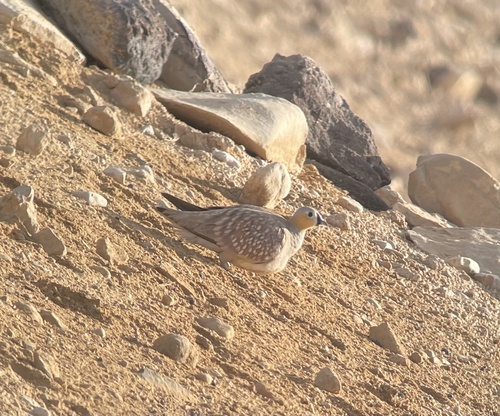 Crowned Sandgrouse
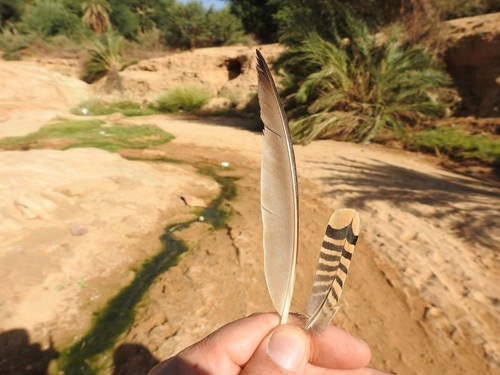 Lichtenstein's Sandgrouse
In short
The most reliable field mark between Crowned Sandgrouse and Lichtenstein's Sandgrouse is the wing pattern in flight: Crowned Sandgrouse shows wholly dark flight feathers contrasting with sandy upperwing coverts, while Lichtenstein's is closely and evenly barred above and below, lacking strong wing contrast. Crowned Sandgrouse males have a distinctive black mask and lack any grey on the neck and breast, while Lichtenstein's of both sexes are more uniformly barred and lack a mask. Females and immatures of Crowned Sandgrouse show dark vermiculations across the entire underparts, not just the breast, unlike the more evenly barred Lichtenstein's. Structure is similar, but Crowned is slightly larger and heavier. Both species prefer arid, stony habitats, but Crowned Sandgrouse tends to avoid areas with much vegetation.
Identification tips
- In flight, look for wholly dark flight feathers: Crowned Sandgrouse of all ages shows solidly dark primaries and secondaries, sharply contrasting with sandy upperwing coverts and creamy underwing coverts. Lichtenstein's never shows this contrast—its wings are finely and evenly barred, blending coverts and flight feathers.
- Check for a black facial mask: Adult male Crowned Sandgrouse has a distinctive black mask, lacking any grey on the neck or breast. Lichtenstein's males lack a mask entirely and are evenly barred.
- Underpart pattern in females and immatures: Female and immature Crowned Sandgrouse show dark vermiculations (wavy lines) across the entire breast and belly. In Lichtenstein's, both sexes and all ages are closely and evenly barred above and below, not vermiculated, and the barring is finer and more uniform.
- Absence of grey tones: Crowned Sandgrouse males lack any grey on the neck and breast, while Lichtenstein's is more uniformly buff and barred, with no mention of grey but also no mask.
- General coloration: From a distance, Crowned Sandgrouse appears more uniformly colored except for the dark wings, while Lichtenstein's is subtly patterned all over with fine barring.
- Tail shape: Both species lack elongated central tail feathers, so this is not a useful mark here.
- Size and structure: Crowned Sandgrouse is slightly larger and heavier (27–29 cm, ~300 g) than Lichtenstein's (25 cm, 175–250 g), but this is subtle and best used in direct comparison.
- Habitat context: Crowned Sandgrouse is more likely in stony, sparsely vegetated deserts, especially among dark red sandstone in North Africa. Lichtenstein's is also a bird of stony deserts but is less tied to specific substrate color.
- Plumage uniformity: Lichtenstein's always looks finely barred and lacks strong color contrasts; Crowned Sandgrouse is more uniform except for the dark wings and, in males, the black mask.
- Sexing pitfalls: Female and immature Crowned Sandgrouse can be confused with Lichtenstein's due to lack of a mask, but look for the difference between vermiculations (Crowned) and fine barring (Lichtenstein's) across the underparts.
- No elongated tail streamers: Neither species has the long central tail feathers seen in some other sandgrouse, so do not use this mark.
- No strong vocal differences noted: Voice is not a reliable field mark based on current sources.
- Flight jizz: Both are compact and fast-flying, but Crowned Sandgrouse's dark wings may make it appear more contrasting in flight, especially in good light.
- When in doubt, prioritize wing pattern: If you see wholly dark flight feathers contrasting with sandy coverts, you are looking at Crowned Sandgrouse; if the wing is evenly barred throughout, it's Lichtenstein's.
- Seasonal variation: No strong seasonal plumage differences are noted for either species that would affect these marks.
Size
Crowned Sandgrouse is slightly larger and heavier, measuring 27–29 cm in length with a body mass around 300 g. Lichtenstein's Sandgrouse is about 25 cm long and weighs 175–250 g. In the field, this size difference may be subtle, but Crowned Sandgrouse can appear a bit bulkier and longer-winged. Both are compact, stocky sandgrouse without elongated tail feathers.
Plumage
- In flight (all ages): Crowned Sandgrouse shows wholly dark flight feathers that contrast strongly with sandy upperwing coverts and creamy underwing coverts. This contrast is absent in Lichtenstein's, which is closely barred blackish on buff both above and below, giving a more uniform, finely patterned look without strong contrast between coverts and flight feathers.
- Adult males: Crowned Sandgrouse males have a black facial mask and lack any grey tones on the neck and breast. Lichtenstein's males lack a mask and are instead evenly barred.
- Females and immatures: Female and immature Crowned Sandgrouse have dark vermiculations (fine wavy lines) across the entire breast and belly, while in Lichtenstein's both sexes are closely barred above and below, not vermiculated, and the barring is more even and fine.
- Underparts: Crowned Sandgrouse's vermiculations cover all of the underparts, not just the breast, while Lichtenstein's is evenly barred throughout.
Behaviour
Both species are ground-dwelling birds of arid regions, often seen in small flocks flying to water at dawn or dusk. Their behavior is broadly similar, with no strong behavioral differences noted in the sources that are useful for field separation.
Habitat
Both species inhabit stony deserts and arid hills, but Crowned Sandgrouse is more likely to be found in areas with little or no vegetation and often among dark red sandstone in North Africa, which matches its plumage. Lichtenstein's Sandgrouse also prefers stony deserts but is not noted for such specific substrate preferences. Both avoid lush or vegetated areas.
Crowned Sandgrouse · Lichtenstein's Sandgrouse · My Tricky Birds