

Crowned Eagle vs Long-crested Eagle
Stephanoaetus coronatus versus Lophaetus occipitalis
Play a quiz with Crowned Eagle and Long-crested Eagle
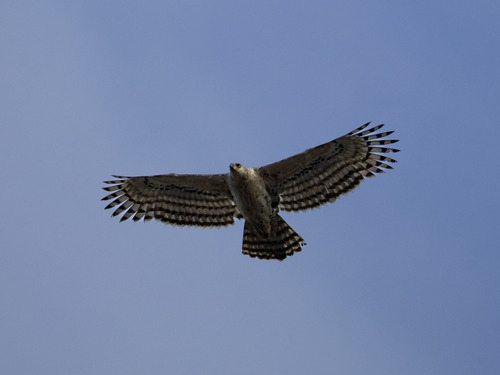 Crowned Eagle
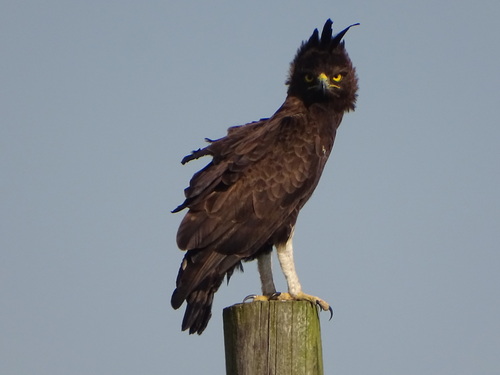 Long-crested Eagle
In short
The most reliable field mark for separating Crowned Eagle from Long-crested Eagle is the presence of a long, shaggy crest and overall dark plumage in Long-crested Eagle, versus the lack of a crest and a much bulkier, paler, and heavily marked appearance in juvenile Crowned Eagle. In flight, juvenile Crowned Eagles show a longer, more heavily barred tail and shorter, broader wings compared to the long, narrow-winged Long-crested Eagle, which flashes white wing patches. Adults are even more distinct, but confusion often arises with young birds. Size is also a major clue: Crowned Eagle is nearly three times heavier and much more massive overall. Always check for the crest and tail pattern first, especially in perched or soaring birds.
Identification tips
- Crest presence: Long-crested Eagle always shows a long, shaggy crest when perched, which is absent in Crowned Eagle of any age. If you see a pronounced crest, it is not a Crowned Eagle.
- Tail pattern (juveniles/immatures): Juvenile Crowned Eagles have a very long, black tail with three pale bars and a narrow black tip, while Long-crested Eagle's tail is shorter, black with pale grey bars, and never as long or as heavily barred.
- Wing shape in flight: Crowned Eagle has broad, short wings and a long tail, giving a bulky, almost hawk-like silhouette. Long-crested Eagle has narrower, longer wings and a proportionally shorter tail, making it look more like a buzzard or small eagle in flight.
- Underwing and wing patches: In flight, Long-crested Eagle shows a conspicuous white patch on both upper and lower wing surfaces (from the primaries and median underwing coverts), absent in Crowned Eagle at all ages.
- Plumage color (juveniles): Juvenile Crowned Eagles are pale-headed and white below with spotted thighs, while juvenile Long-crested Eagles are paler brown overall but never white below and lack spotted thighs.
- Adult plumage: Adult Crowned Eagles are heavily barred and patterned, with no crest and a powerful, deep-chested look. Adult Long-crested Eagles are uniformly dark with a prominent crest.
- Leg and thigh markings: Spotted thighs are a hallmark of juvenile Crowned Eagle, not seen in Long-crested Eagle of any age.
- Perched posture: Crowned Eagle perches upright and appears massive and barrel-chested, while Long-crested Eagle is slimmer, often fluffs up its crest, and perches more lightly.
- Eye color: Adult Long-crested Eagles have bright yellow eyes (darker in females), while juvenile Crowned Eagles may have khaki to yellow ochre eyes, but this is variable and not always reliable.
- Feet and cere color: Both species have yellow feet and cere, but in Long-crested Eagle, the feet may pale to white in males; this is subtle and not a primary field mark.
- Habitat context: If seen deep in dense forest, especially in eastern or southern Africa, Crowned Eagle is more likely; if at a forest edge, open woodland, or perched on a roadside pole, Long-crested Eagle is more probable.
- Size impression: Crowned Eagle is much larger and bulkier; if the bird looks massive and powerful, especially compared to nearby raptors, suspect Crowned Eagle.
- Behavior: Long-crested Eagle is often seen perched in the open, scanning for prey, while Crowned Eagle is more secretive and rarely perches openly.
- Juvenile confusion: If you see a pale, heavily marked juvenile eagle with a long, barred tail and spotted thighs, it is a juvenile Crowned Eagle; if the bird is dark, lacks a crest, and shows white wing patches in flight, it is a Long-crested Eagle.
- Crest development in juveniles: Even young Long-crested Eagles may lack a full crest, but will never show the pale, spotted, or scaled look of juvenile Crowned Eagle.
Size
Crowned Eagle is substantially larger and heavier, with an average adult mass of 3673.5g compared to Long-crested Eagle's 1291.5g [wikidata]. This difference is striking in the field: Crowned Eagle appears massive, deep-chested, and powerfully built, while Long-crested Eagle is much lighter, slimmer, and more compact. Even the largest female Long-crested Eagle does not approach the bulk of a male Crowned Eagle. When perched, Crowned Eagle's size and bulk are obvious, while Long-crested Eagle looks rangy and slender by comparison.
Plumage
Juvenile and immature Crowned Eagles are pale-headed and white below, with black-spotted thighs, a back showing pale-edged feathers (giving a scaled look), and a long, black tail with three pale bars and a narrow black tip. Their wings are short and broad, and the tail is proportionally very long and heavily barred—key in flight. Some juveniles are extremely stripy, but all show the long, barred tail and spotted thighs. By contrast, Long-crested Eagle of any age is much darker overall: adults are blackish-brown with a prominent, long, shaggy crest, and in flight show a distinctive white patch on the upper and lower wing surfaces (formed by the primary feathers and median underwing coverts). The tail is black, barred with pale grey, but is shorter and less obviously patterned than Crowned Eagle. Juvenile Long-crested Eagles are paler brown but still lack the white underparts and spotted thighs of juvenile Crowned Eagle, and their crest is not developed. In all ages, Long-crested Eagle lacks the heavy barring and pale scaling of Crowned Eagle, and never shows a white head or underparts.
Behaviour
Crowned Eagle is a powerful forest predator, often seen soaring above or hunting within dense woodland, but is secretive and rarely perches in the open. Its flight is heavy and purposeful, with broad, rounded wings and a long tail used for maneuvering through trees. Long-crested Eagle, in contrast, is often seen perched conspicuously on poles or exposed branches at forest edges, scanning for prey. Its flight is lighter, with more frequent flapping and gliding, and it often displays its crest when perched. Courtship displays in Long-crested Eagle involve steep dives and rocking flights, sometimes accompanied by calling.
Habitat
Crowned Eagle is found in dense forests and riparian woodlands in sub-Saharan Africa, especially in the east and south, and avoids open country. It is a true forest eagle, rarely venturing far from heavy cover. Long-crested Eagle, while also favoring moist areas and forest edges, is much more tolerant of open habitats, including fragmented woodland, plantations, and even agricultural areas. It is frequently seen near the edges of forests or in more open country, especially where rodents are abundant.