

Croaking Ground Dove vs Blue Ground Dove
Columbina cruziana versus Claravis pretiosa
Play a quiz with Croaking Ground Dove and Blue Ground Dove
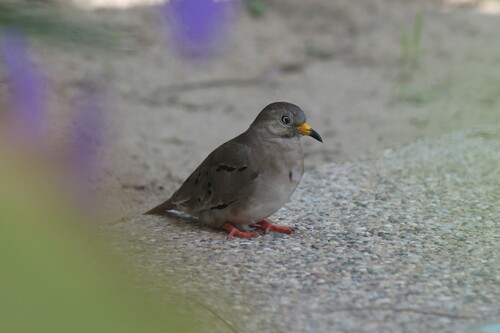 Croaking Ground Dove
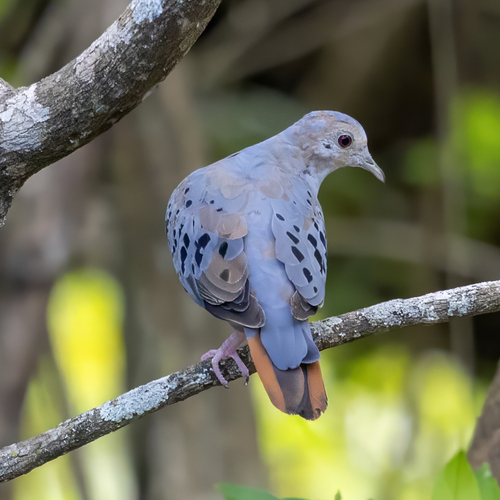 Blue Ground Dove
In short
The most reliable field mark between Croaking Ground Dove and Blue Ground Dove is the male's overall coloration: Croaking Ground Dove males have a bluish gray head and brownish gray upperparts with mauve pink underparts, while Blue Ground Dove males are blue-grey above and pale grey below, often appearing much bluer overall. In flight or at rest, both species show wing spots, but the color and arrangement differ: Croaking Ground Dove shows dark bars and lines of dark spots on brownish wings, while Blue Ground Dove has bold black (male) or chestnut-brown (female) wing spots, often forming bands. Females and juveniles of both species are browner, but Blue Ground Dove females have a ruddier back and chestnut rump, with chestnut wing spots, while Croaking Ground Dove females and juveniles are more uniformly brownish with less intense markings. Structure and size also help: Blue Ground Dove is distinctly larger and heavier-bodied. Both species can occur together in Peru and Ecuador, so careful attention to wing pattern and overall coloration is essential.
Identification tips
- Male coloration: Adult male Croaking Ground Dove has a bluish gray head and brownish gray upperparts with mauve pink underparts; Blue Ground Dove male is blue-grey above and pale grey below, often appearing much bluer overall. This is the most immediate distinction in good light.
- Wing pattern in flight (all ages): Croaking Ground Dove shows a dark bar and lines of dark spots on the closed wing, but these are relatively subtle. Blue Ground Dove males have bold black wing spots forming bands, while females have chestnut-brown wing spots. In flight, Blue Ground Dove's wing spots are more extensive and contrasting.
- Female/juvenile confusion: Female Croaking Ground Dove is brown-headed with less intense wing markings; female Blue Ground Dove is grey-brown on the head, neck, and breast, with a ruddy brown back and chestnut rump and tail, and chestnut wing spots. Juvenile Croaking Ground Dove has buffy feather tips, while juvenile Blue Ground Dove shows ruddy scaling on the back.
- Tail pattern: Croaking Ground Dove has central tail feathers that are darker gray and outer ones that are black with white tips. Blue Ground Dove's outer tail feathers are blackish, and the tail is chestnut in females and juveniles.
- Eye and bare skin color: Croaking Ground Dove has a red eye with a white outer ring and yellow bare skin around the eye, and a bright yellow base to the bill. Blue Ground Dove's iris can be red or yellow, but the eyering is green and the legs are flesh-pink.
- Bill color: Croaking Ground Dove's bill is bright yellow at the base, a useful mark at close range. Blue Ground Dove's bill is not described as yellow-based.
- Size and structure: Blue Ground Dove is larger (20 cm, 65–72 g) and bulkier than Croaking Ground Dove (15 cm, 46–52 g), which is daintier and lighter-built. Use this when both are seen together or with other doves for scale.
- Behavior: Blue Ground Dove may be seen flying through trees or perched higher, while Croaking Ground Dove is more strictly terrestrial, foraging on the ground.
- Pairing behavior: Blue Ground Dove is often seen as a blue-grey male with a brown female; seeing a blue and brown bird together in flight is a strong clue for this species.
- Habitat: Croaking Ground Dove prefers arid, open, or scrubby habitats; Blue Ground Dove is more likely in wooded edges, second growth, or moister areas.
- Geographic overlap: Both species can occur together in Peru and Ecuador; do not rely on range alone for separation in these areas.
- Leg color: Blue Ground Dove has flesh-pink legs, a subtle but sometimes visible distinction.
- Plumage intensity: Croaking Ground Dove females and juveniles are more uniformly brownish with less intense markings, while Blue Ground Dove females/juveniles have a more contrasting, patterned look with ruddier and chestnut tones.
- Wing spot color: Croaking Ground Dove's wing spots are dark but not chestnut; Blue Ground Dove's female/juvenile wing spots are chestnut-brown, a key mark in good light.
- Tail color in females/juveniles: Blue Ground Dove females/juveniles have a chestnut rump and tail, contrasting with the back; Croaking Ground Dove lacks this contrast.
Size
Blue Ground Dove is significantly larger and heavier than Croaking Ground Dove. Blue Ground Dove averages about 20 cm in length and weighs 65–72 g [wikipedia][wikidata], while Croaking Ground Dove is smaller at 15 cm and males weigh about 52 g, females 46 g [wikipedia]. In the field, Blue Ground Dove appears bulkier and more robust, while Croaking Ground Dove is noticeably daintier and lighter-built. This size difference is often obvious when both are seen together or with other doves for scale.
Plumage
Juvenile and female plumages are most likely to cause confusion. Juvenile Croaking Ground Doves resemble females but have buffy feather tips, making them look slightly scaly or pale-edged above. Their wing pattern is subdued, with dark bars and lines of dark spots on brownish wings. Female Croaking Ground Doves are brown-headed and have less intense wing markings than males. In contrast, juvenile and female Blue Ground Doves are greyer-brown on the head, neck, and breast, with a ruddy brown back and a contrasting chestnut rump and tail; their wings have chestnut-brown spots, not blackish. Young Blue Ground Doves show ruddy scaling on the back. Adult male Croaking Ground Doves are bluish gray on the head, brownish gray above, with a mauve pink breast and underparts, and a dark tail with white-tipped outer feathers. Adult male Blue Ground Doves are blue-grey above, paler grey below, with blackish flight feathers and outer tail feathers, and bold black wing spots forming bands. Eye and bare skin color differ: Croaking Ground Dove has a red eye with a white ring and yellow bare skin around it, and a bright yellow-based bill; Blue Ground Dove's iris can be red or yellow, with a green eyering and flesh-pink legs. In flight, Blue Ground Dove's wing spots (black in males, chestnut in females) are more extensive and contrasting than Croaking Ground Dove's more subtle dark bars and spots.
Behaviour
Both species forage on the ground for seeds and may be seen walking or running, but Blue Ground Dove tends to be more arboreal, sometimes seen flying through trees, while Croaking Ground Dove is more strictly terrestrial. Blue Ground Dove is often seen in pairs (especially a blue male and brown female together), while Croaking Ground Dove may be found singly or in small groups. Both species are generally unobtrusive, but Blue Ground Dove's larger size and more robust jizz can be apparent when flushed.
Habitat
Both species overlap in parts of their range (notably Peru and Ecuador), but Croaking Ground Dove is more restricted to arid and semi-arid regions, often in open country, scrub, and dry edges. Blue Ground Dove occupies a wider range, from southeastern Mexico to Argentina and Trinidad, and is found in a variety of habitats including woodland edges, second growth, and more humid areas. Where both occur, Croaking Ground Dove is more likely in drier, open habitats, while Blue Ground Dove can be found in moister, more wooded areas.