

Crested Owl vs Rufous Cacholote
Lophostrix cristata versus Pseudoseisura unirufa
Play a quiz with Crested Owl and Rufous Cacholote
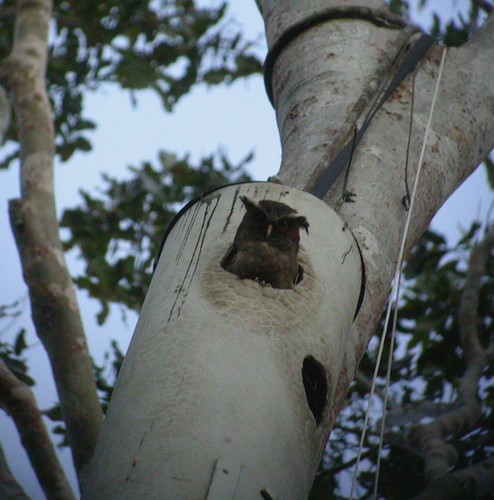 Crested Owl
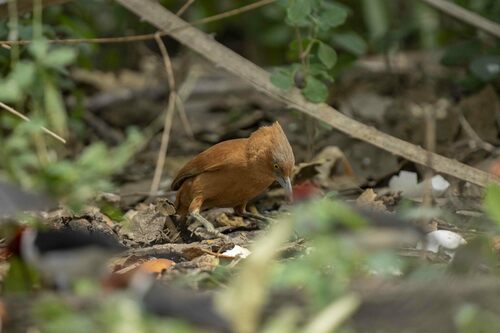 Rufous Cacholote
In short
The most reliable way to separate Crested Owl from Rufous Cacholote is by overall structure and facial pattern: Crested Owl is a much larger, heavier bird with a striking dark facial disk, long white or buff ear tufts, and a prominent whitish eyestripe, while Rufous Cacholote is a smaller, chunky songbird with a rufous or grayish crest and a plain, pale-rufous face. Juvenile plumages do not create confusion, as young Crested Owls have whitish down and short ear tufts, while young cacholotes have a shorter, scruffy crest and less uniform color. In flight, the owl’s broad wings and silent, floating movement are unlike the cacholote’s more direct, fluttery flight. Even at a distance, the owl’s size and upright posture contrast with the cacholote’s active, horizontal stance. If you see a crested, rufous bird in South America, check for the owl’s facial disk and ear tufts versus the cacholote’s plain face and smaller size.
Identification tips
- Size and bulk: Crested Owl is much larger and heavier than Rufous Cacholote; if the bird looks nearly hawk-sized, it is the owl. Cacholote is only about thrush-sized.
- Facial disk and eyestripe: Only Crested Owl has a dark, sharply defined facial disk and a bold whitish eyestripe running into the ear tufts. Cacholote’s face is plain, lacking any disk or stripe.
- Ear tufts vs crest: Crested Owl’s ear tufts are long, white or buff, and project upward, while Rufous Cacholote’s crest is shorter, rufous or grayish, and sits atop the crown without forming tufts.
- Plumage pattern: Crested Owl (both morphs) shows white spotting on the wing coverts and barred flight feathers; cacholote’s wings are plain rufous with dusky tips, no barring or spots.
- Tail pattern: Owl’s tail is chocolate-brown with darker mottling; cacholote’s is rufous, with unbarbed tips and no barring.
- Juvenile plumage: Young Crested Owls have whitish down and short ear tufts, but still show a facial disk; young cacholotes have a scruffy, short crest and uneven color, but never a facial disk or ear tufts.
- Bill color: Crested Owl’s bill is yellow or dark; cacholote’s is blue-gray to gray with a paler lower mandible.
- Iris color: Owl’s iris varies from yellow to brown with rufous mottling; cacholote’s is yellow to buff-yellow.
- Leg color: Owl’s toes are pale gray-brown; cacholote’s legs and feet are olive to greenish gray.
- Posture: Crested Owl perches upright, often motionless; cacholote is more horizontal, perching and moving actively.
- Flight style: Owl flies with broad, rounded wings and silent, floating movement; cacholote’s flight is direct, fluttery, and less steady.
- Habitat: Dense humid forest (owl) vs open woodland, scrub, or savanna (cacholote).
- Activity period: Owl is nocturnal and rarely seen by day; cacholote is diurnal and conspicuous.
- Nest: Cacholote builds large stick nests in trees; owl nests are not typically observed in the open.
- Geographic range: Crested Owl is found in Central America and northern South America; Rufous Cacholote is restricted to Bolivia, Brazil, and Paraguay.
Size
Crested Owl is dramatically larger and heavier: it measures 38–43 cm in length and weighs 425–620 g, compared to Rufous Cacholote’s 20–21 cm and 42–57 g [wikipedia][wikidata]. The owl is nearly twice as long and up to ten times heavier. In the field, this means the owl appears bulky and imposing, while the cacholote is closer in size to a thrush or small jay. The owl’s head is proportionally large with long ear tufts, while the cacholote’s crest is much shorter and less prominent.
Plumage
Juvenile Crested Owls have whitish down and short ear tufts, with a dark facial disk already present; their flight and tail feathers are similar to adults, so even young birds show the key facial pattern and ear tufts. Juvenile Rufous Cacholotes have a shorter, scruffier crest and less uniform color, lacking any facial disk or ear tufts. Adult Crested Owls come in dark and pale morphs: both have a dark facial disk, long white or buff ear tufts, and a prominent whitish eyestripe extending into the tufts. The rest of the plumage is chocolate-brown (dark morph) or rufous-brown (pale morph), with white spotting on wing coverts and barred flight feathers. Rufous Cacholote adults are mostly bright reddish-rufous, paler below, with a crest that ranges from rufous to grayish; their face is plain, lacking any disk or eyestripe, and the throat center is orange-tinged. Their flight feathers have dusky tips, but no barring or white spots. The owl’s tail is chocolate-brown with darker mottling, while the cacholote’s tail is rufous with unbarbed tips.
Behaviour
Crested Owl is a nocturnal, secretive predator, usually perched upright and still in dense forest, rarely seen in daylight. It hunts mainly large insects and occasionally small vertebrates. Rufous Cacholote is diurnal, active, and conspicuous, often seen foraging in pairs or small groups, hopping through open woodland or scrub, and building large stick nests. Its behavior is more reminiscent of a jay or large wren than an owl.
Habitat
Crested Owl inhabits humid forests of Central and northern South America, often in dense, mature woodland. Rufous Cacholote is found in drier open woodlands, scrub, and savanna in Bolivia, Brazil, and Paraguay. Their ranges overlap little, and their habitat preferences are quite different: seeing a crested bird in open, dry country strongly favors cacholote, while a large crested bird deep in humid forest is likely the owl.