
Crested Duck vs Blue-winged Teal
Lophonetta specularioides versus Spatula discors
Play a quiz with Crested Duck and Blue-winged Teal
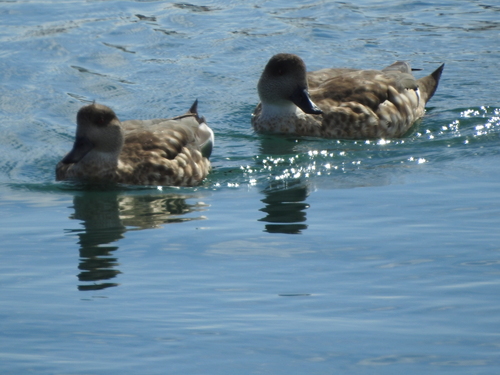 Crested Duck
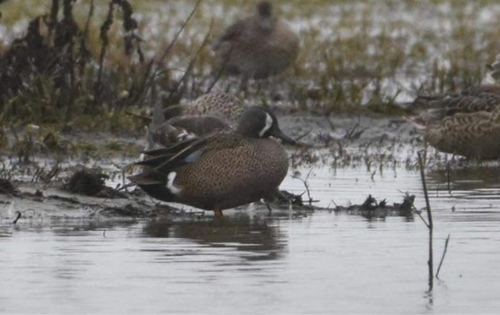 Blue-winged Teal
In short
The most reliable field mark to separate Crested Duck from Blue-winged Teal is the upperwing pattern in flight: Crested Duck (adult and juvenile) shows a coppery to greenish iridescent speculum with a broad black band behind, narrowly edged with white, while Blue-winged Teal (all ages) displays distinctive sky-blue wing coverts and a green speculum. On the ground, Crested Duck is larger, stockier, and often shows a prominent crest (adults), whereas Blue-winged Teal is smaller, more delicate, and males have a bold white crescent on the face. Juvenile Crested Ducks lack the crest and have paler abdomens, but still differ from Blue-winged Teal by structure and wing pattern. Both species can be mottled brown, but the combination of size, structure, and wing coloration is diagnostic.
Identification tips
- Upperwing in flight (all ages): Look for sky-blue wing coverts on Blue-winged Teal—this is absent in Crested Duck, which instead shows a coppery to greenish speculum with a broad black band and narrow white edge.
- Juvenile plumage: Juvenile Crested Ducks lack the crest but still have a pale face and paler abdomen, and their upperwing pattern remains distinct from Blue-winged Teal juveniles, which always show sky-blue coverts.
- Crest: Adult Crested Ducks have a prominent crest on the head (males more so than females), while Blue-winged Teal never shows a crest at any age.
- Facial pattern (adult male Blue-winged Teal): Look for the bold white crescent on the face of male Blue-winged Teal—no such mark is present on Crested Duck.
- Body structure: Crested Duck is bulkier, with a longer, black tail and a more robust build. Blue-winged Teal is smaller, slimmer, and more delicate in appearance.
- Underparts: Crested Duck has light gray underparts and flanks, while Blue-winged Teal shows a light brown body with a white patch near the rear (adult male).
- Bill and face: Blue-winged Teal females have a mottled brown face with a whitish area at the base of the bill; Crested Duck juveniles have a light brown face, but adults are more uniformly colored with a dark bill.
- Tail: Crested Duck's tail is distinctly elongated and black, often obvious when perched or swimming. Blue-winged Teal has a shorter, less prominent black tail.
- Size: If seen together or with other ducks for scale, Crested Duck is much larger and heavier than Blue-winged Teal.
- Flight style: Blue-winged Teal is quick and agile, often in tight flocks; Crested Duck is heavier and slower in flight.
- Habitat: In North America, any small, agile dabbling duck with sky-blue wing coverts is almost certainly Blue-winged Teal. In South America, a medium-sized, crested duck with a coppery speculum is Crested Duck.
- Sexual dimorphism: Both Crested Duck sexes are similar (except crest prominence), while Blue-winged Teal males and females differ strongly in head pattern.
- Crested Duck juveniles: Lack the crest but never show the blue wing coverts of Blue-winged Teal.
- Speculum color: Coppery/greenish in Crested Duck, green in Blue-winged Teal (but always with blue coverts in Teal).
- Voice: Only Blue-winged Teal's calls are described; use with caution, as Crested Duck's voice is not detailed.
Size
Crested Duck is a medium-sized duck, with adults reaching just over 1 kg, making it much heavier and bulkier than Blue-winged Teal, which averages 370 g. In length, Blue-winged Teal is about 40 cm, with a 58 cm wingspan, while Crested Duck is notably larger and more robust overall. The difference is obvious in direct comparison or when familiar with typical dabbling duck sizes: Crested Duck appears stocky with a relatively long, black tail, while Blue-winged Teal is compact and slim.
Plumage
- Juveniles: Crested Duck juveniles lack the crest, have a light brown face, and paler abdomens, but their upperwing still shows a coppery to greenish speculum with a broad black band and narrow white edge—never the sky-blue coverts of Blue-winged Teal. Blue-winged Teal juveniles and females are mottled brown but always show sky-blue wing coverts and a green speculum in flight.
- Adult males: Crested Duck males have a prominent crest, mottled dark brown upperparts with pale centers, light gray underparts, and a long black tail. Blue-winged Teal males have a grayish-blue head with a bold white facial crescent, light brown body, white rear patch, and black tail. Both sexes of Blue-winged Teal have sky-blue wing coverts and green speculum.
- Adult females: Crested Duck females are similar to males but with a less prominent crest. Blue-winged Teal females are mottled brown with a whitish area at the base of the bill, lacking any crest, and still show sky-blue wing coverts in flight.
- Upperwing in flight (all ages): Crested Duck: coppery/greenish speculum, broad black band, white edge. Blue-winged Teal: sky-blue coverts, green speculum, no coppery tones.
Behaviour
Crested Duck is typically seen as a heavier, slower-moving bird, often dabbling or loafing in open water or along shorelines. Its flight is strong and direct, with broad wings and a slightly labored appearance due to its size. Blue-winged Teal is more agile and buoyant, frequently seen in tight flocks, quick to flush, and often flying low over marshes. Blue-winged Teal are among the first ducks to migrate south in fall and the last to return north in spring, often seen in restless, active groups.
Habitat
Crested Duck is native to South America and is found in a range of wetland habitats, often in open water or along shorelines. Blue-winged Teal breeds in North America and prefers shallow marshes, ponds, and lakes with dense emergent vegetation. Blue-winged Teal are more likely to be seen in grassy or muddy edges, resting on muskrat houses, mud flats, or rocks, while Crested Duck is more often seen in open water or on the shore. Range does not overlap except as vagrants.
Voice
Blue-winged Teal males give a short whistle, and females a soft quack. No vocalization details are provided for Crested Duck in the sources, so voice is not a reliable separator here.