

Crested Barbet vs White-eared Barbet
Trachyphonus vaillantii versus Stactolaema leucotis
Play a quiz with Crested Barbet and White-eared Barbet
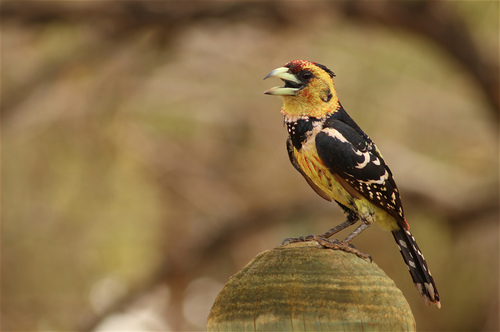 Crested Barbet
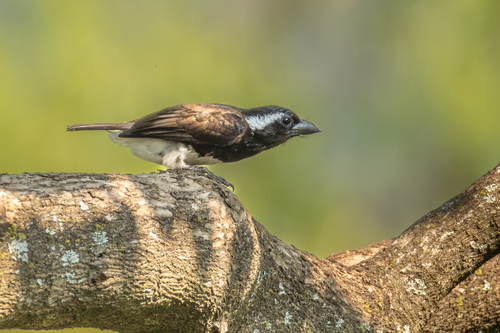 White-eared Barbet
In short
The most reliable field mark to separate Crested Barbet from White-eared Barbet is the Crested Barbet's extremely bold, multi-colored plumage and small black crest, compared to the White-eared Barbet's much plainer dark brown and white pattern with a distinct white stripe behind the eye. Immature White-eared Barbets are even darker overall, lacking the Crested Barbet's bright colors at any age. In flight or perched, the Crested Barbet's yellow, red, black, and white speckled pattern stands out, while the White-eared Barbet remains subdued with a white belly and dark head. Bill thickness and facial pattern are also key: Crested Barbet has a thicker bill and a speckled yellow-red face, while White-eared Barbet shows a dark face with a crisp white post-ocular stripe. Both species overlap in range and habitat, so careful attention to these visual cues is essential.
Identification tips
- Face pattern: Crested Barbet always shows a speckled yellow and red face with a small black crest. White-eared Barbet has a dark face with a crisp white stripe behind the eye and no crest. This is reliable at all ages and in all seasons.
- Crest: Only Crested Barbet has a small black crest. White-eared Barbet's crown is smoothly rounded and dark.
- Overall color: Crested Barbet is extremely colorful—yellow, red, black, and white in a patchwork, especially on the head and belly. White-eared Barbet is dark brown above, with a white belly and variable white on the face, rump, and wings, but never any yellow or red.
- Bill structure: Crested Barbet has a thick, pale bill; White-eared Barbet's bill is black and less robust. This is best seen in good light or close views.
- Wing pattern: Crested Barbet's wings are black with white specks, visible when perched or in flight. White-eared Barbet's wings are plain dark brown, with no speckling or bold pattern.
- Belly color: Crested Barbet's belly is yellow with red speckles. White-eared Barbet's belly is plain white.
- Neck band: Crested Barbet has a broad black band on the neck, contrasting with the yellow head and body. White-eared Barbet lacks any neck band.
- Juvenile/immature confusion: Immature White-eared Barbets are blacker overall but still lack any yellow or red; the white post-ocular stripe is always present. Even young Crested Barbets are colorful and speckled.
- Tail and rump: Crested Barbet shows red markings at the end of the body (rump/tail), while White-eared Barbet may show some white on the rump but never red.
- Leg color: White-eared Barbet has black to grey-brown legs with grey soles; this is subtle and rarely diagnostic in the field.
- Behavior: Crested Barbet is more likely to be seen bouncing on the ground or calling conspicuously from an open branch. White-eared Barbet is more arboreal and less aggressive.
- Flight style: Crested Barbet is reluctant to fly and only does so for short distances. White-eared Barbet's flight is not described but is likely more typical for a woodland barbet.
- Voice: If you hear a long, trilling call from an exposed perch, it's Crested Barbet. White-eared Barbet's voice is not described here.
- Habitat: Both can occur in gardens and woodland edges, so do not rely on habitat alone for separation.
- Sex differences: Both species are sexually alike, so sex is not a useful field mark.
Size
White-eared Barbet is slightly larger (17–18 cm, 48–63 g [wikipedia]) than Crested Barbet (no precise measurement in notes, but described as a small bird [wikipedia]). In the field, this size difference is subtle and not a reliable separation point unless both are seen side by side. Both species are stocky, but the Crested Barbet may appear more compact due to its thick bill and shorter tail impression.
Plumage
- Juvenile/Immature: Immature White-eared Barbets are blacker overall than adults, but still lack any yellow or red; they retain the white post-ocular stripe. Crested Barbet immatures are not specifically described, but even young birds show a mix of yellow, red, black, and white speckling, especially on the face and belly.
- Adult: Crested Barbet is unmistakably colorful: yellow head and belly with red speckles, black and white speckled wings, a small black crest, and a broad black neck band. The face is speckled yellow and red. White-eared Barbet is dark brown above, with a white belly and a dark head, always showing a white stripe behind the eye. The amount of white on the face, rump, and wings varies, but never approaches the Crested Barbet's gaudiness. The White-eared Barbet's bill is black, while the Crested Barbet's is thick and pale. No age or seasonal variation in either species approaches the other's pattern.
Behaviour
Crested Barbets are often seen singly or in pairs, bouncing on the ground or calling from exposed branches. They are aggressive towards other birds and may chase or attack intruders. Their flight is weak and short, preferring to move through cover or along branches. White-eared Barbets' behavior is less described, but as woodland barbets, they are generally more arboreal and less aggressive. Both may be seen in similar habitats, but Crested Barbets are more likely to be seen foraging on the ground or calling conspicuously.
Habitat
Both species overlap widely in southern and eastern Africa, including Eswatini, Malawi, Mozambique, South Africa, Tanzania, and Zimbabwe. Crested Barbet uses a broader range of habitats, from forests and woodland thickets to suburban gardens and watercourses. White-eared Barbet is described as a woodland species, favoring denser, moister habitats. However, both can occur in gardens and woodland edges, so habitat alone is not diagnostic.
Voice
Crested Barbet is highly vocal, producing a long, distinct trill that can continue for extended periods. This call is often given from an exposed perch. The notes do not describe White-eared Barbet's vocalizations, so voice is only a positive clue for Crested Barbet: if you hear a long, trilling call, Crested Barbet is likely.