
Crane Hawk vs Great Black Hawk
Geranospiza caerulescens versus Buteogallus urubitinga
Play a quiz with Crane Hawk and Great Black Hawk
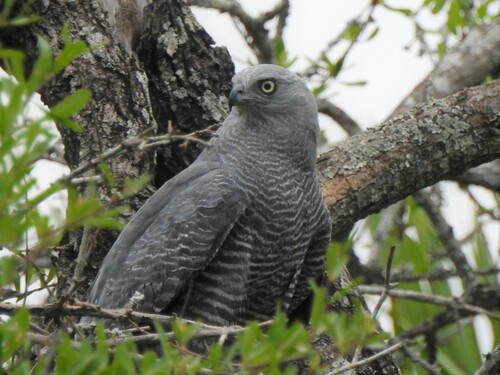 Crane Hawk
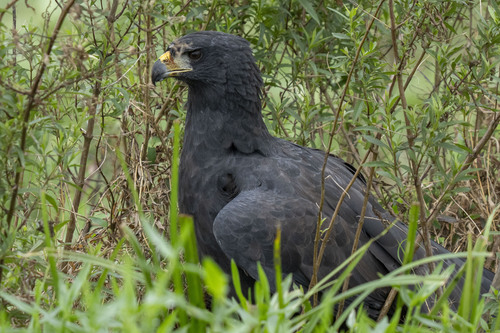 Great Black Hawk
In short
The most reliable field mark between Crane Hawk and Great Black Hawk is the tail pattern: adult Great Black Hawk shows a striking white tail with a broad black tip, while Crane Hawk has a much less contrasting tail. Immature Great Black Hawks are also distinctive, with barred tails and spotted, streaked underparts, unlike the more uniform Crane Hawk. Structurally, Great Black Hawk is much larger and bulkier, with broader wings and a heavier bill. If seen perched or in flight, look for the Great Black Hawk's massive size and bold tail pattern versus the Crane Hawk's slimmer, more agile appearance and plain tail.
Identification tips
- Tail pattern is diagnostic: Adult Great Black Hawk has a short tail with a bold white base and a broad black tip, visible both perched and in flight. Crane Hawk's tail is much less contrasting, lacking this bold pattern. This mark works for adults and is visible at distance.
- Immature/juvenile plumage: Young Great Black Hawks are brown above with heavy spotting and streaks, buff underparts with dark spots, and tails with multiple black and dusky bars. Crane Hawk immatures are much more uniform and lack the strong barring and spotting—so any bird with a barred tail and spotted underparts is Great Black Hawk.
- Size and bulk: Great Black Hawk is much larger and heavier (over 1 kg) than the slim, light Crane Hawk (about 300 g). In the field, Great Black Hawk looks massive and broad-winged, while Crane Hawk is slender and agile. This is especially clear when both are seen in similar contexts.
- Wing and body structure: Great Black Hawk has very broad wings and a heavy bill, giving it a chunky, imposing look. Crane Hawk is more elongated, with a slimmer bill and lighter frame.
- Legs and foraging posture: If observed foraging, Crane Hawk may show its unique double-jointed legs, reaching into tree cavities or epiphytes in acrobatic postures. Great Black Hawk does not show this behavior.
- Plumage uniformity: Adult Crane Hawk is more uniform in color, generally grayish or dark, without the strong tail contrast or body spotting of Great Black Hawk.
- Perched silhouette: Great Black Hawk appears stocky and short-tailed when perched, while Crane Hawk is slimmer and longer-legged.
- Flight jizz: In flight, Great Black Hawk appears broad-winged and heavy, with a short, bold-patterned tail. Crane Hawk is more buoyant and agile, with a less contrasting tail.
- Voice: If you hear a loud, piping 'ooo-wheeeeee,' you are likely hearing Great Black Hawk. Crane Hawk's voice is not described in the sources.
- Sex differences: Both species show little sexual dimorphism in plumage, so do not rely on sex for identification.
- Seasonal variation: The main seasonal difference is in the immature plumage of Great Black Hawk, which is heavily spotted and barred. Crane Hawk does not show such dramatic age-related changes.
- Habitat context: While not diagnostic, note that Crane Hawk may be seen foraging in tree canopies, sometimes among epiphytes, using its unique legs. Great Black Hawk is more likely to be seen soaring or perched in open areas.
- Bill color: Great Black Hawk has a black bill with yellow cere and legs, which may be visible at close range. Bill color is less distinctive in Crane Hawk but is not a primary field mark.
- Pitfalls: Beware of distant views where size is hard to judge—rely on tail pattern and body spotting for immatures, and overall bulk and tail pattern for adults.
- When marks fail: In poor light or distant views, focus on the boldness of the tail pattern and overall size/bulk for your best chance at a correct ID.
Size
Great Black Hawk is dramatically larger and heavier than Crane Hawk. Adult Great Black Hawk reaches 56–64 cm in length and weighs around 1.1 kg, while Crane Hawk is much lighter at about 303.5 g [wikidata]. In the field, Great Black Hawk appears very bulky with broad wings and a short, thick tail, whereas Crane Hawk is noticeably slimmer and lighter, with a more elongated look. This size difference is often obvious even at a distance, especially when both are seen in the same area.
Plumage
Juvenile and immature Great Black Hawks are dark brown above with heavy spotting and streaks, and their underparts are buff with dark spots. Their tails show multiple black and dusky bars, which is a key feature for separating them from Crane Hawk of any age. Adult Great Black Hawks are entirely black with a short tail that is white with a broad black tip—very bold in flight or when perched. In contrast, Crane Hawk is more uniform grayish or dark, lacking the bold tail pattern. Its tail does not show the strong white and black contrast of Great Black Hawk. Sexes are similar in both species, so age and tail pattern are the most useful plumage clues.
Behaviour
Crane Hawk is unique for its foraging behavior, often using its double-jointed legs to reach into tree cavities for prey—a behavior not seen in Great Black Hawk. Crane Hawk may be seen actively probing branches or epiphytes, sometimes hanging or stretching in unusual postures. Great Black Hawk, on the other hand, is more likely to be seen soaring or perched conspicuously, scanning for prey, and does not exhibit the same acrobatic foraging. Both may perch high, but the foraging style is a strong behavioral clue.
Voice
Great Black Hawk has a distinctive piping call described as 'ooo-wheeeeee.' There is no vocalization information provided for Crane Hawk, so voice is only useful for confirming Great Black Hawk if heard.