

Costa Rican Swift vs Slaty Flowerpiercer
Chaetura fumosa versus Diglossa plumbea
Play a quiz with Costa Rican Swift and Slaty Flowerpiercer
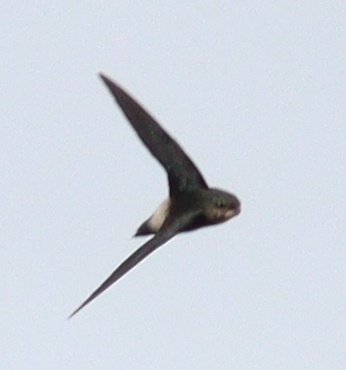 Costa Rican Swift
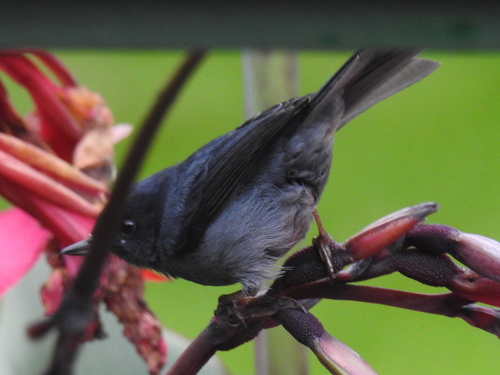 Slaty Flowerpiercer
In short
The most reliable way to separate Costa Rican Swift from Slaty Flowerpiercer is by overall structure and behavior: the swift is a compact, fast-flying aerial insectivore with a sooty-black body and pale grayish throat, while the flowerpiercer is a small, perching songbird with a thin, upturned bill and distinctive sexual dimorphism in plumage. Juvenile Slaty Flowerpiercers show two tawny wing bars, which are never present on the swift. In flight, the swift’s streamlined silhouette and rapid, direct flight are unlike the flowerpiercer’s more fluttery, perching movements. Habitat and context also help: swifts are seen high overhead or in open air, while flowerpiercers are typically in shrubs or forest edges, often near flowers.
Identification tips
- Juvenile wing bars: Only juvenile Slaty Flowerpiercers show two tawny wing bars; Costa Rican Swifts never have wing bars at any age. If you see a small bird with wing bars, it is not a swift.
- Flight style: Swifts are almost always seen flying, with rapid, direct, and powerful wingbeats. Flowerpiercers perch frequently, flit between branches, and hover at flowers.
- Bill shape: Swifts have short, broad bills suited for catching insects in flight. Flowerpiercers have a thin, upturned bill with a hooked upper mandible—adapted for piercing flowers. This is especially obvious at close range or in good light.
- Perching behavior: Swifts rarely perch in the open, while flowerpiercers are often seen perched on exposed twigs, shrubs, or near flowers.
- Plumage uniformity: Costa Rican Swifts are sooty black above with a blue gloss and a pale grayish rump, and their throat and breast are pale grayish. Flowerpiercers show sexual dimorphism: males are blue-grey with a lead-grey throat, females and young are olive-brown above and buff below.
- Underpart color: Swifts have pale grayish throats and breasts, but the rest of the underparts are darker. Male flowerpiercers have a lead-grey throat and breast, while females and juveniles are paler and buffier below.
- Tail and wing color: Swifts have dull black uppertail coverts and uniform wings. Flowerpiercers have blackish wings and tail with grey feather edges (males), or brownish (females/juveniles).
- Habitat and elevation: Swifts are found in lowland and foothill open airspaces; flowerpiercers are in high-elevation montane forests, edges, and gardens with flowers.
- Vocalizations: If you hear a thin 'tsip' call or a complex song, it is a flowerpiercer. Swifts are mostly silent.
- Feeding behavior: Swifts catch insects in flight; flowerpiercers pierce flowers and feed on nectar and small insects from foliage.
- Sexual dimorphism: Only the flowerpiercer shows clear differences between males and females; swifts are sexually alike.
- Contextual clues: Swifts are often seen in groups high overhead; flowerpiercers are solitary or in pairs, low in vegetation.
- Size and jizz: Both are small, but the swift appears more robust and streamlined, while the flowerpiercer is daintier and more active in vegetation.
- Response to hummingbirds: Flowerpiercers may be chased by territorial hummingbirds and retreat into cover—a behavior not shown by swifts.
- Nest and eggs (if observed): Flowerpiercers build cup nests in shrubs and lay two brown-speckled pale blue eggs. Swifts nest in different situations and are unlikely to be seen at the nest.
Size
Both species are similar in length (Costa Rican Swift ~11 cm, Slaty Flowerpiercer ~10 cm), but the swift is more robust and built for continuous flight, while the flowerpiercer is lighter (10 g) and adapted for perching and maneuvering among vegetation. The swift’s body is more compact and muscular, with longer wings relative to body size, whereas the flowerpiercer is more delicate and has a finer, upturned bill.
Plumage
Juvenile Slaty Flowerpiercers are easily separated from Costa Rican Swifts by their two tawny wing bars and faintly streaked buff-yellow underparts—marks never shown by the swift at any age. Adult male flowerpiercers are blue-grey with a lead-grey throat and breast, blackish wings and tail with grey feather edges; females and young are olive-brown above, paler below, and lack the swift’s sooty-black upperparts and pale grayish rump. The swift is consistently sooty black above with a blue gloss, pale grayish rump, and pale grayish throat and breast, with no sexual dimorphism. The swift’s plumage is uniform and lacks wing bars or strong contrasts, while the flowerpiercer’s pattern varies by sex and age.
Behaviour
Costa Rican Swifts are almost always seen in flight, rapidly scything through the air in pursuit of insects, rarely perching in the open. Their flight is fast, direct, and powerful. Slaty Flowerpiercers, by contrast, spend most of their time perched in shrubs, flitting between flowers, or foraging in the canopy and edges. They often hover briefly to pierce flowers, and their movements are more fluttery and less sustained than the swift’s. Flowerpiercers may be chased by hummingbirds and retreat into cover.
Habitat
Costa Rican Swifts are found in the lowlands and foothills of Costa Rica and Panama, typically seen flying high over open areas, forest edges, or clearings. Slaty Flowerpiercers are restricted to higher elevations in the Talamancan montane forests, from 1200 m upwards, often well above the timberline in páramo. They favor mountain forest edges, sunlit clearings, gardens with flowering shrubs, and dense vegetation. Thus, seeing a bird in the open sky over lowland forest points to swift; a bird in a flowering shrub at high elevation is likely a flowerpiercer.
Voice
The Slaty Flowerpiercer gives a thin 'tsip' call and a complex, musical song with whistles, warbles, and trills. Costa Rican Swifts are generally silent or give only brief, high-pitched calls in flight, and are not known for elaborate vocalizations. Hearing a varied song or frequent calls from a perched bird strongly suggests flowerpiercer.