

Cory's Shearwater vs Manx Shearwater
Calonectris diomedea versus Puffinus puffinus
Play a quiz with Cory's Shearwater and Manx Shearwater
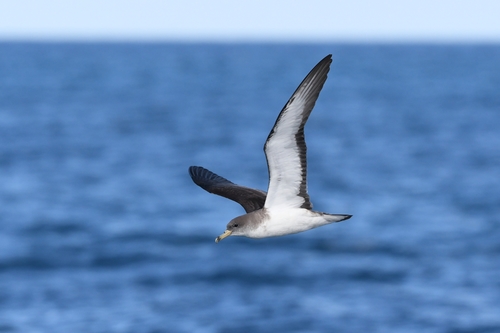 Cory's Shearwater
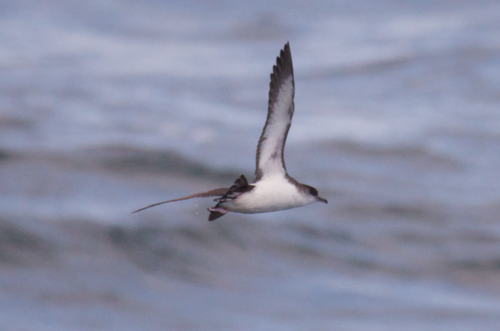 Manx Shearwater
In short
The most reliable field mark between Cory's Shearwater and Manx Shearwater is their overall size and structure: Cory's is much larger and bulkier, with a heavier bill and broader wings, while Manx is distinctly smaller and slimmer. In flight, Cory's shows a brownish-grey upperwing with a white underside and a pale yellow bill, whereas Manx is sharply black above and white below, creating a crisp, high-contrast look. The underwing pattern is also key: Cory's has more white on the primaries (especially P10), while Manx's underwing is mostly white with a narrow dark trailing edge. If you see a large, languid shearwater with pale bill and brownish tones, it's Cory's; a smaller, sharply black-and-white bird with a dark bill is Manx. Both can be confused at sea, especially at distance, but careful attention to size, structure, and underwing pattern will separate them.
Identification tips
- Size is the quickest separator: Cory's is much larger and bulkier than Manx, with a broad wingspan and heavy body. Use this when birds are seen together or with other species for scale.
- Bill color and shape: Cory's has a pale yellow bill with a dark patch near the tip, thick and heavy; Manx's bill is slender and dark. This is visible at close range or in good light.
- Upperwing coloration: Cory's is brownish-grey above with darker wings, giving a soft, muted look. Manx is sharply black above, contrasting strongly with its white underparts.
- Underwing pattern: Cory's shows more white on the primaries, especially P10, creating a whiter wingtip below. Manx's underwing is white with a narrow dark trailing edge, never as extensively white at the tips as Cory's.
- Underparts: Cory's is mostly white below with a brown border along the trailing edge of the wing. Manx is clean white below with a crisp black border, especially on the trailing edge.
- Head and neck: Manx has a sharp division between black crown/nape and white face/throat; Cory's is more uniformly brownish-grey with a less defined contrast.
- Flight style: Cory's is slower, more ponderous, with deep, steady wingbeats and long glides. Manx is quick, agile, and often banks and twists, showing its black-and-white contrast.
- Jizz at distance: Cory's appears long-winged and heavy, often with a languid, effortless glide. Manx looks compact, with a 'flying cross' shape and rapid changes in direction.
- Tail: Cory's has a dark brown tail, sometimes with whitish tips to the upper tail-coverts; Manx's tail is black, short, and square-cut, blending into the black upperparts.
- Legs and feet: Cory's has pale flesh-colored legs and feet, but these are rarely visible at sea. Manx's are not described in the notes.
- Plumage pitfalls: Both species are similar below, but Cory's always looks browner and less crisp than Manx. In poor light, Manx can look dusky, but never as brown or as large as Cory's.
- Habitat and context: If seen in the Mediterranean, Cory's is far more likely; in the North Atlantic, especially near the UK and Ireland, Manx is common. Both can occur together off western Europe in migration.
- Sex and age: Both sexes are similar; no strong age-specific field marks are described, so use structure and wing pattern for all ages.
- Voice: Not described in the notes, but both are largely silent at sea; vocalizations are not useful for field separation in these contexts.
- When in doubt: Focus on size, bill color, and the sharpness of the black-and-white contrast—Manx is always more sharply marked and smaller than Cory's.
Size
Cory's Shearwater is substantially larger and heavier than Manx Shearwater. Cory's averages about 886 g in body mass and measures 45–52 cm in length with a 112–122 cm wingspan. Manx is much lighter, around 521 g, with a length of 30–38 cm and a wingspan of 76–89 cm. This difference is obvious in direct comparison: Cory's appears broad-winged and heavy-bodied, while Manx is slim and compact. Size alone can separate distant birds if seen together, but beware of lone birds in poor conditions.
Plumage
Age-specific upperwing patterns are not described in detail for either species, but adult Cory's Shearwater (and by extension Scopoli's) shows brownish-grey upperparts with darker wings, and a mostly white underwing with extensive white on the primaries, especially the outermost (P10). Manx Shearwater, by contrast, is sharply black above and white below, with a clean division at the side of the neck and flanks. In flight, Manx's underwing is mostly white but edged with a narrow dark border along the trailing edge. Cory's has a paler yellow bill with a dark tip patch, while Manx's bill is dark. Both sexes are similar in both species. Juvenile and immature plumages are not described as distinctive for either in these notes, so adults and immatures are separated mainly by the above contrasts.
Behaviour
Both species exhibit the typical 'shearing' flight of their family, gliding low over the sea with stiff wings. Cory's Shearwater's flight is slower, more languid, and often appears heavier, with fewer wingbeats and broader wings. Manx Shearwater is more agile and buoyant, with rapid, snappy wingbeats and a tendency to dip and bank, often described as a 'flying cross' due to its wing posture. Manx often flies closer to the water surface and appears more energetic. Both species rarely perch on land except at breeding colonies.
Habitat
Cory's Shearwater breeds on rocky Mediterranean islands and forages in the Atlantic outside the breeding season, while Manx Shearwater breeds on North Atlantic islands (UK, Ireland, Iceland, etc.) and winters in the South Atlantic. At sea, both are pelagic and can overlap in the Atlantic, but context can help: Cory's is more likely in the Mediterranean and eastern Atlantic, Manx in the North Atlantic and off the British Isles. Both are seen far offshore, but Manx is more likely near northern coasts.