

Coqui Francolin vs Double-spurred Spurfowl
Campocolinus coqui versus Pternistis bicalcaratus
Play a quiz with Coqui Francolin and Double-spurred Spurfowl
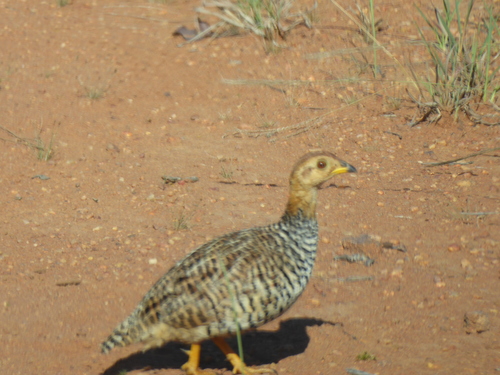 Coqui Francolin
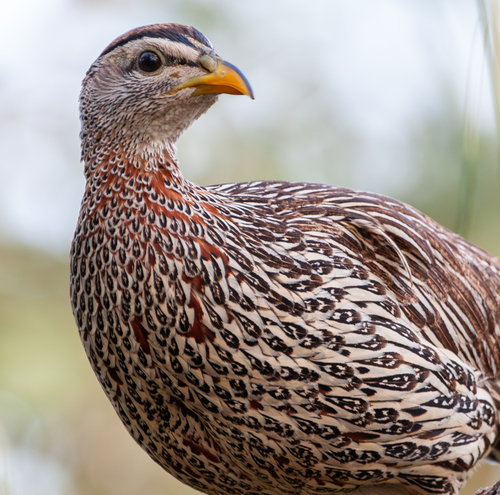 Double-spurred Spurfowl
In short
The most reliable field mark to separate Double-spurred Spurfowl from Coqui Francolin is the combination of size, head pattern, and leg spurs. Double-spurred Spurfowl is noticeably larger and bulkier, with a striking chestnut crown, white supercilium, and white cheek patches, while Coqui Francolin is smaller and lacks these strong facial contrasts. Males of Double-spurred Spurfowl almost always show two leg spurs, a feature absent in Coqui Francolin. Immature Double-spurred Spurfowl resemble adult females, so focus on head and face pattern rather than spurs for young birds. Both species can be shy and prefer to creep away, but their structure and plumage offer consistent separation.
Identification tips
- Size and bulk: Double-spurred Spurfowl is much larger and heavier than Coqui Francolin; this is often apparent even at a distance, especially when birds are side by side or with familiar species for scale.
- Head pattern: Look for the spurfowl's chestnut crown, white supercilium, and white cheek patches—these are absent in Coqui Francolin, which has a plainer face. This mark is reliable for all ages and sexes.
- Neck collar: The chestnut neck collar of Double-spurred Spurfowl is a strong mark, especially on males, and is not shown by Coqui Francolin.
- Leg spurs: Adult male Double-spurred Spurfowl almost always have two leg spurs per leg (the upper one blunt). Females and young males may lack spurs, so this mark is best used for mature males at close range. Coqui Francolin lacks spurs.
- Leg color: Double-spurred Spurfowl has dull green legs, while Coqui Francolin's leg color is not specified here, but it does not show the same greenish tone.
- Upperpart pattern: Both species are brown above, but Double-spurred Spurfowl is more heavily streaked and spotted with cream and dark, while Coqui Francolin is more uniform.
- Underpart markings: The spurfowl's chest and flanks have dark brown feathers edged and centrally spotted cream; Coqui Francolin lacks this strong contrast.
- Structure: The spurfowl is deep-chested and robust, with a heavy build; the francolin is slimmer and more delicate.
- Flight style: When flushed, Double-spurred Spurfowl explodes into the air with a strong, pheasant-like flight. Coqui Francolin may flush more lightly, but this is subtle and not always diagnostic.
- Juvenile confusion: Immature Double-spurred Spurfowl resemble adult females and lack spurs, so rely on head pattern and size for separation at this age.
- Sex differences: Female Double-spurred Spurfowl are slightly smaller and lack spurs, but still show the distinctive head and neck pattern.
- Habitat: Both species use open or lightly wooded habitats, so do not rely on location alone unless outside the spurfowl's range.
- Vocalization: If you hear a mechanical 'krak-krak-krak' from a mound, it is Double-spurred Spurfowl; Coqui Francolin's call is not described here.
- Behavior: Both species are shy and prefer to walk away unseen, but Double-spurred Spurfowl is especially noted for this behavior.
- Pitfalls: Beware of immature spurfowl, which lack spurs and can appear less robust—always check head pattern and overall size first.
Size
Double-spurred Spurfowl is substantially larger and heavier: males measure 30–34 cm in length and weigh about 507 g, females about 381 g [wikipedia]. Coqui Francolin is smaller and lighter (precise measurements not provided here, but always noticeably more compact in the field). The spurfowl appears more robust and deep-chested, while the francolin is more slender overall.
Plumage
For all ages, Double-spurred Spurfowl shows a distinctive head pattern: a chestnut crown, white supercilium, white cheek patches, and a chestnut neck collar. The upperparts are brown with dark and cream streaks and spots, and the chest and flanks are dark brown edged and centrally spotted cream. The legs are dull green, and males have two leg spurs (immature males take several months to develop these). Females are similar but lack spurs and are slightly smaller. Juveniles after post-juvenile moult look like adult females, so head pattern remains the best field mark. Coqui Francolin lacks the strong facial contrasts and chestnut crown, instead showing a more uniform, less boldly marked face and head. No distinctive age-specific upperwing or flight marks are noted for either species in the sources, so rely on head and body pattern for all ages.
Behaviour
Both species are unobtrusive and prefer to walk or creep away rather than flush, but Double-spurred Spurfowl is especially noted for its reluctance to fly, only taking off explosively when pressed. When flushed, the spurfowl has a strong, pheasant-like flight. Both species can be seen on the ground, often in open areas with some cover.
Habitat
Double-spurred Spurfowl favors open habitats with scattered trees, especially in tropical West Africa and, rarely, Morocco. It nests on the ground. Coqui Francolin also prefers open or lightly wooded habitats, so habitat alone is not a reliable separator where ranges overlap.
Voice
Double-spurred Spurfowl males sing a mechanical 'krak-krak-krak' from a mound, especially in spring. No vocal description is provided for Coqui Francolin in the sources, so voice is only useful if the spurfowl's distinctive call is heard.