

Copper Seedeater vs Tawny-bellied Seedeater
Sporophila bouvreuil versus Sporophila hypoxantha
Play a quiz with Copper Seedeater and Tawny-bellied Seedeater
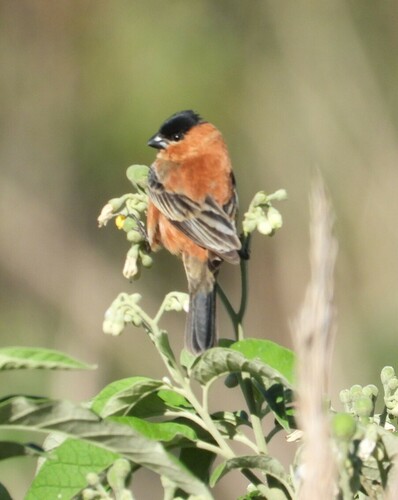 Copper Seedeater
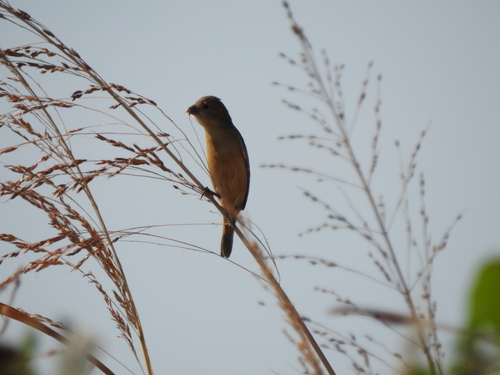 Tawny-bellied Seedeater
In short
Adult males are most reliably separated by head color: Copper Seedeater has a black cap, while Tawny-bellied Seedeater shows a grayish crown and nape. Both are tiny, short-billed seedeaters with similar body size and structure, and both sexes of both species can be confusingly plain brown or buff. In all plumages, check for the extent and color of the head pattern, the tone of the underparts, and the shape and size of the white wing patch. Females and juveniles are especially tricky, but subtle differences in wing edging and underpart color can help. Both species overlap in range and habitat in Brazil and Paraguay, so careful observation is needed.
Identification tips
- Adult male head pattern is the best field mark: Copper Seedeater males have a solid black cap down to the eye, while Tawny-bellied Seedeater males have a grayish crown and nape with a tawny or rufous face. This is the most reliable mark in breeding plumage.
- Underpart color in males: Copper Seedeater males are cinnamon below, while Tawny-bellied Seedeater males are tawny to pale rufous, often darkest on the belly. This difference can be subtle in poor light.
- Wing panel shape and size: On perched birds, look for the white patch at the base of the primaries. Copper Seedeater shows a larger, more rectangular white panel; Tawny-bellied Seedeater's is smaller and sometimes barely visible. This mark is visible in both sexes and all ages, but is most useful on perched birds in good light.
- Wing edging color: Copper Seedeater has cinnamon-brown to whitish edges on the coverts and tertials; Tawny-bellied Seedeater has sandy brown edges. This is subtle but can help on close views.
- Tail pattern: Both species have blackish tails, but Tawny-bellied Seedeater has gray edges on the outer tail feathers (in males), while Copper Seedeater's tail is more uniformly blackish.
- Female and juvenile upperparts: Copper Seedeater females/juveniles are olive-brown above; Tawny-bellied Seedeater females/juveniles are sandy brown. Lighting and wear can blur this difference.
- Female and juvenile underparts: Copper Seedeater females/juveniles have ochre-buff underparts with a whitish belly; Tawny-bellied Seedeater females/juveniles are warm buff, palest on the throat and belly. This is subtle and variable.
- Bill color: Both species have a short, thick bill. Males of both are black-billed; female Tawny-bellied Seedeater can show a dark horn-colored bill, but this is not always obvious.
- Leg color: Both have blackish legs (males), but female Tawny-bellied Seedeater may have slightly paler legs. Not a strong field mark.
- Iris color: Both have dark brown irises; not useful for separation.
- Size and structure: Both are tiny, compact seedeaters with similar proportions. Do not rely on size or jizz.
- Habitat and range: Both occur in Brazil and Paraguay in similar habitats. Tawny-bellied Seedeater is more widespread in southern South America, but this does not help in overlapping areas.
- Voice: No distinctive vocal differences are described in the available sources; do not use song or call for separation based on current information.
- Season and molt: Both species are sexually dimorphic year-round; males in non-breeding plumage may appear duller but retain key head and underpart color differences. Juveniles resemble females in both species, so use subtle color and wing panel differences.
- Pitfall: Immature males may show intermediate plumage, lacking full head color—use wing panel size and underpart tone as secondary clues in these cases.
Size
Both species are among the smallest Sporophila, with Copper Seedeater at 9.5–10 cm and Tawny-bellied Seedeater at about 10 cm in length. Tawny-bellied Seedeater averages 10.5 g in mass [wikidata], but Copper Seedeater's weight is not specified—likely very similar. Structure is nearly identical: both have a short, thick bill and compact proportions. Size is not a reliable separator in the field.
Plumage
-
Juveniles and Females: Both resemble each other closely, with overall brown or olive-brown upperparts and buff underparts, but Copper Seedeater females/juveniles are more olive-brown above and ochre-buff below, while Tawny-bellied Seedeater females/juveniles are sandy brown above with warmer buff underparts. Both show darker wings and tail with paler edges, and a small white patch at the base of the primaries, but this patch is usually larger and more rectangular in Copper Seedeater, and smaller or less distinct in Tawny-bellied Seedeater.
-
Adult Males: Copper Seedeater males have a black cap extending to the eye, cinnamon body, and blackish tail and thighs. Tawny-bellied Seedeater males have a grayish crown and nape, tawny to rufous face, and tawny/rufous underparts, with a blackish tail edged gray. Both have dark wings with pale edges, but Copper Seedeater's wing edges are cinnamon-brown to whitish, while Tawny-bellied Seedeater's are sandy brown. The white primary patch is larger and more rectangular in Copper Seedeater, and smaller in Tawny-bellied Seedeater.
Behaviour
No diagnostic behavioral differences are noted in the available sources. Both species are typical seedeaters, often seen foraging in grasslands or perched on exposed stems. Flight style and feeding behavior are not described as distinctive between these two.
Habitat
Both species overlap widely in Brazil and Paraguay and are found in similar open habitats, especially grasslands and areas with tall grasses. Tawny-bellied Seedeater has a broader range, also occurring in Argentina, Bolivia, and Uruguay, while Copper Seedeater is more restricted to Brazil, Paraguay, and Suriname. Both are affected by habitat loss due to agriculture and burning, but habitat alone is not a reliable separator where ranges overlap.
Copper Seedeater · Tawny-bellied Seedeater · My Tricky Birds