

Connecticut Warbler vs Common Yellowthroat
Oporornis agilis versus Geothlypis trichas
Play a quiz with Connecticut Warbler and Common Yellowthroat
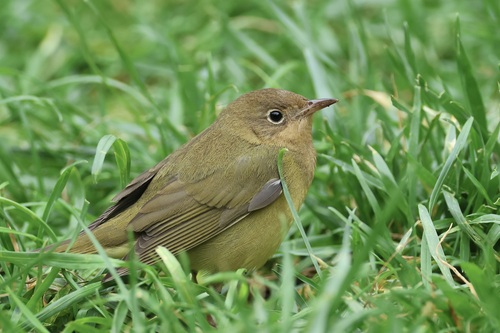 Connecticut Warbler
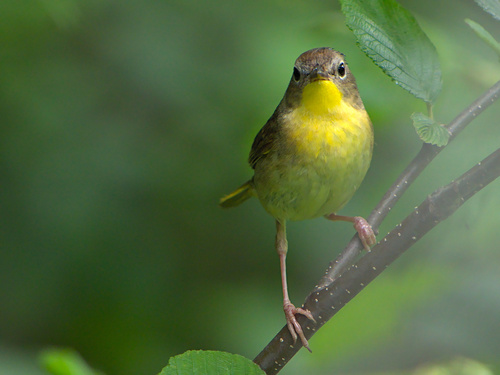 Common Yellowthroat
In short
The most reliable field mark to separate Connecticut Warbler from Common Yellowthroat is the presence of a bold white or pale eye-ring in Connecticut Warbler (all ages and sexes), versus the black mask (adult male) or plain face (female/immature) of Common Yellowthroat, which never shows a strong eye-ring. Immature and female Connecticut Warblers can be especially confusing, but their longer-legged, ground-walking jizz, pale throat, and complete eye-ring are distinctive. In flight or perched, check for the Connecticut's longer tail and pink legs versus the shorter-tailed, more compact Common Yellowthroat. Both have olive upperparts and yellow underparts, but the Connecticut is larger and more solitary, while Common Yellowthroat is smaller, more active, and often found in pairs or groups in dense low vegetation.
Identification tips
- Eye-ring: Connecticut Warbler of all ages and sexes shows a strong, complete white or pale eye-ring; Common Yellowthroat never does. This is the single best field mark, especially in immatures and females.
- Facial Mask: Adult male Common Yellowthroat has a bold black mask across the face, bordered above by white or gray; Connecticut Warbler never shows any mask, regardless of sex or age.
- Throat Color: Connecticut Warbler (especially females and immatures) has a pale, often whitish throat contrasting with yellow underparts; Common Yellowthroat has a yellow throat and chest, blending into a white belly.
- Underparts: Connecticut Warbler is yellow below throughout, while Common Yellowthroat shows a yellow throat/chest and white belly.
- Upperparts: Both are olive above, but Connecticut Warbler is generally plainer and lacks any facial markings except the eye-ring; Common Yellowthroat males have the mask, females and immatures have a plain face.
- Leg Color: Connecticut Warbler has pink legs, which can be a subtle but helpful mark if seen well; Common Yellowthroat's legs are less distinctly colored.
- Tail: Connecticut Warbler has a longer tail, often held slightly cocked and bobbed up and down; Common Yellowthroat's tail is shorter and more often flicked side-to-side.
- Bill Shape: Both have thin, pointed bills, but Connecticut's may appear slightly longer and finer in the field.
- Size and Structure: Connecticut Warbler is larger, longer-legged, and more upright when walking; Common Yellowthroat is smaller, rounder, and more compact.
- Behavior: Connecticut Warbler walks on the ground in a slow, deliberate manner, often alone; Common Yellowthroat is more active, flitting through low vegetation, and often in pairs or groups.
- Habitat: Connecticut Warbler prefers woodland undergrowth and forest edges, often away from water; Common Yellowthroat is strongly associated with marshes, wet meadows, and dense brush near water.
- Vocalization: If you hear a loud 'twichety twichety twichety twich' or 'jip' call, it's Common Yellowthroat; Connecticut's voice is not described here.
- Seasonal Pitfalls: In fall, immature male Common Yellowthroat may show a faint mask, but still lacks an eye-ring; female/immature Connecticut Warblers may look plain-faced but always show the eye-ring.
- Group Size: Connecticut Warbler is usually solitary except in small pre-migration groups; Common Yellowthroat is often seen in pairs or loose flocks.
- Jizz in Flight: Connecticut Warbler may appear longer-tailed and more direct in flight, while Common Yellowthroat is more bouncy and erratic, but this is subtle and less reliable than plumage and face pattern.
Size
Connecticut Warbler is noticeably larger: adults measure 13–15 cm in length with a 22–23 cm wingspan and average 15 g in mass, sometimes reaching up to 25 g before migration [wikipedia][avonet]. Common Yellowthroat is smaller overall, with a more compact build and shorter tail (exact measurements not provided, but consistently described as smaller and lighter in field guides and community tips). In the field, Connecticut Warbler often appears lankier and longer-legged, while Common Yellowthroat is more petite and rounded.
Plumage
Juvenile and immature Connecticut Warblers show a strong, complete pale eye-ring and a pale (often whitish) throat, with olive upperparts and yellow underparts; males have a gray hood, but females and immatures are browner above and lack the full hood. In all ages, the eye-ring is a key feature. Common Yellowthroat males (adult) have a black facial mask bordered above by white or gray, which is unique and never shown by Connecticut; females and immatures lack the mask but never show a strong eye-ring, instead having a plain face with paler underparts and a yellow throat/chest. First-year male Common Yellowthroats may show a faint mask, but still lack any eye-ring. Both species have olive upperparts and yellow underparts, but Common Yellowthroat has a white belly, while Connecticut's underparts are more uniformly yellow. No distinctive upperwing or flight pattern marks are described for either species at any age; separation is based on face pattern, throat color, and overall jizz.
Behaviour
Connecticut Warbler is typically solitary and walks on the ground with a distinctive, deliberate gait, often bobbing its tail up and down (wren- or sandpiper-like). It forages low or on the ground, rarely joining mixed flocks except occasionally in fall. Common Yellowthroat is much more active and social, often found in pairs or small groups, and frequently flits through dense low vegetation, rarely walking on the ground. Its movements are quick, with frequent tail flicks and short flights between perches.
Habitat
Connecticut Warbler is usually found in dense, moist woodland undergrowth, especially in migration, and is more likely to be seen walking on the ground in open patches of forest floor or woodland edge. Common Yellowthroat prefers marshes, wet meadows, and dense brushy habitats, often near water, and is much more likely to be found in open, weedy or shrubby areas than deep woods. If you flush a warbler from dense reeds or cattails, Common Yellowthroat is much more likely.
Voice
Common Yellowthroat has a distinctive, loud 'twichety twichety twichety twich' song and a soft 'jip' call. Connecticut Warbler's voice is not described in the provided notes, so vocalization is only diagnostic for Common Yellowthroat. If you hear the characteristic song or call, it's a strong indicator for Common Yellowthroat.