

Common Woodpigeon vs Collared Dove
Columba palumbus versus Streptopelia decaocto
Play a quiz with Common Woodpigeon and Collared Dove
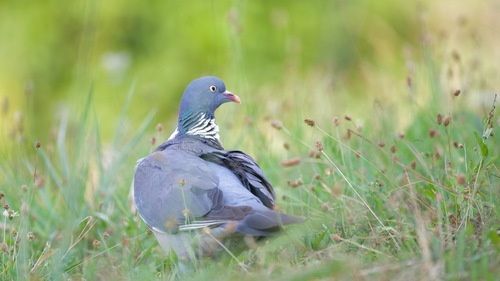 Common Woodpigeon
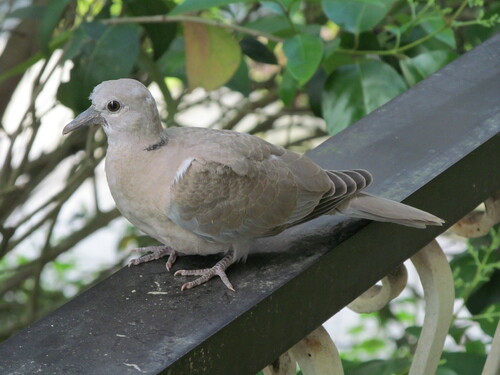 Collared Dove
In short
The most reliable field mark to separate Common Woodpigeon from Collared Dove at any age is the presence of bold white wing bars (in flight and at rest) and white neck patches on adult Woodpigeons, which Collared Doves never show. Juvenile Woodpigeons lack the neck patches but still show the white wing bars, while Collared Doves have a diagnostic black half-collar on the nape (often faint or missing in juveniles). Woodpigeon is much larger and bulkier, with a pinkish breast and pale yellow eye, compared to the Collared Dove’s slimmer build, uniform pale grey-buff plumage, and red eye. In flight, Woodpigeons show broad white wing bands and a large, rounded tail, while Collared Doves have a narrower tail with broad white tips and lack any white in the wing. Both species are common near human habitation, but Woodpigeon prefers larger trees and open spaces, while Collared Dove is more closely tied to buildings and suburban areas.
Identification tips
- White wing bars (Woodpigeon only): In all ages, Woodpigeon shows bold white bands across the upperwing, visible both in flight and at rest. Collared Dove never shows any white in the wing.
- Neck patches vs. collar: Adult Woodpigeon has green and white neck patches; juveniles lack these but may show small white patches by 6–8 months. Collared Dove (adult) has a black half-collar edged with white on the nape; juveniles may lack or have a faint collar.
- Size and bulk: Woodpigeon is much larger and bulkier, with a longer neck and bigger head. Collared Dove is slimmer and more delicate.
- Breast color: Woodpigeon has a pinkish breast; Collared Dove is more uniformly pale grey-buff or pinkish-grey, with little contrast.
- Eye color: Adult Woodpigeon has a pale yellow eye; Collared Dove has a red iris (appears dark from a distance), with a narrow reddish-brown rim. Juvenile Collared Dove has a brown iris.
- Bill color: Woodpigeon’s bill is variable but generally paler than Collared Dove’s black bill; juvenile Woodpigeon has a greyer bill.
- Tail shape and pattern: Woodpigeon has a broad, rounded tail with little white; Collared Dove’s tail is squarer with broad white tips to the outer feathers, especially visible from below in flight.
- Underwing: Collared Dove shows a blue-grey underwing patch, but not a bar; Woodpigeon’s underwing is pale but lacks this patch.
- Flight style: Woodpigeon takes off with a loud clatter, flies powerfully with occasional sharp flicks, and displays with wing clapping and gliding. Collared Dove’s flight is more clipped and direct, with a distinctive display flight (vertical climb and gliding descent with wings in an inverted 'V').
- Perching habits: Woodpigeon often perches high in trees or on exposed branches; Collared Dove prefers wires, rooftops, and fences near buildings.
- Habitat context: If seen deep in woodland or in large flocks in open fields, Woodpigeon is more likely. Collared Dove is rarely far from human habitation and seldom in dense woodland.
- Juvenile confusion: Juvenile Woodpigeon lacks neck patches but still shows white wing bars; juvenile Collared Dove lacks a strong collar and has a brown iris, but never shows white in the wing.
- Group size: Large flocks suggest Woodpigeon, especially outside the breeding season; Collared Doves are usually in pairs or small groups.
- Voice (not detailed in sources): If heard, Woodpigeon’s call is a deep, rhythmic cooing; Collared Dove’s song is a repetitive three-note coo, but this is not always diagnostic in the field.
- Seasonal variation: Both species breed throughout much of the year if food is available, but Woodpigeon’s plumage may darken on the head in hot summer periods.
Size
Common Woodpigeon is substantially larger and heavier than Collared Dove. Woodpigeon measures 38–44.5 cm in length with a wingspan of 68–80 cm and a weight of 300–615 g [wikipedia], making it the largest pigeon in Western Europe. Collared Dove is medium-sized, at about 32 cm in length, with a wingspan of 47–55 cm and a typical mass of 125–240 g (average 193 g) [wikidata]. In the field, Woodpigeon appears much bulkier and longer-necked, while Collared Dove is noticeably slimmer and more delicate overall.
Plumage
-
Juveniles: Juvenile Woodpigeons lack the adult’s white neck patches but already show the distinctive white wing bars in flight and at rest. Their overall tone is paler grey, with a greyer bill and no pinkish breast. Juvenile Collared Doves are very similar to adults but with a poorly developed or absent black nape collar and a brown iris instead of red. Both are overall pale grey, but Collared Dove never shows white in the wing.
-
Adults: Adult Woodpigeons are basically grey with a pinkish breast, bold white wing bars (visible in flight and at rest), and green and white neck patches. The eye is pale yellow. Collared Dove adults are uniform grey-buff to pinkish-grey, with a diagnostic black half-collar edged with white on the nape, red eyes, and a blue-grey underwing patch (not a bar). The tail of Collared Dove is square-tipped with broad white tips to the outer feathers, while Woodpigeon’s tail is broader and more rounded, with less obvious white.
-
Flight: In flight, Woodpigeon’s white wing bars are striking and visible at all ages. Collared Dove shows no white in the wing but has a contrasting white terminal band on the tail’s underside.
Behaviour
Woodpigeon is gregarious outside the breeding season, often forming large flocks, and is frequently seen feeding in open fields or perched high in trees. Its flight is powerful and direct, with occasional sharp wing flicks and a loud clatter on takeoff. Display flights include wing clapping and gliding on stiff wings. Collared Dove is usually seen in pairs or small groups, often perched on wires, rooftops, or near buildings. Its flight is direct and clipped, with a distinctive display flight: a rapid vertical climb followed by a long, gliding descent with wings held in an inverted 'V'. Collared Doves are less likely to be seen in large flocks and are more sedentary around human habitation.
Habitat
Both species are common in human-modified landscapes, but Woodpigeon favors mature trees in woodlands, parks, and gardens, often near open fields or water. It is less closely tied to buildings and more likely to be found in rural or semi-rural settings. Collared Dove is strongly associated with towns, villages, and suburban areas, rarely far from buildings, and usually nests within 1 km of human habitation. It is more likely to be seen on wires, fences, and rooftops, and less often in deep woodland or large open fields away from structures.