

Common Tailorbird vs Plain Prinia
Orthotomus sutorius versus Prinia inornata
Play a quiz with Common Tailorbird and Plain Prinia
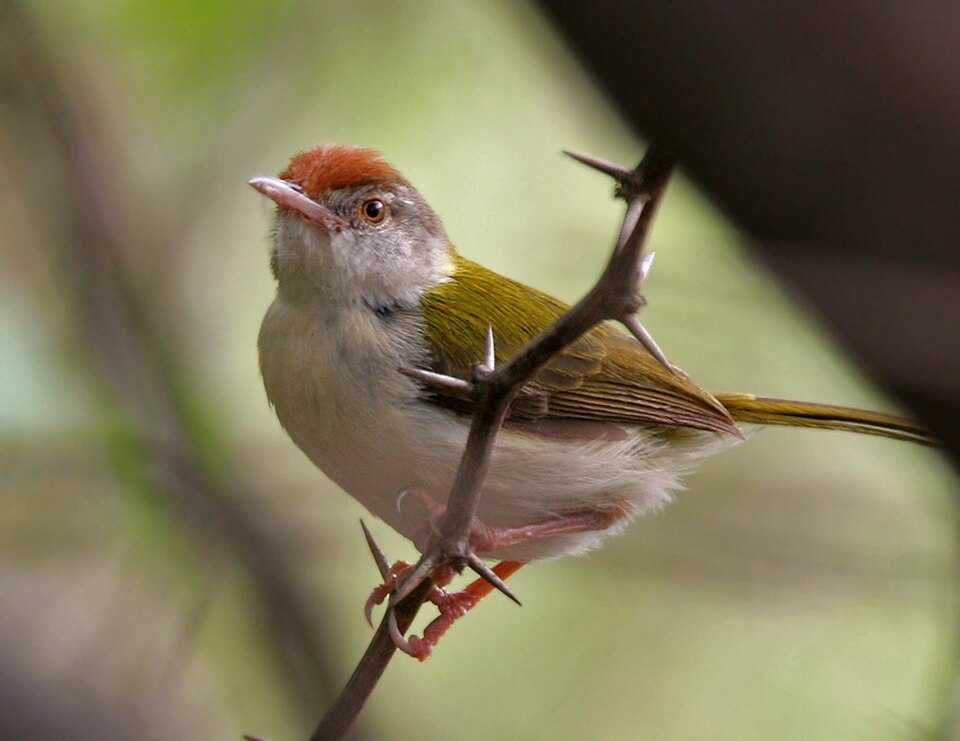 Common Tailorbird
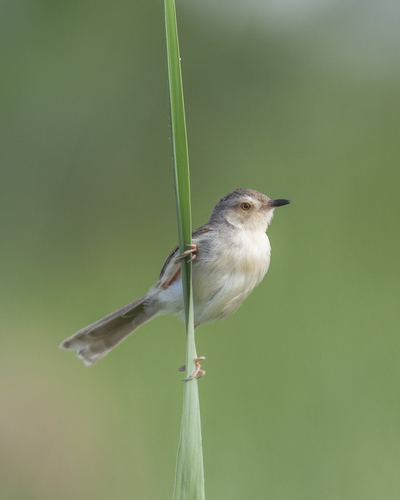 Plain Prinia
In short
The most reliable field mark to separate Common Tailorbird from Plain Prinia is the presence of a rufous crown and bright green upperparts on the tailorbird, versus the plain prinia's lack of rufous on the crown and its more subdued grey-brown or brown upperparts. In breeding season, male tailorbirds may show elongated central tail feathers, but this is not always dependable. Both species have long tails and similar warbler-like structure, but the tailorbird is generally brighter and more contrasting, especially on the head. Juvenile and non-breeding birds can be duller, which increases the risk of confusion, but the tailorbird's green back and rufous crown remain key. Vocalizations are loud and distinctive for both, but are not described in detail here.
Identification tips
- Rufous crown (all ages/seasons): Only Common Tailorbird shows a distinct rufous crown; Plain Prinia always lacks this. This is the single most reliable field mark.
- Upperparts color: Tailorbird is bright green above (even in duller young birds), while Plain Prinia is grey-brown or warm brown above, never greenish.
- Supercilium: Plain Prinia shows a short white supercilium (eyebrow), especially in breeding plumage; tailorbird lacks a strong supercilium, instead showing a more uniform face with rufous crown.
- Tail structure and length: Both species have long tails, but in breeding season, male tailorbirds may show elongated central tail feathers. Plain Prinia's tail is shorter in summer and longer in winter, but this is subtle and not always reliable.
- Tail posture: Tailorbird often holds its tail upright and flicks it, giving a wren-like appearance; prinia's tail is long but usually not held as upright.
- Underparts: Tailorbird is creamy white below; Plain Prinia is whitish-buff, sometimes warmer buff in winter. This is a subtle difference and not always diagnostic.
- Bill: Both have strong, sharp bills; tailorbird's has a curved tip, prinia's is short and black. This is subtle and best seen at close range.
- Wing pattern in flight: No distinctive panels or marks are described for either species; do not rely on wing pattern for separation.
- Neck patches: When calling, tailorbird may show dark patches on the sides of the neck (bare skin), sometimes appearing as a dark gorget; prinia does not show this feature.
- Juvenile confusion: Young tailorbirds are duller but retain greenish upperparts and rufous crown; young prinias are plain brown above and lack rufous on the crown.
- Habitat context: Tailorbirds are especially common in dense urban gardens and thick foliage, while prinias are more often in open scrub or grassland, but both can occur together in edge habitats.
- Voice: Both are loud and distinctive; if you know the calls, use them, but details are not provided here.
- Sex differences: Sexes are similar in both species; only male tailorbirds in breeding season may show elongated central tail feathers, but this is not always reliable.
- Seasonal changes: Plain Prinia shows a longer tail and warmer brown upperparts in winter; tailorbird's plumage is less variable by season.
- Nest association: Tailorbirds are famous for their sewn-leaf nests, but this is not a field mark for the bird itself and should not be used for identification.
Size
Both species are small, active warblers with similar proportions: short rounded wings, long tails, and strong legs. The Common Tailorbird averages about 7.5 grams in weight [wikidata], with a length range of 10–14 cm [wikipedia]. The Plain Prinia is slightly larger, at 13–14 cm [wikipedia], but there is significant overlap and this difference is subtle in the field. Bill length and shape are similar, though the prinia's bill is described as short and black, while the tailorbird's is sharp with a curved tip.
Plumage
- Juvenile/immature birds: Both species are duller when young, but the Common Tailorbird still shows a greenish back and rufous crown, while the Plain Prinia juveniles are plainer brown above and lack rufous on the crown.
- Adult breeding plumage: Common Tailorbird is bright green above, creamy white below, with a distinct rufous crown. Males may have elongated central tail feathers. Plain Prinia is grey-brown above with a white supercilium, rufous fringes on the closed wing, and whitish-buff underparts. No rufous crown. In breeding, the prinia's tail is shorter.
- Adult non-breeding/winter plumage: Plain Prinia becomes warmer brown above, underparts more buff, and tail appears longer. Common Tailorbird remains bright green and rufous-crowned, though young birds are duller.
- Flight views: No distinctive upperwing pattern or panels are described for either species; both have short, rounded wings and long tails.
Behaviour
Both species are active, often skulking in dense vegetation and flicking their long tails. Common Tailorbird is described as shy and usually hidden, but its tail is often held upright and moved around, giving a wren-like jizz. Plain Prinia also has a longish tail, but is not described as holding it as upright as the tailorbird. Both forage for insects and are quick-moving. Tailorbirds are famous for their unique nest construction (sewing leaves), but this is not a field mark for the bird itself.
Habitat
Both species are widespread residents in South and Southeast Asia. Common Tailorbird is especially common in urban gardens and thick foliage, while Plain Prinia is more generally described as occurring in a wide range of open habitats, including grasslands and scrub. Both can overlap in gardens and edge habitats, so habitat alone is not diagnostic, but tailorbirds are more likely in densely vegetated urban settings.
Voice
Both species are noted for loud, distinctive calls, but detailed descriptions are lacking in the provided notes. The Common Tailorbird's song is described as a loud 'cheeup-cheeup-cheeup' with variation, but no direct comparison to Plain Prinia's song is given. Both can be located by voice, but separation by ear is not covered here.